
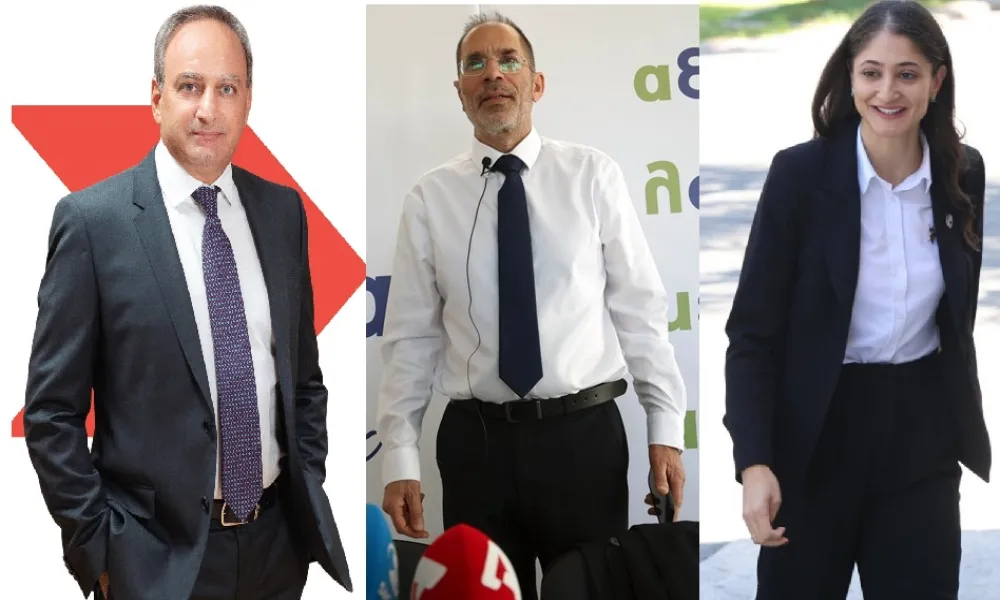

While the Democratic Rally (DISY) continues to grapple with an internal battle over its choice of presidential candidate for 2028, and President Nikos Christodoulides is already pursuing what appears to be a re-election campaign despite saying he has yet to decide whether to seek a second term, AKEL is exploring potential candidates who could unite the centre-left behind a common presidential bid.
The left-wing party is keen to avoid repeating the model of running an independent party candidate or appearing politically isolated without allies. Instead, it is seeking to lay the groundwork for a broader centre-left alliance involving ALMA, EDEK, the Greens and potentially Volt.
ALMA instead of DIKO
In AKEL's political calculations, Odysseas Michaelides' ALMA appears to be taking over, to some extent, the role traditionally played by DIKO in cooperation arrangements with the Left.
With DIKO now participating in the government and supporting Christodoulides, AKEL is looking for a new partner in the political centre. ALMA could potentially fill that gap.
The party's objective is to establish a broader political coalition capable of challenging for the presidency, rather than relying on its own traditional electoral base.
The electoral numbers
The results of May's parliamentary elections suggest that such an alliance would not be starting from a weak electoral position.
The combined vote share of the five parties potentially involved approaches 38%, although this does not mean their support could automatically be transferred to a common presidential candidate.
The key question is whether such a coalition could provide a sufficiently strong electoral foundation to attract additional voters from other political camps, as well as unaffiliated voters.
The parties' results in the parliamentary elections were as follows:
- DISY: 27.1%
- AKEL: 23.9%
- ELAM: 10.9%
- DIKO: 10.0%
- ALMA (Odysseas Michaelides): 5.8%
- Direct Democracy (Fidias Panayiotou): 5.4%
- EDEK: 3.3%
- DIPA: 3.1%
- Volt: 3.1%
- Greens: 2.0%
Informal consultations underway
For now, discreet consultations and meetings are taking place, with views being exchanged and potential candidates being considered.
One name emerging at the centre of these discussions is economist Tasos Yiasemides, who is seen as possessing characteristics that could make him an acceptable choice across different political groups within the centre-left.
For AKEL, the challenge is to find a candidate with broader appeal who could help establish a new political force with a strong socio-economic agenda, capable of seriously contesting power without alarming the country's business community and economic establishment.
At the same time, the party must avoid alienating its traditional supporters by appearing to abandon its political and ideological identity in pursuit of a more electorally flexible candidate.
Moving beyond Mavroyiannis
Andreas Mavroyiannis' candidacy in the 2023 presidential election appears to be losing political momentum within AKEL, despite his respectable electoral performance.
The prospect of repeating his candidacy is gradually losing support within the party. Mavroyiannis, meanwhile, appears ready to move ahead independently. He has said he will not wait for AKEL and could announce an independent presidential bid early next year, a prospect that has reportedly not been welcomed by the party leadership.
The political landscape ahead of 2028 is prompting AKEL to consider a different approach: a fresh face with a renewed public profile, a strong social presence and the ability to appeal to voters beyond the party's traditional base.
The party is also looking for a candidate who would not endorse the political narrative associated with former president Nicos Anastasiades and the Crans-Montana talks.
A new political foundation
AKEL's search for a candidate cannot be separated from the current socio-economic climate.
Rising prices, inflation, the cost of living, the housing crisis, energy costs and household purchasing power are increasingly important issues in people's everyday lives.
These are the concerns the party hopes to place at the centre of its political strategy as it seeks to build a centre-left coalition.
The economy could provide common ground for parties with different political traditions and disagreements on other issues, allowing them to cooperate around a shared social and economic agenda.
Why Tasos Yiasemides?
Yiasemides' potential candidacy is not simply about finding another name for the ballot. It is about identifying someone who could bridge the differences between AKEL, ALMA and EDEK, while potentially attracting the participation of other political forces.
One of his main advantages is his professional background as an economist, which is directly relevant to the socio-economic issues expected to dominate the 2028 presidential campaign.
There is also a second, equally important consideration. Yiasemides has roots in EDEK and is associated with the political tradition of former party leader Yiannakis Omirou.
This represents the more moderate and pragmatic wing of EDEK on the Cyprus problem, in contrast with the harder rejectionist position that prevailed under former leader Marinos Sizopoulos.
His political background could therefore provide common ground between AKEL and other interested parties. A candidate of this kind could potentially secure broader acceptance without forcing any participating party to abandon its fundamental political positions.
Michaelides open to cooperation
ALMA leader Odysseas Michaelides is reportedly positive about the prospect of cooperation with AKEL, believing that common ground could be found for a broader political agreement.
His meeting with AKEL general secretary Stefanos Stefanou took place in a particularly positive atmosphere.
Michaelides has said he does not support either a Mavroyiannis candidacy or a purely party-based nomination. He also appears to have ruled out Stelios Platis as a potential common candidate.
Yiasemides, however, could be a more suitable choice, both in terms of the socio-economic agenda and his positions on the Cyprus problem.
Irene Charalambidou's reservations
Not everyone within ALMA appears equally enthusiastic about cooperation with AKEL.
ALMA MP Irene Charalambidou is opposed to the prospect of an alliance with the Left. She is reportedly looking towards Averof Neophytou and favours ALMA running independently, with Michaelides himself as its presidential candidate.
Such a move would preserve the party's political independence and give it greater flexibility ahead of a potential second round.
However, Charalambidou is not herself a member of ALMA, a factor that gives her position a different weight from the decisions of the party leadership.
Michaelides is unlikely to want to test his electoral strength just two years after the parliamentary elections, particularly if the results were to fall short of expectations and damage his own political standing and that of his party.
He appears willing to proceed with discussions with AKEL and could put forward potential candidate names when the time comes.
EDEK could hold the key
Perhaps the most important factor determining whether the proposed alliance can become a reality is EDEK.
The party's upcoming electoral congress on 12-13 December, when its new leadership will be elected, is expected to be a turning point.
If Sofia Christodoulou Makri is re-elected as party president, the way could open for serious consideration of EDEK leaving the government and seeking new political partnerships with centre-left forces, particularly around socio-economic issues.
The Cyprus problem remains a major obstacle
The Cyprus problem, however, remains the biggest stumbling block.
If EDEK comes under the political control of the group associated with Costis Efstathiou, either through his own election or that of someone sharing his political approach, cooperation with AKEL could become impossible.
The group's positions on the Cyprus problem differ significantly from those of AKEL, leaving little room for a common political agreement.
The outcome of EDEK's internal leadership contest will therefore determine not only the party's future direction but also the prospects of establishing a broader centre-left alliance.
Greens also considering cooperation
The Greens could also become part of the proposed alliance.
Party figures have already indicated to AKEL that there is an appetite for discussions and participation in a broader political arrangement.
However, the Greens must first complete their own internal electoral procedures, with their party congress scheduled for 14 November. The outcome will help clarify which political direction the party intends to pursue.
Volt presents a more complicated picture
Volt presents a more complicated case.
The party appears divided between the political influence of AKEL and DISY, both of which support a settlement of the Cyprus problem.
AKEL nevertheless believes that a significant section of Volt's electorate could support a centre-left presidential candidate, even if the party's official position were to favour a different option.
This assessment is also linked to the possibility that Christodoulides or a DISY candidate could face political pressure from the visible or less visible influence of ELAM.
The question, therefore, is not simply which candidate Volt officially endorses, but also which direction its electorate ultimately takes.
Alternative candidates remain in the frame
Other potential candidates have not been ruled out.
Nicosia Mayor Charalambos Prountzos could enter the discussions if there are significant developments in the Cyprus problem. However, his potential candidacy would more likely involve an AKEL-ALMA agreement rather than EDEK.
Another possibility is AKEL general secretary Stefanos Stefanou himself.
His candidacy could be considered if all attempts to find a mutually acceptable figure fail. Such a choice would offer a candidate with a clear party identity and political consistency, but potentially limited appeal beyond AKEL's traditional electorate.
It would be more of a fallback option than a candidate capable of securing victory in the presidential election.
All eyes on EDEK
Substantive discussions are expected to begin after EDEK completes its internal party procedures in December, when its new leadership will be known.
The potential coalition would bring together different political strengths. AKEL would contribute its organisational machinery and social reach, while ALMA would offer a different political identity, with an emphasis on institutional credibility and accountability.
EDEK would bring its historical political roots in the centre, the Greens would add an environmental dimension, and Volt, or at least part of its electorate, could contribute a European and reform-oriented perspective.
Within AKEL, there is reportedly a strong group that believes Tasos Yiasemides could be the figure capable of bringing these different political forces together ahead of the 2028 presidential election.