
Military deterrence is necessary, but it cannot by itself deliver lasting peace in the Eastern Mediterranean.
The most dangerous mistake Greece and Cyprus could make is to believe that peace in the Eastern Mediterranean will be secured once they acquire enough missiles to make Turkey afraid.
Defence spending is necessary as long as threats exist. But weapons cannot deliver the political solution that Greece and Cyprus say they are seeking through peace talks. Military capabilities certainly cannot become the vision of two European countries for generations to come.
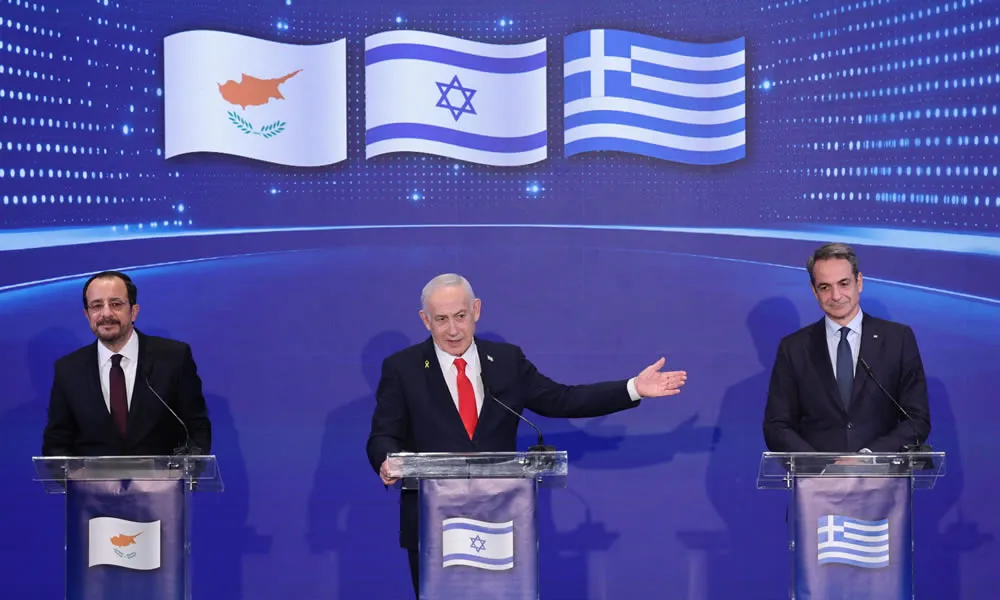
Greece is buying Rafale fighter jets, F-35s and frigates, and is now acquiring the “Achilles Shield”. Cyprus is seeking stronger defence partnerships and offering its military infrastructure to third countries. Athens and Nicosia are strengthening ties with Israel, France and the United States in an effort to create a network of strategic interests capable of deterring Turkish revisionism.
These relationships are important. But there is a limit to this logic.
If every Turkish weapons system is answered with another Greek weapons system, then Greece and Turkey have effectively accepted that their relationship will become a permanent arms race. One country will arm itself because it fears the other, while the other will arm itself because it sees the first country doing so.
That may provide a degree of deterrence. It does not guarantee peace.
The real question is not how Greece could win a war with Turkey. It is how it can create the conditions under which such a war never happens.
Some argue that Greece could achieve this by adopting the Israeli model.
Why Greece and Cyprus Cannot Become Israel
There are many who point to Israel as a model for dealing with Turkey. Why, they ask, can Israel, with a population of roughly 10 million, confront Iran and project military power across the Middle East, including towards Ankara, while Greece, with a similarly sized population, feels permanently under pressure from a larger Turkey?
And then there is Cyprus, the potential weak point in a perceived Israel-Greece defensive arc, given that it remains divided and has an unguarded 183-kilometre line of confrontation.
The numbers provide part of the answer.
In 2025, Israel's GDP reached approximately $611 billion, compared with around $281 billion for Greece. In other words, two countries with broadly similar populations have economies differing by more than a factor of two.
The difference in defence spending is even more striking. According to SIPRI, Israel spent approximately $48.3 billion on defence in 2025, equivalent to 7.8% of GDP. Greece spent around $8.4 billion, or approximately 3% of GDP.
In other words, Israel is not militarily comparable to Greece simply because the two countries have similar populations. For decades, Israel has organised a substantial part of its economy, technology, education and society around national security.
It has a world-class defence industry, a large reserve system, leading intelligence services, a technology ecosystem closely linked to defence, a special strategic relationship with the United States and, according to international assessments, a nuclear deterrent.
The cost of that choice is also enormous. Israel is a society that has lived for decades with war as a permanent possibility.
Neither Greece nor Cyprus can — and, more importantly, should not want to — become a second Israel.
Why?
Because they have something Israel does not.
The European Union
Despite all its current weaknesses, the European Union offers Athens and Nicosia a major and largely underused strategic opportunity.
Perhaps the greatest shield for Greece and Cyprus is not the “Achilles Shield”, nor Israel, France or Egypt, but transforming the European Union from an economic bloc into a genuine geopolitical and defence union.
This does not mean creating a Europe that seeks wars. It means creating a Europe strong enough to deter them.
The EU faces major challenges which, if it fails to address them collectively, could undermine its future. And Europe's geopolitical strengthening is not only about the Aegean and the Eastern Mediterranean.
The same question is posed even more urgently along its north-eastern borders, from Finland and the Baltic states to Poland and the Black Sea.
The war in Ukraine and continuing tensions with Moscow have demonstrated that peace cannot indefinitely rest on a fragile balance of fear. The European Council now speaks of the need to protect all of the Union's land, air and maritime borders and describes Russian aggression as an existential challenge to European security.
A stronger Europe is therefore needed not only to deter Turkey in the Eastern Mediterranean or Russia on its eastern flank. It is needed to redefine Europe's overall relationship with the major powers around it.
Relations with Russia, as with Turkey, should not be based either on European weakness or permanent preparations for war. They should rest on a balance in which borders are non-negotiable, the use of force does not pay and cooperation remains available to anyone willing to accept those rules.
That may be the real meaning of Europe's geopolitical coming of age.
The objective is not a Europe that learns to fight more. It is a Europe strong enough to impose serious conditions for peaceful coexistence.
The Difference is Enormous
Today, Turkey can assess its relationship with Greece largely through a bilateral balance of power, considering factors such as population, aircraft, ships, missiles, economic strength and geography.
No matter how much Greece invests in its armed forces or how closely it works with Israel, the balance of power is difficult to transform fundamentally. Turkish assertiveness could therefore continue to grow.
A genuine European Defence Union would change that calculation.
An attack on Greek or Cypriot territory would no longer be merely a problem for Athens or Nicosia. It would concern the European space as a whole.
This is not as utopian as it might have seemed a few years ago.
The EU has already created the €150 billion SAFE instrument, while through Readiness 2030 it aims to mobilise up to approximately €800 billion for European defence. Cyprus has already received the first instalment of funding under SAFE, with a total allocation of approximately €1.2 billion, while Turkey could potentially participate in the programme under certain conditions.
But the critical question is not how many billions Europe will spend.
It is what kind of Europe it wants to become.
A genuine European defence policy should not have a larger European military budget as its ultimate goal. Its goal should be to make war between European states and their neighbours increasingly difficult, increasingly costly and ultimately politically irrational.
The European Example
Europe once achieved something similar with France and Germany.
It did not eliminate their differences. It did not turn the French into Germans or the Germans into French.
It did something much more intelligent.
It bound their economies, institutions and interests together so deeply that another war between them became unthinkable.
That is precisely what the Eastern Mediterranean needs, under very different circumstances.
Turkey will always be there. It will always be next to Greece and opposite Cyprus. Building a strategy that assumes an eternally hostile Turkey is therefore just as problematic as believing that differences can disappear simply because we wish them away or pursue a policy of appeasement.
Peace requires two things at the same time.
Security and Shared Interests
Security is necessary so that Greece and Cyprus can negotiate without fear and without making concessions under the threat of force.
But shared interests are also necessary, so that Turkey has more to lose from a conflict than it could gain.
Trade, energy, electricity interconnections, transport, tourism, investment, the environment and migration can all contribute.
The more interests overlap, the greater the cost of a rupture.
This is not appeasement. It is the same idea on which post-war Europe was built.
Partnerships with Israel and Egypt remain useful. But no state has eternal friends.
Israel could improve its relations with Ankara tomorrow. Egypt could redefine its interests. The United States could change its priorities.
The principle that “the enemy of my enemy is my friend” therefore operates under temporary conditions.
Greece and Cyprus can operate within a powerful European framework rather than being drawn into bilateral conflicts and the disputes of third countries.
Greece and Cyprus do not merely cooperate with Europe. They are Europe.
And part of the EU is also the Turkish Cypriot community, which represents one of the strongest political cards available to the Republic of Cyprus in pursuing a European solution to the Cyprus problem.
That is the card that should be played to the end.
No one can be certain how much security the “Achilles Shield” will provide, or for how long, any more than anyone can be certain how much deterrence will ultimately come from aircraft, frigates and missiles.
A Smarter European Union
Generals, whether they win or lose, have no field of vision beyond the battlefield.
Politics can see something greater.
It can create a Europe so united, so strong and so present on its eastern and northern borders that nobody believes they can impose their will on a member state through the threat of force.
At the same time, it can build a Europe smart enough to keep the door to cooperation open to both Turkey and Russia.
In the final analysis, Greece and Cyprus do not need to become Israel.
The best shield is not the one that wins the war.
It is the one that makes war unnecessary.
The two countries should do everything within their power to help Europe recover its lost vision and finally become a powerful geopolitical force for peace, for the benefit not only of its own peoples but also of Israelis, Turks, Russians and Ukrainians.
Leaders from small European countries have played an important role in shaping the European project in the past. Belgian statesman Paul-Henri Spaak helped drive the process that led to the Treaties of Rome; Luxembourg's Pierre Werner produced the first major plan for monetary union in 1970; Dutch statesman Jan Willem Beyen helped advance the creation of the Common Market; and Jean-Claude Juncker played a major role in European political integration and crisis management.
Countries the size of Greece and Cyprus have produced politicians who looked far beyond their own domestic problems.
There is every reason to believe that Greece and Cyprus can produce leaders capable of doing the same.