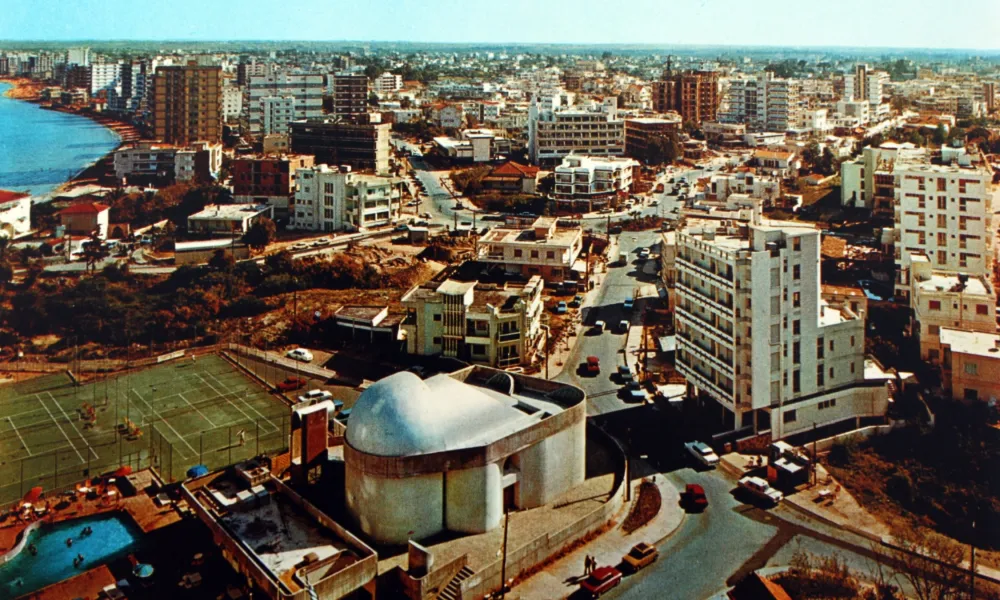
It was the city that seemed to be one step ahead of the rest of Cyprus. Until August 1974, when the Turkish invasionbrought time to an abrupt halt. Its residents left in haste, believing their absence would last only a few days, leaving behind homes, shops, schools, an entire life. Fifty-two years later, Kikis Kazamias unfolds the images of a city that has changed dramatically, yet remains recognisable beneath the decay. A city that belongs not only to the past, but remains a symbol, and an unfulfilled promise of return.
From Deryneia
For Kikis Kazamias, the journey to Famagusta begins on the road that starts at the Deryneia checkpoint. It is not simply a route into the city, but an emblematic axis linking Famagusta to almost the whole of the north. Anyone who passes through the checkpoint and continues straight ahead, without turning left or right, passes in front of the Famagusta Town Hall and moves parallel to the Venetian walls of the old town.
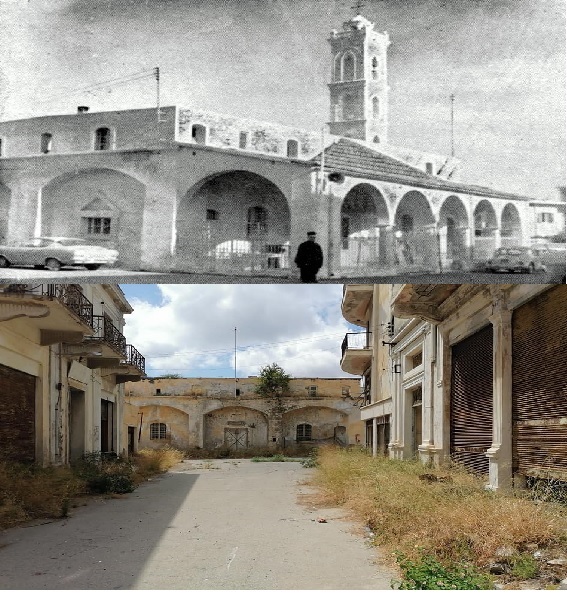
On one side lie the walls, and on the other the Turkish Cypriot quarter of Sakarya. The road continues towards Trikomo, with the Pentadaktylos mountain range and Kantara ahead. From there, different routes open up. One leads towards the Apostolos Andreas cape, another towards Lefkoniko and the heart of the Mesaoria, while via Kantara the traveller can head towards the northern coast and Kyrenia. Crossing the Mesaoria and passing north of Nicosia, the route can extend all the way to Morphou. "The road does not lead only to Famagusta, it functions as an imaginary line connecting the towns, plains and coasts of the north," Mr Kazamias notes.
The "golden" period
Historically, Varosha may be the name of the old town, but for the people of Famagusta it is their identity: "If you ask, eight out of ten will tell you 'I'm a Varoshiotis,' not 'I'm a Famagustian,'" says Mr Kazamias. The new Famagusta developed into an urban and economic centre that would soon surpass every other city in dynamism. From the declaration of the Republic of Cyprus until 1974, it experienced explosive growth and became the most prosperous area of Cyprus. Its economic base had initially been built on the primary sector. Kikis Kazamias recalls the story of one of the pioneering hoteliers of the Kounnas family, associated with the Grecian Hotel. On a trip to Sweden in the late 1960s, he noticed how intensely the local population sought out the sun. The idea was simple: Cyprus had sunshine for most of the year and could offer it as a tourism product to the residents of Northern Europe. On his return, he invested in the coastal zone.
The return of Famagusta is not the solution to the Cyprus problem. It is a first step. Its return does not mean the Cyprus problem is solved, but if Famagusta is not returned, the Cyprus problem cannot be solved.
The area of Kennedy Avenue, which later filled with multi-storey hotels and tourism businesses, had previously consisted mainly of fields and sand dunes. At least three of the first major hotels were built by owners of orange groves. Agricultural prosperity thus formed the foundation of tourist Famagusta. By 1974, according to Kikis Kazamias, around 70% of Cyprus's tourism activity was concentrated in Famagusta. The city had acquired hotel infrastructure and a cosmopolitan character, while also serving as the island's most important commercial centre, with its port handling around 90% of commercial traffic.
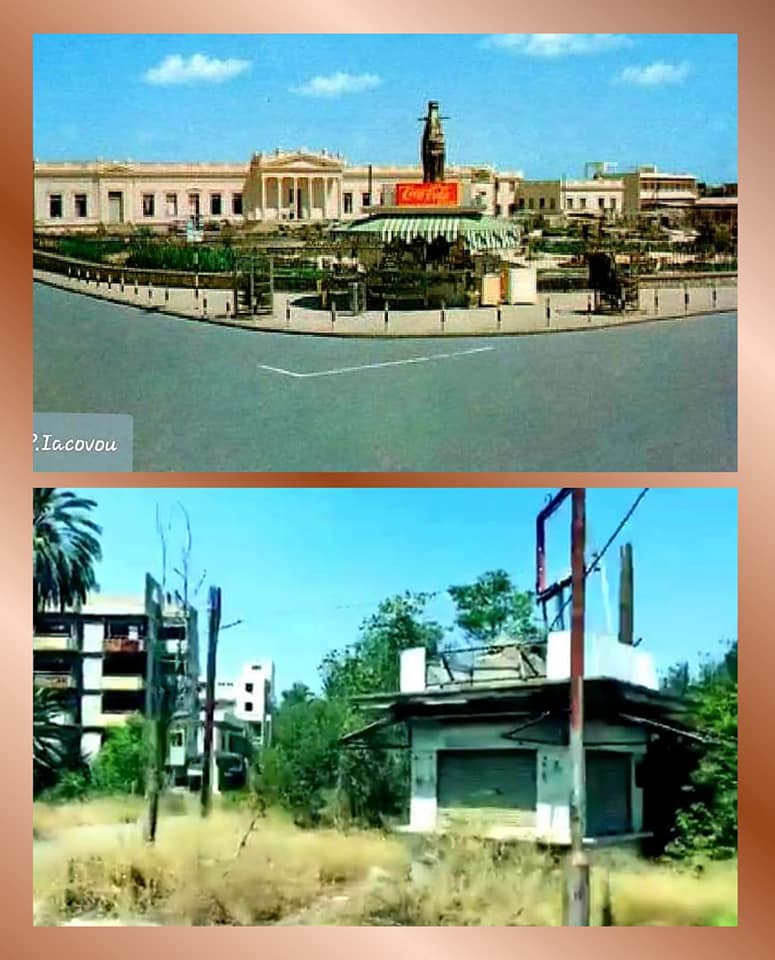
Tourism development brought visitors from across Europe and, according to Kikis Kazamias, contributed to the Europeanisation of Cypriot society. From 1964, soldiers of the United Nations Peacekeeping Forcewere stationed in the area, many of them from Sweden, Norway and Finland, which is also why there were so many Scandinavian tourists, and why the Swedish band ABBA stayed at a Famagusta hotel in the late 1960s. Artists, actors and writers also passed through the city, and Famagusta was considered one of the most important tourist centres of the Eastern Mediterranean.
"The luckiest ones"
For the generation that spent its teenage years in Famagusta in the late 1960s, the city was a place of freedom, prosperity and vibrant social life. Kikis Kazamias estimates that around 2,000 young people of his generation were fortunate enough to grow up in the city during its period of rapid growth. He himself graduated from school in 1969. "I consider myself among the luckiest, because I grew up during its period of explosive growth," he says. The beaches, the hotels, the nightlife and the atmosphere made it the island's most popular destination. Behind the tourist zone stretched the residential quarters, such as Ayios Memnon and Kato Varosha, where large areas of orchards existed. Orange, lemon and other citrus trees dominated the landscape.
During the flowering season, particularly in April, entire areas were filled with the scent of blossoms. This coexistence of the urban and the rural gave Famagusta its distinctive character: a short distance from the luxury hotels, the discotheques and the commercial avenues lay orchards and working-class neighbourhoods. A special place in collective memory was held by the Kataklysmos festival, with swimming races, water skiing and international speedboat races from the mid-1960s onwards, and of course the Orange Festival. Social life pulsed along Democracy Street. On weekends, a large part of it turned into a pedestrian zone. People walked, met acquaintances and enjoyed the evening outing. The city had many patisseries, theatres and cinemas, as well as cafés such as Edelweiss, Poccaccio and Vienna. The latter was the favourite hangout of Kazamias's group of friends. There, young people would eat cheese pastries, drink milkshakes, and then head to the cinema. Football held a special place in Famagusta's life, with Anorthosis and Nea Salamina as the city's two great teams. "Famagusta was not simply cosmopolitan in the sense of Saint-Tropez or Monte Carlo. It was, at the same time, a cultural hub," Kazamias notes. Behind the hotels and the vibrant nightlife, a city with rich cultural activity was developing. A Municipal Library, a Municipal Art Gallery and a Municipal School of Arts operated, offering free lessons in painting, sculpture and iconography. The presence of writers, philologists and educators in the schools was also significant. The philologist Panayiotis Sergis staged ancient tragedies with students, performed at the ancient theatre of Salamis. Men of letters such as Kyriakos Plisis and Kyriakos Charalambides were also active in the schools.
The day the city emptied
This world collapsed abruptly on 14 August 1974. Residents heard that Turkish tanks were advancing on Famagusta. There was no organised information, no evacuation plan, no state mechanism to guide them. Fearing the tanks would enter the city, they hastily abandoned their homes. "They left in the clothes they were wearing. They got into their cars and left," says Kikis Kazamias. The city was left almost empty. Some, believing their departure would be temporary, later tried to return. Several fell into ambushes and were killed.
The opening of the checkpoints in April 2003 marked a new milestone for the refugees. For the first time in almost three decades, they were able to visit the towns, villages, homes and schools they had left behind. Kikis Kazamias, then Minister of Communications and Works in the government of Tassos Papadopoulos, chose, for as long as he remained a minister, not to cross into the north, given the political and institutional dimensions of the process. He resigned in April 2004 and, around a week later, made his first visit. He went alone to Lefkoniko, where he was born, and to Famagusta, where he grew up and attended school. "I felt joy at seeing the place where I was born and raised. I went into my school and sat at my old desk," he recalls. Two weeks later he returned with his three children. The second visit was emotionally harder, as he watched his children's reactions, having known Famagusta until then only through his own accounts. For Mr Kazamias, the visit does not amount to giving up the right of return. On the contrary, it is a way of keeping the connection to the place alive. "I give up these places to no one," he stresses.
"Exploitation, not development"
The opening of parts of the fenced-off area of Famagusta created a new reality. Visitors can move along specific streets, observing the abandoned buildings up close. Kikis Kazamias rejects the term "tourism development" and insists that this is, rather, "tourism exploitation." In his view, the opening of certain streets has not been accompanied by progress in talks or by any process for the return of the lawful residents. Instead, an image is created in which destruction is turned into a tourist spectacle. Despite his criticism, he says he will continue visiting the area. "I don't go there for tourism. I go to see my place, to show it to my children, my friends and my visitors, and to explain to them the true picture," he says. He also places particular importance on the voices of Turkish Cypriots of Famagusta who oppose the unilateral exploitation of the fenced-off city. Today's image of Famagusta differs depending on the area. Inside the fenced-off city, time seems to have frozen, while outside it, intense construction activity has been recorded. The development stretching from the large roundabout towards the university areas and Trikomo is described by Kazamias as "completely unplanned." At the same time, many of the old working-class neighbourhoods have become deserted or are not adequately maintained. Problems, however, existed even before 1974.
Return as a first step
Kikis Kazamias places particular emphasis on joint initiatives by Greek Cypriots and Turkish Cypriots from Famagusta. In a joint memorandum co-signed by five Greek Cypriot lawful residents of the fenced-off city and five Turkish Cypriot residents of present-day Famagusta, the city is treated as a potential point of reconnection. The initiative, he explains, does not seek to separate Famagusta from the wider Cyprus problem, nor to claim that the suffering of the people of Famagusta is greater than that of other refugees. "The return of Famagusta is not the solution to the Cyprus problem. It is a first step. Its return does not mean the Cyprus problem is solved, but if Famagusta is not returned, the Cyprus problem cannot be solved," he notes. Given the level of development the city had reached before 1974, and its capacity to regain its economic and social momentum, it could serve as a model for the reconstruction of other areas in the north following a comprehensive solution. At the same time, the historical experience of Greek Cypriot and Turkish Cypriot coexistence could serve as an example for the whole of Cyprus. "We don't only care about our city. We believe we can be pioneers of development, reconnection and the harmonious coexistence of the two communities," he concludes. For a man who lived through Famagusta's most brilliant period and watched it empty within a single day, memory is not simply nostalgia. It is a way of keeping alive the connection to a place that, despite 52 years of occupation and decay, remains part of the identity of its people.