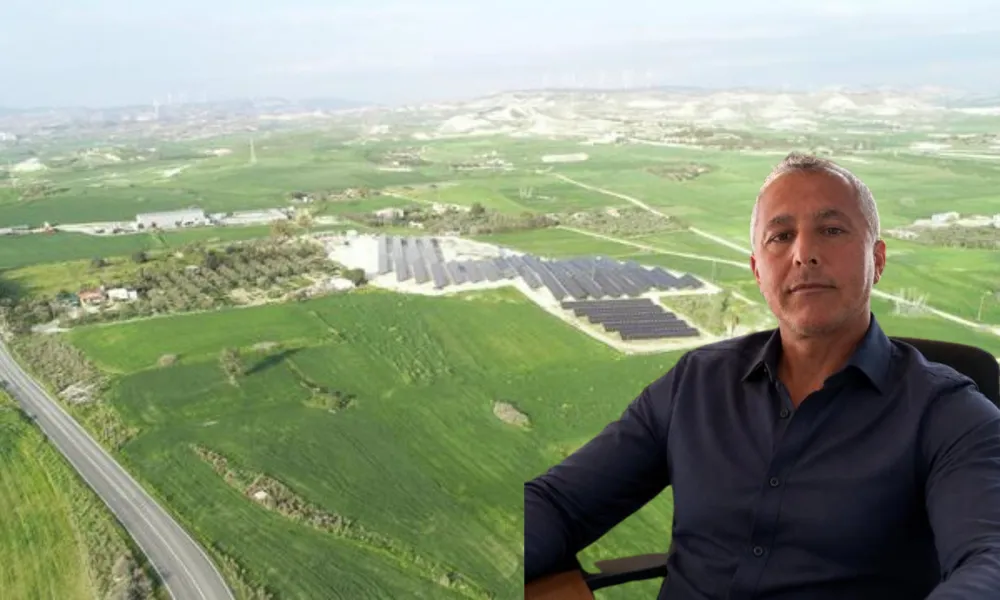

The operation of Cyprus's first hybrid photovoltaic park with a storage unit marks a significant milestone for the country's energy transition, opening up the debate on the role batteries can play in harnessing green energy, in stabilising the electrical system, and in managing the water problem. In an interview with "P," mechanical engineer Neophytos Vlassiou, executive managing director of the company that owns the first hybrid photovoltaic park, Pavlina Memorial Energy Park, explains that energy storage is no longer a technology of the future but a mature solution, one that can significantly reduce green energy curtailments, strengthen energy security, and lower costs for consumers and the economy alike. At the same time, he argues that Cyprus lost valuable time in developing the necessary infrastructure, with the result that large-scale RES curtailments continue and the country's solar output is not being fully utilised.
The experience
The operation of the first hybrid photovoltaic park with a storage system proves that the technology is no longer theoretical, Mr Vlassiou says, noting that with hard work and cooperation among all the parties involved, a private project can be licensed, connected and operate successfully within the Cypriot electrical system. He explains that it is still too early for definitive conclusions, since only one month of operation has passed. However, he notes, the first signs are positive, though a full assessment requires time and a range of different production and demand conditions. At the same time, he says, "there are still constraints, such as charging from the grid, which do not allow batteries to make full use of their flexibility. As more, and larger, systems are added, and once the regulatory framework is completed, many of today's constraints can be lifted. The bottom line is that the technology works. Now it needs to be allowed to offer the full range of its services to the grid."
The role of storage
The experience of operating the first hybrid park shows in practice what storage can offer the electrical system. Batteries absorb energy when production exceeds demand and return it when the system needs it, Mr Vlassiou explains. In this way, he adds, the grid becomes more flexible, sharp fluctuations are reduced, and the risk of both production curtailments and consumption load shedding is limited. Batteries can also offer rapid response, frequency and voltage support, and operational reserve. These services are particularly important for Cyprus, given that it has a small and, at present, electrically isolated system. Batteries do not replace the grid or the necessary generation units, but they form a key link in the safe integration of more RES.
RES into water
Storage is not the only way to make use of surplus green energy. As Mr Vlassiou explains, large flexible loads could also play an important role, absorbing energy during hours when there is a production surplus. RES curtailments occur because the electrical system cannot absorb all the energy produced during peak sunshine hours, Mr Vlassiou explains, adding: "Storage is the most immediate solution, because it shifts surplus midday energy to the afternoon and evening hours. It will not eliminate every curtailment, but it can reduce them dramatically and limit conventional generation."
In 2025, he recalls, around 306 GWh of distributed RES were curtailed, compared with around 167 GWh in 2024. This quantity corresponds to roughly 47.4% of the potential distributed green production that was generated. The great failure of our planning, he stresses, is that "we knew curtailments would increase, but we did not move at the same pace on storage, grid upgrades and the creation of large flexible loads." One such flexible load, the mechanical engineer suggests, could be state-run desalination. "With a conservative assumption of around 4.85 kWh to produce one cubic metre of water, the 306 GWh corresponds theoretically to around 63 million cubic metres, that is, 63 billion litres. For comparison, in 2017 Cyprus's desalination plants supplied around 67.6 million cubic metres of water. This is, of course, a theoretical upper bound, before losses, capacity constraints, unit availability and transport needs," he notes. He points out that the economic scale is also enormous. He explains that, at an indicative electricity price of around €0.18 to €0.27 per kWh, the 306 GWh corresponds to roughly €55 to €82 million. If a total desalinated water production cost of around €1.50 per cubic metre is taken as an order of magnitude, the 63 million cubic metres represent a value of around €95 million.
RES curtailments and theoretical water production
- RES curtailments 2025: 306 GWh
- Theoretical water production: approximately 63 million m³
- Indicative energy cost: approximately €55-82 million
The water produced, Mr Vlassiou says, could be stored in dedicated state reservoirs and, where hydraulic, quality and environmental conditions allow, in suitable state reservoirs or dams. In many cases, he notes, it is more cost-effective to store the water already produced than to store the equivalent electrical energy entirely in batteries. Careful planning is required, however, he explains, since channelling drinking water directly into open reservoirs can cause losses and create the need for reprocessing. The need for timely, permanent infrastructure is not new for Cyprus. The experience of the water crisis has already shown the cost of delayed action. In 2008, under the government of Demetris Christofias, the Republic of Cyprus signed a contract worth around €35 million with Ocean Tankers for the transport of up to eight million cubic metres of water from Greece. This corresponded to around €4.4 per cubic metre for transport alone, before the cost of purchasing the water and local infrastructure. The water was unloaded at Germasogeia and channelled into Limassol's network. This example shows that when we fail to invest in permanent infrastructure in good time, we later pay several times over for emergency solutions.
Desalination and storage
If surplus green energy can be used to produce water, batteries can operate in a complementary way, ensuring greater flexibility in the operation of desalination plants. Mr Vlassiou's assessment is that they can support desalination plants at lower energy cost, particularly when combined with photovoltaics and smart scheduling. Desalination plants, he clarifies, "need a stable and predictable electricity supply, and it is not efficient for them to constantly stop and restart. Batteries can store midday green production and cover the transitional and evening hours, reducing consumption of expensive conventional energy." The optimal solution, he points out, is a combination: running the units directly when there is an RES surplus, storing electrical energy to continue operation, and storing the water produced. In this way, two forms of flexibility are put to use: the battery and the water reservoir itself. Desalination plants, he continues, "can be treated as flexible loads on the electrical system. During hours of surplus solar production, they could increase their output, with the water stored for periods of increased demand or drought. This requires sufficient desalination capacity, pipelines, tanks, suitable reservoirs and joint planning between the electricity and water authorities. Not every curtailed kilowatt-hour can automatically be converted into water, but even making use of a portion of it would bring significant economic and strategic benefit."
The delays that cost us
One of the main problems, according to Mr Vlassiou, is that Cyprus was slow to establish the necessary framework for storage. The first private battery, according to the investor behind the first hybrid photovoltaic park, could have been operational at least two years earlier. Had the framework been put in place in time, he said, we would today have more storage capacity, smaller curtailments, and better use of green energy in desalination and other large-scale consumption. The goal, he says, must be for us to begin genuinely enjoying the benefits from 2027 onwards, without further delays.
Without storage, he warns, the energy left over at midday is not available in the evening, and batteries fill precisely that gap. At the same time, sufficient and flexible conventional units, reserves and demand management are also needed. What matters is not only battery capacity in MWh, but also their power output in MW and their discharge duration.
The road to cheaper electricity
Mr Vlassiou stresses that there is no single solution to Cyprus's energy problem, but rather a combination of policies and investments. What is needed, he concludes, is "the simultaneous development of storage, grid upgrades, sufficient and flexible conventional generation for hours without RES, genuine market competition, and shifting consumption to hours of abundant green energy." Energy planning, the mechanical engineer explains, must be linked to desalination, water pumping, electromobility, industry and the energy efficiency of buildings. The cheapest kilowatt-hour is the one that never needs to be produced, while a cheap green kilowatt-hour only has value when it can be stored or consumed at the right moment.
"Not every curtailed kilowatt-hour can automatically be converted into water, but even making use of a portion of it would bring significant economic and strategic benefit."
A genuinely competitive market
Ultimately, the goal is not only to produce more green energy, but to ensure it reaches the consumer at a lower cost. Neophytos Vlassiou says the illusion should not be cultivated that installing more photovoltaics is, on its own, enough to secure cheaper electricity. Storage systems, grid upgrades and a genuinely competitive electricity market are needed alongside it.
The market cannot operate under genuine conditions of competition when, through the mechanisms currently in force, energy suppliers are led, or effectively compelled, to purchase a significant share of the energy they sell to their customers from EAC Generation, based on the regulated wholesale tariff, at prices noticeably higher than those at which they could buy energy from RES producers, explains the owner of the first hybrid park.
In this way, he explains, the increased cost is passed on to the supplier, who, in order to remain financially viable, either pushes down the price paid to independent producers or passes the additional cost on to the end consumer. The result is that genuine competition is limited, and the lower production cost from photovoltaics fails to reach the citizen's bill.
EAC, he stresses, is a critical organisation for the security and adequacy of the electrical system, and it goes without saying that it must have the financial resources necessary to maintain its units, infrastructure and required reserves. This, however, must be done in a clear and transparent manner.
It is not right, he notes, for the financial support of a state organisation to be achieved indirectly, through rules that distort competition and shift a disproportionate cost onto private producers, suppliers and, ultimately, consumers themselves.