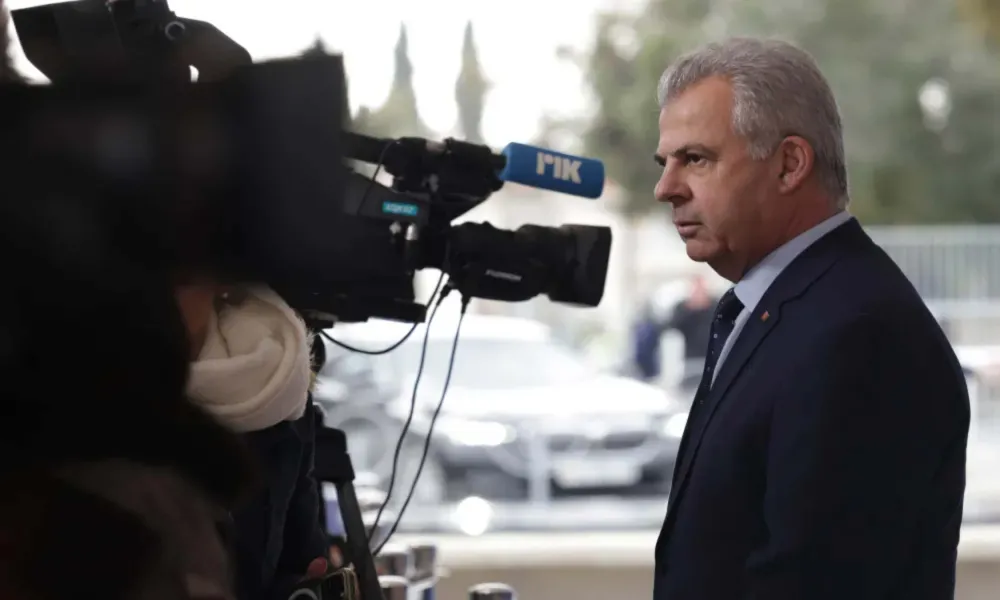

Minister of Justice and Public Order Costas Fytiris speaks to "P" about the Cyprus FBI, the prisons, relations with the Police and the security details of political figures.
Disagreements with the Police leadership have come to light. What is your relationship today?
Under the Police Law, the minister has responsibility for the implementation of the Law and general oversight, and issues directions to the Police whenever he deems appropriate. I believe that in whatever position we serve, disagreements exist and they are entirely normal. These, however, are resolved through proper communication and honesty. The role of the Minister of Justice is primarily supervisory, and that is what I do. I set policy and exercise oversight, so that I am accountable to society and ensure that government policy is implemented. When I disagree, I say so institutionally and directly. I believe that strong institutions function better when there is honest dialogue rather than silence, and that is what I practise. My personal pursuit is always the best possible functioning of the Police for the benefit of the citizen and the fight against crime of any form.
"Organised crime is not tackled with piecemeal arrests, but by striking criminal organisations as a whole. Their structure, their finances and their networks. This is precisely the philosophy behind the creation of the new specialised unit, which many call the 'Cyprus FBI'," he says.
Sick leave
A topical issue is that of sick leave, especially in services such as the Police and the prisons. What is the problem you have identified and what is being promoted?
The issue of sick leave does not concern only the Police or the prisons. It is a matter that concerns the public service more broadly, and it therefore needs to be addressed as a whole, with seriousness and with respect towards all employees. Our responsibility, as a State, is twofold. On the one hand, to fully protect those who genuinely face health problems and need support. On the other, to ensure that an institution that exists to protect the employee does not become an object of abuse, which is ultimately at the expense of the public service's employers, who are the taxpaying citizens.
"Criminal organisations today use encrypted applications, artificial intelligence and modern means of communication. If the State is left without corresponding lawful tools, it will always be behind developments and without the effectiveness society demands," the Minister notes, referring to the surveillance bill.
In the Police and the prisons the issue also has an operational dimension. When there are increased absences, the daily functioning of the services is affected, front-line members who are called upon to cover additional needs are burdened even further, and additional cost is created for the state and the taxpaying citizen. There are quite a few cases of employees who take sick leave and, instead of "recovering", work elsewhere or go on holiday.
For this reason, on my initiative, four meetings were held with the co-competent ministries and the relevant services, so that the matter could be examined in depth and practical solutions promoted. We are not interested in impressions. We are interested in having a framework that is consistent with the principles of equality before the law and respect towards society. We do not seek to question any employee's right to sick leave. On the contrary, we want to ensure that those who genuinely need it will receive the necessary support, while at the same time the services will be able to function effectively and without injustices at the expense of exemplary employees. Our philosophy and goal is the full protection of those who genuinely face health problems, but also the full assurance that the rules are applied in the same way for everyone, with simultaneous recognition and reward of the best.
Other ministries should take over
Are you concerned by the multiple duties with which police officers are burdened, in relation to staffing numbers?
Police officers are admittedly burdened with many duties. There are, therefore, two solutions. Either the Police is reinforced with personnel, so that it can respond to its duty, or other ministries take over requirements that stem from their own laws and which the Police is called upon to implement. Looking at the laws of other ministries, police action is required for specific articles to be enforced. That is, the Police implements provisions of other ministries' legislation that are not of a policing nature. For these actions to continue being carried out by the Police, it must be reinforced with personnel. Otherwise, these duties should be removed, so that the Police can focus on its core duty, which is policing and the security of citizens. If it were solely my decision, I would choose to remove duties from police officers, have them taken over by the ministries themselves, and utilise those members of the Force in other duties.
"The process of selecting a new prisons director is under way. The aim is for the process to be completed within September. Ninety warder positions have also been advertised, while 45 positions for temporary warders are being promoted in parallel."