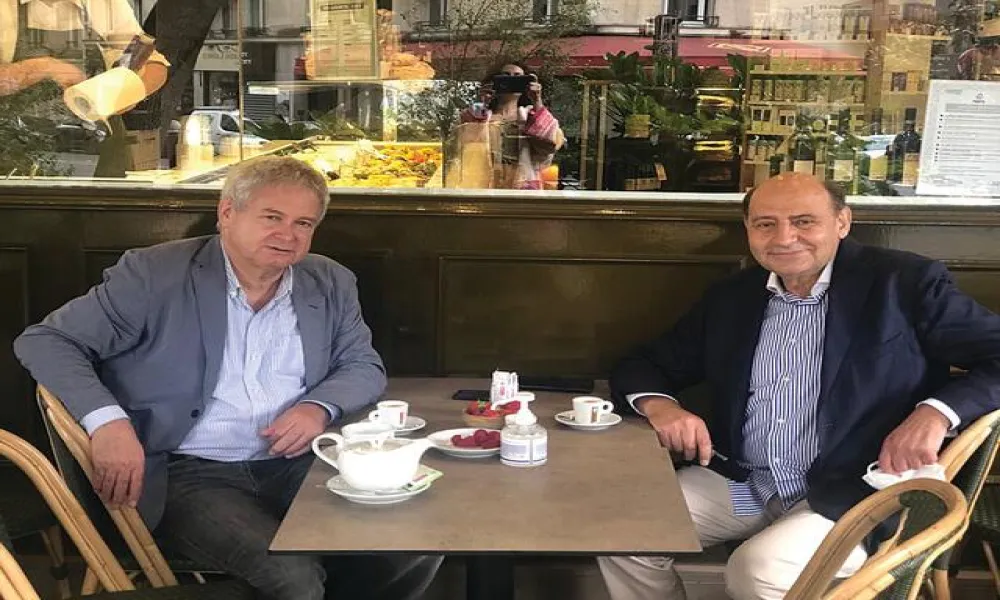
Today, the celebrated and award‑winning chef returns to the village that raised and inspired him – Agios Ioannis in Pitsilia – after his sudden and premature death last week. On Friday, the Cypriot and Greek communities of Paris, along with many friends, including prominent French admirers of both his cooking and his character, bid him farewell at a modest ceremony in the city’s Greek Orthodox Metropolitan Church, where he lived and thrived for nearly fifty years.
Andreas Mavrommatis died without warning. It was a Saturday afternoon. He had just finished a stroll through Parisian boutique shops with his close friend and collaborator Antonis Antoniou. They also visited the new restaurant he was preparing – named “Thalis” – which opened after his death and of which he was immensely proud. After dropping Antonis off at home and agreeing to meet later that evening at the restaurant “Mavrommatis,” as they did every day, he drove toward his office. Feelings unwell, he changed course to head to his doctor, but collapsed halfway there. “We will keep him in our hearts until we meet again,” Antonis told us. “He was unbelievably generous. When I was in hospital for six months, he came every day, sat with me for hours, played Greek music – we sang together. He sent me food without fail… Andreas was a perfectionist. No dish left the kitchen without passing under his eyes. He spotted every detail. If he didn’t like something, it went straight back.”
He never made It to Monaco
Antonis recalls that during their final drive through Paris, they talked about Monaco, where Andreas was due to travel on Monday, 16 March, for the 2026 Michelin Star ceremony. He never made it. No one knows for certain, but rumours suggest that he might have received a second Michelin star that day for the exceptional quality, technique and consistency of his cooking. According to Antonis, Andreas was perfectly content with one star. He never pursued another. As he once said in an interview: “A Michelin star is a great honour, but it isn’t the goal. The goal is to make people happy when they taste your food.”
“He was my alter ego”
Former Cypriot negotiator and diplomat Andreas Mavroyiannis spoke to Politis about his 50‑year friendship with the chef. “We met on our very first day in Paris – by chance. From then on, we were inseparable. We shared everything. He was an extraordinary person, with rare virtues. Modest, gentle, generous, deeply human. All of that existed alongside incredible discipline, uncompromising standards – especially towards himself – and absolute perfectionism. He was someone you could trust completely to do whatever was humanly possible, and then a little more.”
A touch of magic
Mavroyiannis continued: “Whenever he had to give a speech, or present something, he shared it with me. We would revise it together, refine the text. He would explain the depth of his thinking, and we worked side by side to produce the best result. But Andreas was always the one who, in the end, added a touch of magic – an element of brilliance that made whatever he touched unique. The same applied to his work in the kitchen. From 1980, when he began creating something of his own, we worked together on new dishes – a never‑ending process of testing and retesting. And when he finalised a dish and prepared it with his team, on the day it was first served, he always added something – a final touch that elevated it even more. He was an artist, a creator who drew on the flavours of his childhood, on quality ingredients and on how to bring them to life. He worked constantly between the demands of haute cuisine, his roots and the broader Mediterranean. He experimented endlessly, even pairing dolmades with sushi. He was astonishing in this fusion – but always with taste and pleasure as the goal. He was a true Epicurean, a man of culinary enjoyment rooted not in showmanship but in intimacy. ‘We don’t cook to impress,’ he used to say. ‘We cook to enjoy together, as people.’”
Mavrommatis had expressed this philosophy in an interview: “Food is a way to tell a story. To share your home. Cooking isn’t performance – it’s memory, emotion, the flavours you carry from childhood.”
Mass production… that still tasted homemade
“Andreas and his brothers – Evagoras and Dionysis – built a vast enterprise: 16–17 establishments, a production unit that was part factory, part restaurant network, part catering service, part takeaway… But if he had to make 100 kilos of taramasalata – and his was the best in the world – he knew that mass production could compromise taste. So he made the 100 kilos in 50 batches of two. This is how he achieved homemade flavour in large‑scale quantities. That’s the kind of person he was,” Mavroyiannis explained.
He also described how the French came to embrace Mavrommatis’ cuisine. In the early 1980s, Andreas opened a small bistro, Les Délices d’Aphrodite. “It started as a little grocery shop. Then, with a simple home kitchen, he made a bit of moussaka. We learned to make afelia. Slowly he added stools, then small tables, then a full dining room. He began from nothing. But from the start, the French – because of their affection for Greece and its cuisine – recognised what he was doing and who he was. In the ’60s and ’70s, central Paris was full of Greek restaurants – most of them terrible, selling the Parthenon, sirtaki and gyros. When Andreas arrived with seriousness and authenticity, he immediately stood out. Very quickly, he entered the gastronomic guides.”
Trachanas and Commandaria
Although Mavroyiannis struggles to choose a favourite dish, he highlights the “astounding” artichokes à la Polita. Mavrommatis himself loved trachanas soup. “It has simplicity, warmth, and reminds me of my childhood,” he used to say.
In a 2021 interview, he recalled: “In 2020, we managed to bring Commandaria into the Sommelier competition as the best wine in the world. We served it with trachanas topped with mint. Cyprus has many products loved by gastronomy professionals. Along with Greece, which always inspires us, we have ingredients cherished by the French – such as colocasia (taro) and halloumi. Our restaurants feature goat’s milk halloumi that we make ourselves. Halloumi became known in France through our restaurants, and that is an honour for us. The French even included halloumi in their dictionary.”
“I will miss his company”
“I will miss him – our constant discussions, our exchanges. There was never a gap in that relationship, even if we didn’t meet for months. We had planned to spend a fortnight together in Paris now. We didn’t make it. Our consolation is that Andreas lived – and lived beautifully, with a wonderful approach to life,” Mavroyiannis concluded.
What Gavras and Aliagas wrote about Mavrommatis
Andreas Mavrommatis left Limassol for Paris in the late 1970s to study psychology and sociology. The restaurant job he took to support his studies became the path he would follow for the rest of his life.
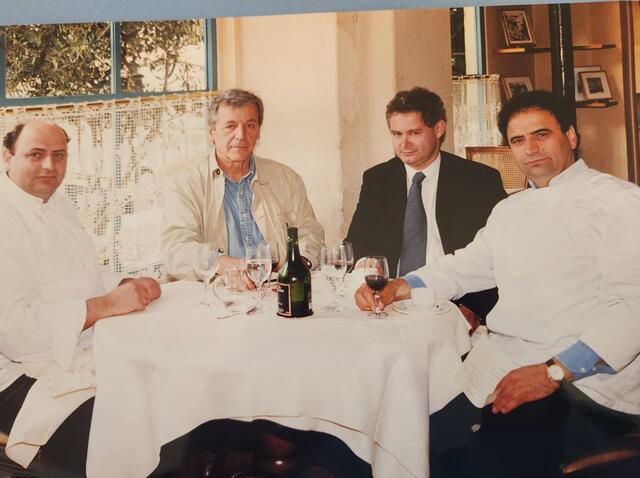
In the preface to Mavrommatis’ cookbook 45 Recipes from Greece Made with Love, film director Costas Gavras wrote:
“Some people are admirable, possessing an inner duality – a sense of beauty and goodness – and are innovative artists who also preserve tradition. Andreas Mavrommatis is one of them. Ancient Mediterranean traditions from Greece and Cyprus, galaxies of knowledge, thought and craft, allowed him to rise above conformity. His journey, and that of his brothers – his accomplices and guardian angels – from their island home to the world of Parisian gastronomy is a long road: a road of lyrical flavours, both discovered and invented, through an osmosis of know‑how, creativity and the demanding discipline of French cuisine.”
Nikos Aliagas added:
“Andreas Mavrommatis is an alchemist who translates our emotions onto his plates with precision. He draws inspiration from the purity of olive oil, the velvet texture of red wine, the sweet bitterness of oregano, the taste of a leaf of stuffed chard… He is a poet, and his recipes will delight you in a thousand ways.”