Eighteen months into its operation, the Nicosia District Local Government Organisation presented an account that goes beyond figures and infrastructure projects. It offered a snapshot of a reform still in motion, shaped by human effort, institutional friction and unresolved questions about coordination at state level.
Opening his address, NDGO Nicosia President Constantinos Yiorkadjis chose to begin not with charts or budgets, but with people. He introduced his team one by one and publicly thanked the organisation’s employees, repeatedly underlining that passion, determination and hard work were the driving forces behind the measurable results achieved over the past 18 months.
As he acknowledged, the first six months were particularly difficult. The transition phase, he said, made it clear that District Organisations and municipalities or communities are two sides of the same coin. One cannot function effectively without the other.
325,000 files and a system under strain
One of the most striking figures presented concerned development licensing. NDGO Nicosia inherited approximately 325,000 physical files, which had to be received, transferred and archived. This task, Mr Yiorkadjis explained, was carried out using a deeply problematic software system, adding further pressure to an already complex transition.
He also described as unfortunate the timing of requests by the Ministry of Energy, which coincided with the physical transfer of files. At that same period, citizens were being asked to submit original documents for photovoltaic applications, despite the fact that many of those documents were literally in transit between authorities.
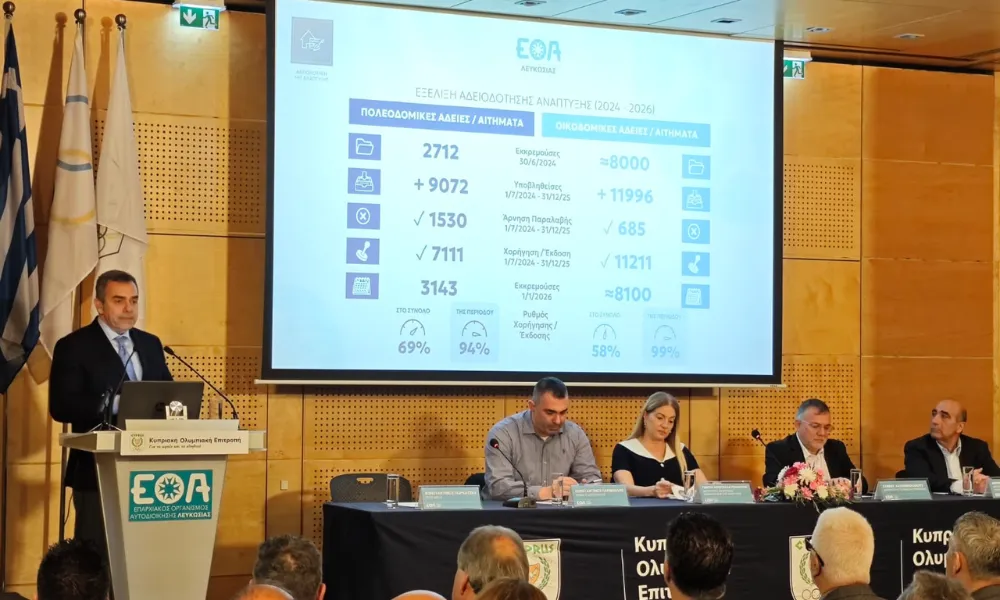
Despite these structural constraints, processing rates have steadily improved. For the period examined, completion rates reached 94% for planning permits and 99% for building permits, reflecting what the President described as a gradual stabilisation of the system.
Water supply: the best network in Cyprus
Water management featured prominently in the presentation. NDGO Nicosia currently manages a water supply network extending 2,565 kilometres, serving over 170,000 water meters.
Addressing a frequently cited concern, Mr Yiorkadjis clarified that 20% non-revenue water, often perceived as a weakness, is in fact the lowest rate nationwide. According to him, this places Nicosia’s network among the most efficient in Cyprus.
He also referred to the recent inauguration of new water reservoirs at the Athalassa facilities, which provide 36 hours of water autonomy in the event of a complete supply interruption, significantly strengthening system resilience.
Strategic gaps in national water planning
With measured tone but clear intent, the President raised concerns about coordination with the Water Development Department. He cited the Mazera pumping station as a telling example: its current output of 12,000 cubic metres per day already equals peak summer consumption for the area it serves.
Projected demand growth of 5% to 7% over the next five years, he noted, highlights a lack of strategic foresight and coordination. He further reminded the audience that Western Nicosia is supplied by springs and dams, posing a direct question: how will these areas be supplied if desalination becomes the dominant national strategy?
Flood protection and lost energy potential
Turning to flood management, Mr Yiorkadjis pointed out that for years flood protection fell under municipal responsibility, despite the fact that municipalities lacked the financial capacity to deliver large-scale projects. The result, he argued, was a fragmented and ultimately ineffective approach.
His reference to the Kotsiatis landfill was particularly pointed. Using the phrase “for reasons we do not understand”, he described the ongoing loss of energy potential, noting that despite available technology, valuable energy continues to be wasted rather than recovered and utilised.
What comes next: the 2026 priorities
Looking ahead, the President outlined the organisation’s priorities for 2026. These include completing staffing, clearly defining and enforcing internal procedures, and introducing oversight by two internal auditors.
Equally central is the adoption of a single, unified software system across all services. Above all, Mr Yiorkadjis stressed a commitment that no citizen letter, complaint or request will remain unanswered.
Reform still in progress
The 18-month review paints a picture of a reform that is producing tangible results, while simultaneously exposing long-standing weaknesses in coordination, planning and institutional alignment at national level. The numbers tell one story. The questions they raise tell another.
For NDGO Nicosia, the challenge now is not only to consolidate what has been achieved, but to ensure that the next phase of local government reform is supported by coherent state policy and long-term strategic planning.