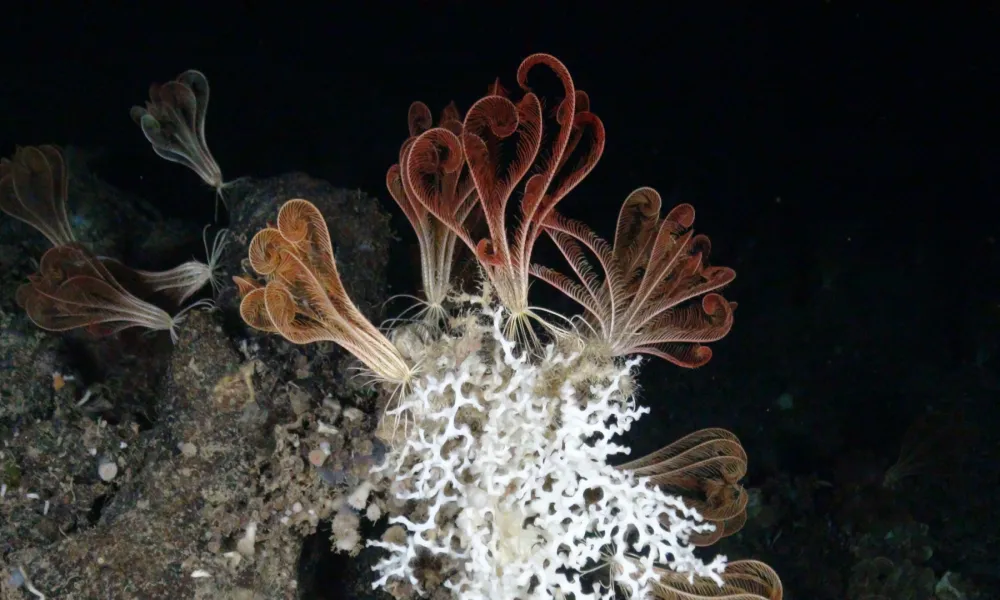
Today, Cyprus holds the Presidency of the Council of the European Union, while Commissioner Costas Kadis helps steer EU fisheries and ocean policy. Under their auspices, Mediterranean fisheries ministers will gather in Cyprus in May to define a future vision for the region, to be outlined in the next ‘MedFish4Ever ministerial declaration’.
These discussions take place under increasing strain on the Mediterranean. The sea is warming at two to three times the global average and is considered a climate change hotspot, while most fish stocks in the region remain overexploited. Invasive species are reshaping ecosystems across the Eastern Mediterranean, including in Cypriot waters. In this context, protecting marine life is not a distant environmental ambition: it is a question of resilience, food security and regional responsibility.
That is why an apparently technical issue now deserves political attention. With background studies having concluded positively, Mediterranean countries now have an opportunity to adopt a precautionary, science-based decision in 2026 that would ensure real protection for the Mediterranean deep sea. This would take the form of shifting the regional ban on bottom trawling from the current 1,000 metres to 800 metres. At first glance, a change of 200 metres may sound minor, and yet this is one of the clearest steps to strengthen protection for some of the most vulnerable deep-sea ecosystems across the Mediterranean, with limited cost to the fishing sector. It is about returning to the abundance that once characterised this sea.
A science-based, low-cost opportunity
The current 1,000-metre limit was adopted by the General Fisheries Commission for the Mediterranean (GFCM) in 2005 as a precautionary measure to protect vulnerable deep-sea habitats, such as cold-water corals and sponge grounds. It was an important step at the time, but more than twenty years later, the region is still operating under that same threshold, even as deep-sea science has leapt ahead. In 2016, Mediterranean scientists called to revise this rule in light of new evidence. Yet, a decade on, that regional revision remains overdue.
It is much needed because bottom trawling is one of the most destructive fishing methods at sea. It drags heavy gear across the seabed, damages fragile habitats, affects non-target species, and adds pressure to ecosystems that recover slowly, if at all. Indeed, a single pass of a trawl net can cause irreversible damage. In a sea already stretched by warming waters and biodiversity loss, leaving vulnerable deep-sea areas exposed to trawling is becoming harder to defend.
Not to mention that this is a low-cost intervention. Pilot projects carried out in seven Mediterranean countries (Egypt, France, Greece, Italy, Malta, Spain and Tunisia) found that the fishing sector would broadly maintain its economic performance if the ban were shifted. This proves its minimal economic and social costs, yet high ecological gain.
Indeed, shifting the ban would help protect an estimated 100,000 additional square kilometres of deep-sea across the Mediterranean, according to research by Oceana. This overlaps with areas of vulnerable marine ecosystems that are especially sensitive to bottom trawling and climate stress. It would also safeguard key essential fish habitats for overexploited stocks, including commercially important deep-sea shrimp such as the blue and red shrimp, which can still be caught in shallower waters.
A precautionary approach in a changing climate
As the Mediterranean Sea warms, deep waters are increasingly acting as climate refuges. Protecting ecosystems below 800 metres is therefore about keeping habitats resilient enough to support life and fisheries into the future.
For Cyprus, the issue is also relevant. Cyprus does not fish at these depths itself, yet deep-sea fishing by other EU fleets takes place within Cyprus’s waters. Supporting a Mediterranean-wide shift in the ban would therefore help protect Cypriot deep-sea habitats, while reinforcing a principle that matters deeply across the region: fisheries rules must apply fairly, be consistent with international obligations, and be applied across all fleets.
In this context, the case for acting with caution is compelling, as fishing fleets risk moving into deeper waters as some fish stocks migrate to cooler waters. This goes hand in hand with having in place effective monitoring systems of fishing activities, including mandatory satellite tracking of vessels, as well as enhanced surveillance and inspections by Mediterranean countries, to ensure proper protection of these deep-sea climate refuges.
A legacy opportunity
This is what makes the current political moment crucial. The MedFish4Ever ministerial declaration is approaching its ten-year anniversary, and a new Ministerial Declaration is due in 2027. 2026 offers a window to demonstrate ambition for Mediterranean fisheries policy to deliver measurable results, not just commitments on paper.
For Commissioner Costas Kadis, this represents a defining opportunity. As EU Commissioner for Fisheries and Oceans, coming from the Mediterranean, he is uniquely placed to champion a decision that strengthens both EU leadership and regional cooperation. Supporting an extension of the deep-sea trawl ban to below 800 metres at the GFCM annual meeting in October 2026 would strengthen the EU as a global leader in deep-sea protection.
The Mediterranean has already witnessed too much delay. Shifting the deep-sea trawl ban from 1,000 to 800 metres will not solve every problem facing the region’s fisheries, but it can contribute to easing them by creating a sense of shared purpose across the region to reverse the decline of the Mediterranean Sea. And it would send an important signal that protection of the Mediterranean is still possible when science is matched by political will.
Commissioner Kadis has all the cards in his hand to turn a fishing depth limit into something more important: an inspiring Mediterranean success story, and a legacy for the sea that has shaped Cyprus’ history, its culture, and will shape its future. It is now simply a matter of political willingness and commitment.
Co-signatories
Alexandra Cousteau is co-founder of Oceans 2050 and Senior Advisor to Oceana, continuing her family's legacy of ocean advocacy with a focus on restoration and abundance.
Dr. Xenia I. Loizidou is a civil and coastal engineer with 30 years’ experience in marine and coastal dynamics in the Mediterranean. Since 2019, she has been appointed Ambassador for the Coast by the Mediterranean Action Plan of the United Nations Environment Programme.