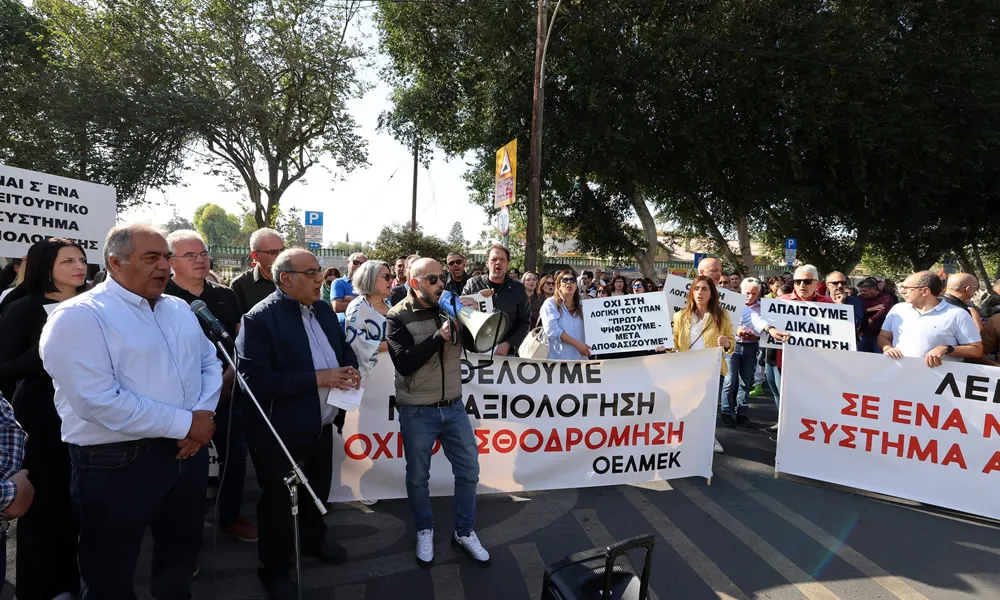
With today’s two-hour work stoppage over the proposed teacher and school evaluation scheme, educators have once again turned parents and students into collateral damage. Schools remain closed during the early morning hours, bus routes are suspended, and thousands of families are scrambling for last-minute solutions, as Parliament prepares to take final decisions. Absences will not be counted, but the disruption and loss of teaching time are already a reality.
From their sofas and beds, teachers and secondary school professors are “protesting” today against the new evaluation system for educators and educational work, which is before the plenary session of the House of Representatives and is expected to be put to a vote next Monday. At the same time, the two-hour work stoppage announced by OELMEK and POED, from 7.30 to 9.00am, is causing widespread disruption for parents and pupils.
Some parents have taken leave from work, others have relied on grandparents and relatives, while many have decided not to send their children to school at all, as it is impossible to find transport for a 9.00am arrival.
As announced by the Ministry of Transport, morning bus routes will not operate. The only exceptions are Technical Schools, where lessons begin as normal at 7.30am, and special schools, where student transport will take place at 9.05am. For primary schools, gymnasiums and lyceums, buses will operate only for the departure of students who do eventually attend.
Absences without consequences
Regarding student absences in general secondary education, the Ministry of Education clarified that absences “will be recorded but will not be counted”. As Education Minister Athena Michaelidou stated, “we encourage parents who are able to send their children to school to do so, but we cannot punish children who are not at fault”.
Parents appeal to teachers
Organised parents in primary education also expressed strong dissatisfaction, issuing a public appeal to teachers to reconsider their action. The president of the Federation of Primary School Parents’ Associations, Ioannis Ioannou, warned that such mobilisations “do not affect the ministry or Parliament, but lead to hardship for parents and students”, stressing that families are once again being asked to deal with the consequences of a conflict that does not directly concern them.
“A right, but not understandable”
The Education Minister appeared firm in response to the reactions of the trade unions, stressing that the ministry has already provided draft criteria and weightings for the evaluation process, which it was agreed would be finalised by the Monitoring Committee with the participation of the organisations.
“We respect the right to take action, but it is not understandable. All the criteria are there and have been sent to Parliament and to the organisations,” she said, adding that “we cannot threaten in order to have our positions accepted”.
Ms Michaelidou underlined that the goal is a system that is “pedagogically sound and applicable”, noting that work on its implementation will begin immediately after it is passed. “After Parliament, neither our positions nor those of the organisations are fully implemented. That is what the democratic process dictates,” she said.
Referring to the stance of political parties, the minister estimated that “only AKEL will vote against”, while defending Parliament’s right to submit amendments. “How can the positions of only one side be adopted?” she asked, addressing the unions directly: “What is the reason for this disruption? Is 15% enough to justify the hardship caused? What message are we sending to children?”
Escalation remains on the table
While today’s work stoppage is already causing disruption, the possibility of escalation remains open. Following POED, OELMEK has also warned of further measures. Speaking yesterday, the organisation’s vice-president, Andreas Mavratsas, said that after the end of today’s action at 9.30am, the Pancyprian Conference of General Representatives will convene to determine the next steps.
Mr Mavratsas explained that key points of disagreement include the principal’s participation in numerical evaluation, the scale from 1 to 100, and the absence of a clear induction programme for newly appointed teachers. He added that the work stoppage was decided because the final version of the bill was not delivered on time by Parliament, despite expectations raised with the organisations.