The Cyprus issue has recently returned to the forefront of political attention, largely through diplomatic movements and public statements. Some observers link this renewed activity to broader geopolitical developments in the Eastern Mediterranean, particularly in relation to energy and security.
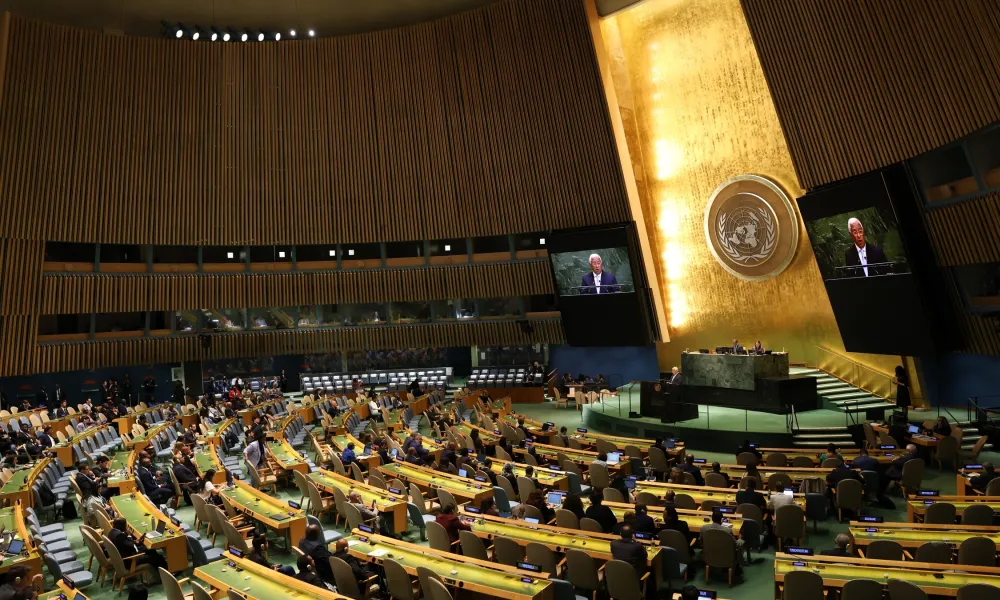
UN efforts to restart dialogue continue, with emphasis placed on informal contacts and the exploration of common ground. Last week, reports from the occupied areas suggested that Turkish Cypriot leader Tufan Erhürman said a new initiative by UN Secretary-General António Guterres is expected in July.
In a social media post, Erhürman said that during a meeting at the Antalya Diplomacy Forum with the UN Under-Secretary-General for Political and Peacebuilding Affairs, Rosemary DiCarlo, views were exchanged on “the new initiative of the UN Secretary-General on the Cyprus issue, expected in July, after the parliamentary elections and the completion of the Cypriot Presidency of the Council of the EU”. He described the meeting, during which confidence-building measures were also discussed, as “productive and useful”.
He later clarified that the UN Secretary-General’s interest in the Cyprus issue remains active and that a new initiative is on the agenda for July. However, he stressed this should not be interpreted as a new plan, but rather as Guterres’ intention to re-engage directly with the issue.
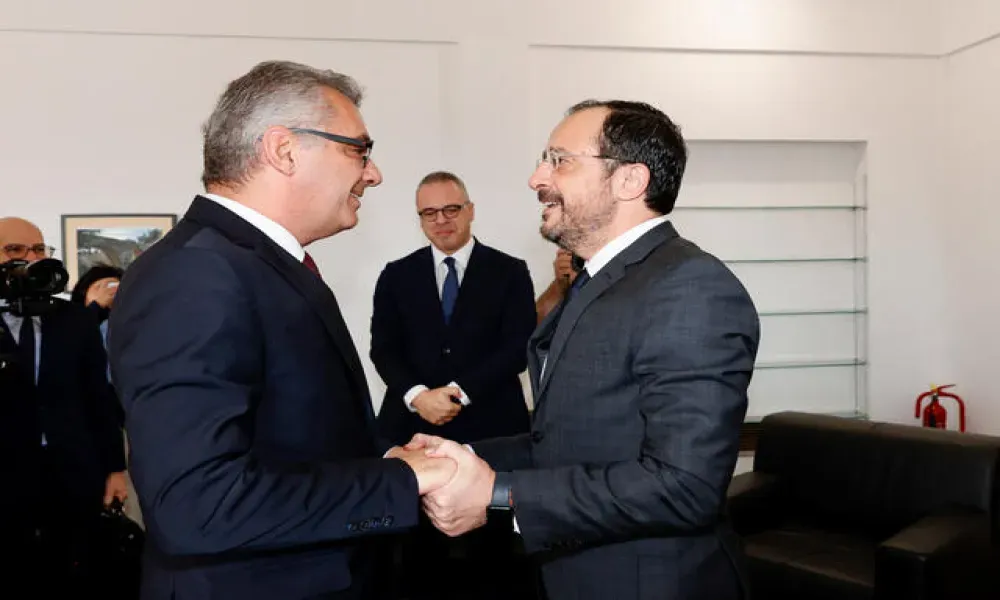
On Tuesday, 21 April 2026, Cypriot President Nikos Christodoulides, following a meeting at the Presidential Palace with UN Under-Secretary-General Jean-Pierre Lacroix, expressed appreciation for the Secretary-General’s political commitment.
“We are grateful for the political commitment of the UN Secretary-General. We support his new initiative, and especially now with all these international developments, his role is very important for us in our efforts to resume negotiations and reach a settlement of the Cyprus problem,” he said.
Lacroix noted that the United Nations is working to create conditions conducive to the resumption of talks, with President Christodoulides responding that “we need a favourable environment for the resumption of negotiations”.
Realism and Overcoming Constraints
Sociologist Dr Nicos Peristianis, President of the Universitas Foundation, highlights in an interview with Politis the key difficulties that continue to hinder progress on the Cyprus issue, with particular emphasis on the differing concerns and priorities of the two communities. He also explains why, despite significant convergences, several critical issues remain unresolved. He stresses the need for realism, creative compromises and meaningful societal participation in shaping a viable settlement.
The interview is based on his recent book The Constitution of a Deeply Divided Society: Reflections on the Cyprus Problem and Its Resolution (Papazisi Publications). The book explores new ideas on governance models, constitutional design and political restructuring, focusing not only on resolving the Cyprus problem but also on the future of a shared, functional state.
Two Different Worlds
Why has the Cyprus problem stalled again despite widespread agreement on the need for a solution?
Because the Cyprus problem is genuinely a very difficult issue. Greek Cypriots primarily emphasise the aspect of invasion and occupation after 1974, and seek assurances that they will not be left vulnerable to Turkey after a potentially unstable settlement. They also believe that, as the majority, they should have the primary role in a democratic system.
Turkish Cypriots, on the other hand, highlight their sense of insecurity as a minority and the painful experiences of 1963–74, which they do not want to repeat under a new arrangement. They do not wish to live as second-class citizens under a permanent majority.
Both perspectives are important but difficult to reconcile simultaneously. Unfortunately, the two communities developed separately, like parallel societies, without a unifying social fabric. Cyprus became a deeply divided society, with institutions that separate rather than unite: distinct languages, religions, ethnic identities, historical narratives, education systems, media, political parties and cultural organisations.
After 1963, an initial territorial separation emerged, followed by the full division after 1974. The continued existence of a separate entity for Turkish Cypriots—albeit unrecognised—has reinforced distinct socialisation and political identity, alongside dependence on Turkey. In essence, the challenge resembles bringing together two very different states or worlds rather than two closely related communities.
Recognising Differences
Does this mean we should not expect a solution? Is this why efforts remain inconclusive?
We should not, and cannot afford to be, pessimistic. A solution to the Cyprus problem concerns our very existence, and therefore persistence is essential. In fact, non-solution carries greater risks for all Cypriots.
We must acknowledge our differences but also seek ways to gradually bridge them in order to build a viable multinational—more precisely, intercommunal—state. Significant progress has been made over the years, with important convergences achieved. However, serious differences remain and must be addressed.
These include agreement on territorial adjustments, the return of displaced persons, implementation of the four freedoms, and the distribution of powers between the central government and constituent states. However, difficulties persist on issues such as veto rights, foreign troops and security guarantees.
On rotating presidency, for example, there was initial agreement, but public hesitation—particularly among Greek Cypriots—remains strong. Imposing unpopular provisions would reduce legitimacy and threaten the sustainability of any settlement.
Creative Breakthroughs
So what should be done?
We should focus on these difficult issues and seek creative compromises. We should also stop questioning everything, including the agreed framework that has been under discussion for over 50 years.
This solution has been accepted and supported by both the United Nations and the European Union. It is not realistic to restart from zero. The focus must be on improving the existing framework and ensuring it is functional and sustainable.
A Federal Model for Cyprus
Some argue that a bizonal bicommunal federation is not an ideal model. Is that the case?
There is no abstract “ideal” constitutional model that fits all societies. Systems must reflect the realities of each country.
Cyprus is a heterogeneous society with historically distinct communities. It cannot adopt constitutional models designed for homogeneous states. For example, the US federal constitution was created for a relatively uniform society formed by 13 colonies with shared language, religion and institutions.
Cyprus has no such shared historical unity with Turkish Cypriots, nor a common liberation struggle. Institutions have developed separately.
Closer to Belgium Than the US
Which model is more appropriate?
Cyprus is more comparable to heterogeneous states such as Canada, Switzerland and Belgium.
Belgium, for example, evolved into a federal state as linguistic and economic differences between Flemish and Walloon communities became politically significant. Over time, it transformed into a federal system to accommodate these differences peacefully.
This model is closer to Cyprus than the US example.
One or Two Peoples?
How does this relate to Cyprus?
The US Constitution begins with “We the People”, reflecting a single nation. By contrast, Belgium’s constitution recognises a federal state composed of communities and regions.
Cyprus more closely resembles the Belgian model, with two politically equal communities living in separate areas. The 1960 Constitution referred to “Greeks and Turks of Cyprus”, not a single people.
The Annan Plan, despite its flaws, moved towards recognising two communities sharing a common homeland.
A Divided or Shared People?
Are we destined to remain divided?
Constitutions reflect existing realities but also indicate future aspirations. A future Cypriot constitution could combine difference with unity, referring to two politically equal communities forming a reunited federal state.
We may not yet be a single people in practice, given the short period of shared statehood. However, such an identity can be rebuilt through shared political experience and cooperation.
In this sense, peoples are not fixed—they are shaped through collective action. Constitutions reflect both reality and aspiration.