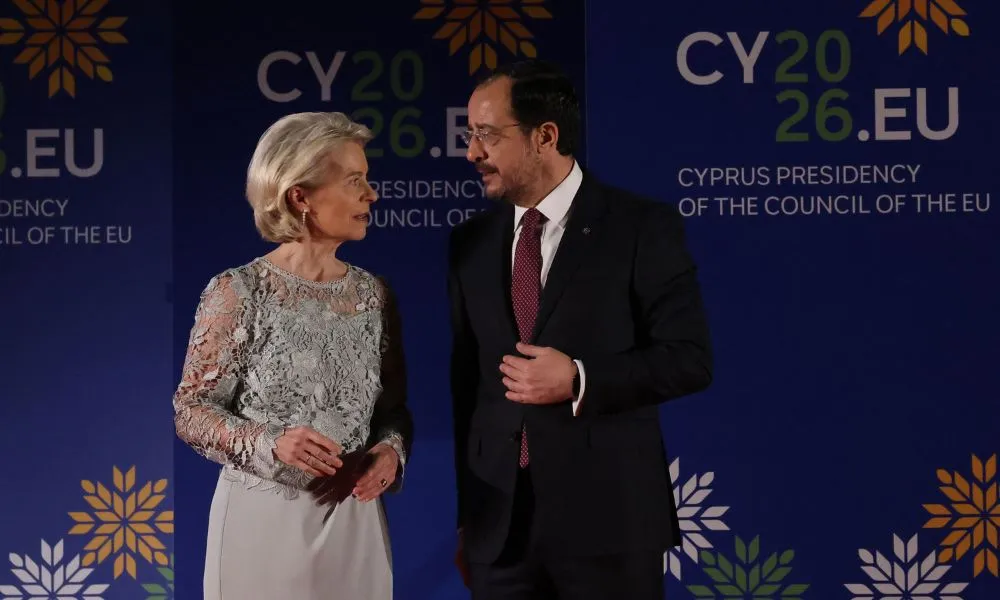
Regional stability and prosperity in the Eastern Mediterranean are “closely linked” to a settlement of the Cyprus issue, European Commission President Ursula von der Leyen has said, noting that the process to appoint a new EU Special Envoy for Cyprus is currently under way.
In an interview with the Greek newspaper Kathimerini, she reiterated the European Commission’s support for a UN-led solution based on relevant Security Council resolutions, calling for a bizonal, bicommunal federation with political equality.
She added that the European Union remains ready to engage actively and contribute to the process under the auspices of the United Nations.
The Cyprus problem
Von der Leyen stressed that resolving the Cyprus issue remains crucial for the wider region, underlining that the EU continues to work in line with European Council conclusions while supporting confidence-building measures. She also highlighted that the EU is the largest donor to the Committee on Missing Persons.
Regarding the appointment of a new EU envoy following the resignation of Johannes Hahn, she said the selection process is ongoing.
On energy, she confirmed that the Great Sea Interconnector remains under close monitoring and continues to feature in EU interconnection plans. She described it as one of eight “high strategic importance energy networks,” underscoring its significance and the EU’s commitment to its implementation.
Regional war
Addressing broader EU challenges, von der Leyen said issues such as demographic ageing, competitiveness, strategic dependencies and political fragmentation cannot be tackled in isolation. The key question, she noted, is whether Europe is ready to confront them collectively—adding that doing so could transform them into opportunities to deepen integration and strengthen the EU’s global role.
She pointed to Europe’s strengths, including its social market economy, robust public healthcare systems, high-quality education and resilient infrastructure, arguing these provide a strong foundation to face current challenges.
On the EU’s geopolitical role and developments in the Middle East, she said the war has had significant regional consequences and that the EU has been working from the outset with partners across the region to support efforts towards lasting peace.
Cyprus as a bridge
However, she acknowledged that the requirement for unanimity in foreign policy often limits the EU’s ability to act decisively, suggesting that a shift towards qualified majority voting would help avoid repeated deadlocks.
Von der Leyen also noted the participation of several Mediterranean partners in a recent leaders’ meeting hosted in Cyprus, highlighting the EU’s strategic partnerships with countries such as Egypt and Jordan. She referred as well to cooperation with European leaders, including Cypriot President Nikos Christodoulides.
Describing Cyprus as occupying a unique position on the EU’s “south-eastern frontier”, she said the island acts as a bridge between the Union and its wider neighbourhood.
Turning to the energy crisis, she acknowledged that households and businesses continue to feel the impact of high energy prices. In response, the Commission has introduced a “toolbox” aimed at reducing costs and strengthening Europe’s energy resilience.
Firefighting hub
She emphasised the need to boost domestic, affordable and reliable energy while accelerating the transition to clean energy sources. This includes expanding and modernising Europe’s electricity grid to enhance resilience and energy security.
Finally, she addressed plans for a European firefighting hub in Cyprus, designed to respond to rising wildfire risks and strengthen preparedness in the Eastern Mediterranean. The centre, included in the EU’s Mediterranean Pact, will host six firefighting aircraft co-financed by the EU, with the potential for expansion in the future.
The facility is also expected to function as a centre of excellence for best practices and knowledge-sharing in civil protection.
CNA