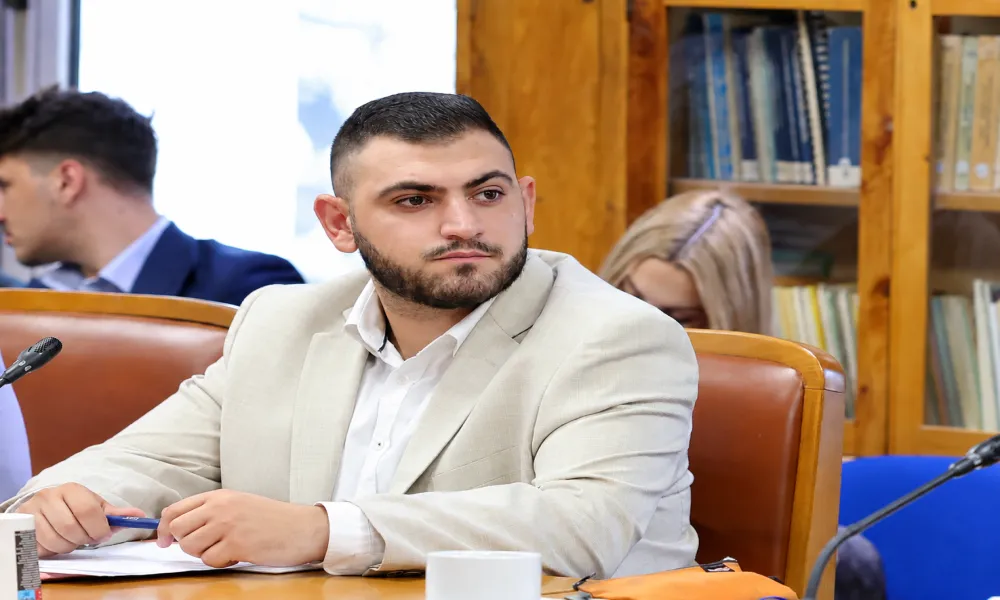
George Pamboridis has made up his mind. On 28 November he will be there. At the ballot box. Standing tall, unshaken, with all his academic qualifications and the accompanying scrolls tucked under his arm. Whatever happens, he is not backing down.
Even if they tell him the date has changed, that the ballot box has broken down, or that the electoral assembly has been moved to Neo Chorio, Paphos, he will go and vote. Even if he is the only one there.
On the other hand, Averof Neophytou has a problem.
It is not that he is afraid of Pamboridis. Averof is not afraid of elections, provided he knows in advance who will win them. Ideally, this can be achieved if there is no opponent. Somewhere along the way, he miscalculated.
He believed that after Annita Demetriou's withdrawal, Pamboridis would also walk away, especially if he heard the roar of Frixos Koullermou:
"Where are you going, man? Have you set out to destroy your political career?"
Foulis' tricks did not work, but as everyone knows, the fox of Argaka is not easily discouraged.
For those who know him, the former DISY president is a man of strategy, tactics, manoeuvres, blows above and below the table, below the belt and just above the ankles. If there were an Olympic sport for political manoeuvring, he would have won the gold medal without appearing in the final.
He would first have convinced his opponents that participation itself would damage the unity of the sport.
This time, however, he found Pamboridis standing in front of him.
With his four degrees. With his high-class law firm. With a wife who reportedly makes the best stuffed vegetables in Cyprus. And, of course, with his social contribution, since he introduces himself as the father of GeSY.
As is well known, Pamboridis does not seem particularly moved by the traditional DISY soufflé recipes involving unity, consensus and avoiding internal divisions.
We have already established that the only recipes that move him are Galateia's.
So they pressure him. They try to persuade him. They explain that the party's interests must come first.
Yet he persists.
As if he were ever going to retreat in front of Foulis.
The drama
This is where Averof's real drama begins.
The fox starts wondering what he can possibly do to make Pamboridis withdraw. Not for his own benefit, heaven forbid, but for the good of the party.
Should he send a delegation of DISY elders to explain that it is wrong to divide the movement?
Pamboridis would ask for a written legal opinion, identify three contradictions and send it back with corrections.
Should he offer him a position in a future Cabinet?
Pamboridis would first want to know who the president will be.
Should he suggest that he withdraw for the sake of the party?
Pamboridis would reply that what is best for the party is to hold elections and elect him.
Should he have his phone cut off?
Possibly.
But he would first have to persuade everyone else to do the same.
Should he request that Nicosia be excluded from the election because Pamboridis appears particularly strong in the capital?
The degrees
There is, of course, also the matter of academic qualifications.
Pamboridis, with four degrees, can analyse the DISY constitution through four different scientific lenses.
Averof, according to our records, possesses a degree from a university on Long Island, which he chose because it happened to be next to the restaurant where he worked as a busboy.
However, he also possesses two immensely valuable certificates.
One in professional-level pilotta.
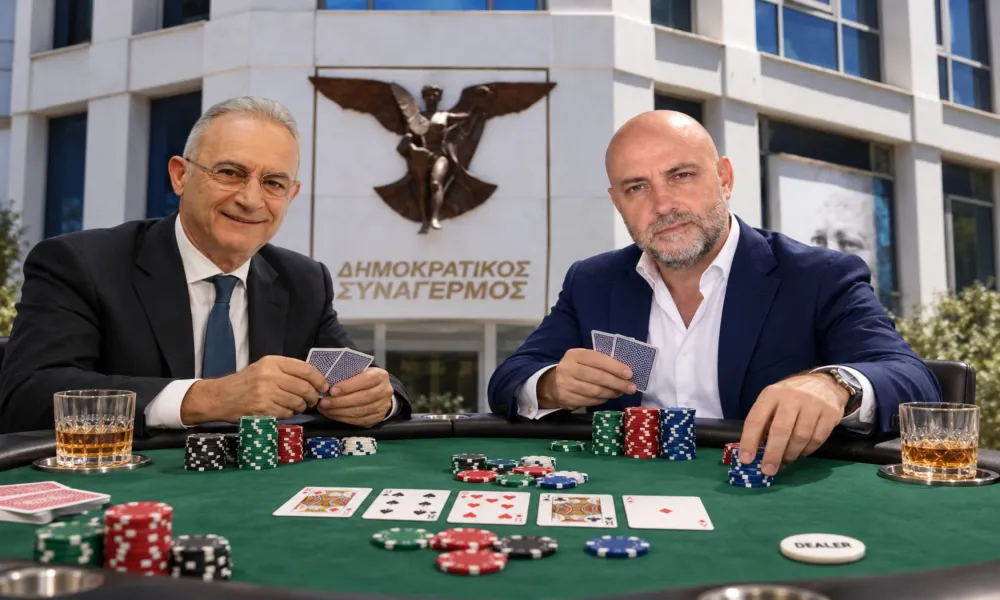
And one in poker.
Let us be clear. We never underestimate a good pilotta player.
In fact, we would argue that the game contains a great deal of strategy, which in politics may prove more valuable than four doctorates.
Pamboridis may know the law, but Averof knows exactly when to call capo and leave the other player speechless.
Pamboridis may invoke legal precedent, but Averof can make his opponent think he is losing while actually holding a royal flush.
Tornaritis' proposal
Some people, such as Tornaritis, have called for the two men to meet and settle matters.
Imagine their next conversation.
"George, think carefully. It's a shame to divide DISY."
"Averof, that's exactly why I want elections. Let the people decide."
"But that's what I'm telling you. Let the people decide. We just don't need to trouble them by making them go and vote."
"What do you mean?"
"Well, let's sort it out between ourselves first."
"And who will be the candidate?"
"Do we really have to discuss every detail, George?"
The difference
That is precisely where the difference between the two men lies.
Pamboridis wants to reach 28 November and count votes.
Averof would prefer to reach 28 November having already counted the voters, the delegates, the undecided and, if possible, the beans before they enter the ballot box.
In fact, he may even resort to his ultimate weapon.
He could propose a televised debate with Pamboridis on the exclusive subject of party unity, moderated by Averof himself.
And if that does not work, there is always pilotta.
"Come on, George, let's play a game. Whoever loses withdraws."
"I accept. But first let's appoint an independent electoral committee."
"But we're playing pilotta!"
"Exactly. With you as my opponent, I also want observers."
And thus the battle for the nomination may end up becoming a clash between two entirely different schools of thought.
The Pamboridis school, according to which elections are held in order to reveal the winner.
And the Averof school, according to which the ideal situation is for the winner to have been identified before the election takes place.
The only certainty is that, if Pamboridis persists until the end, he will force Averof to deploy every ounce of his political craft.
And if neither pilotta nor poker proves effective, there remains one final option.
To enrol at a university and obtain three more degrees.
The only problem is that there is not enough time before 28 November.
Unless he can convince Pindarou headquarters that, in the interest of party unity, the election should be postponed until his graduation.