
There are people who, even in the most difficult moments of their lives, find a reason to smile. Not because they are not afraid or because they do not break down. But because they have learned that, even when they fall, they can get back up again.
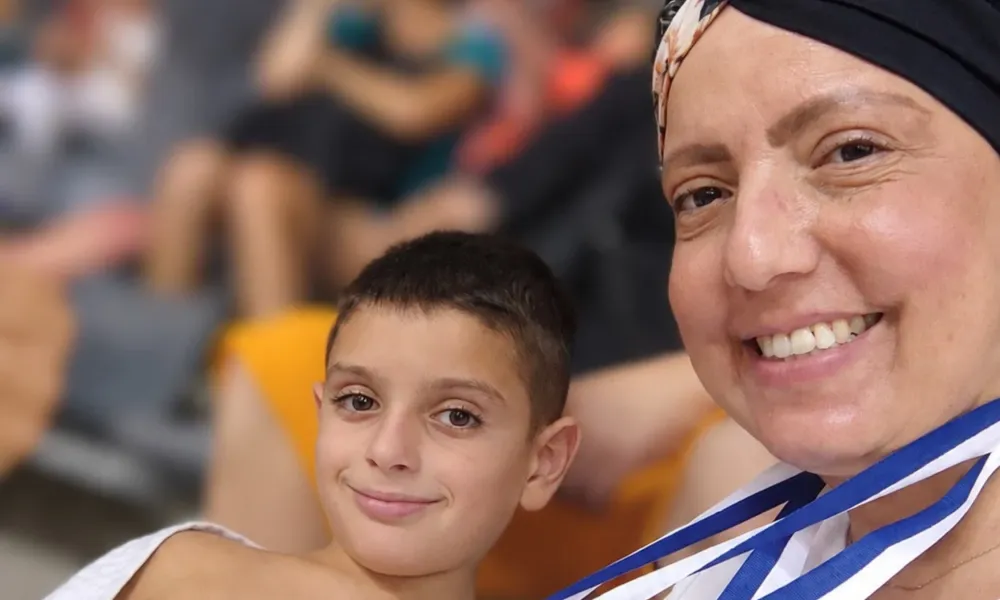
Chrysso Kakoulli is one of them.
She has faced breast cancer three times. At a very young age.
She does not hide the fact that she cried, felt sadness and became angry. Nor did she ever try to convince herself that she had to be strong every moment of the day. She allowed herself to break down so she could rise again. She gave herself time to understand, confront her new reality and move forward.
She did so with the same optimism, determination and love for life that had characterised her even before her first diagnosis in March 2019.
Three diagnoses in five years. Surgeries, radiotherapy, a mastectomy, chemotherapy. And in between all of that, two young children, a family and a daily routine that still had to continue.
Chrysso does not talk about her battle with cancer as though she were fearless. She admits there are still moments today when she is afraid.
What stands out in her story is not what she went through, but how she confronted it.
Because, as became clear during our conversation, strength is not always found in remaining standing. Sometimes it lies in allowing yourself to fall and then finding a way to rise again.
An examination that changed everything
It all started in March 2019.
Chrysso was 37 years old at the time, with her younger son only seven months old and her older son around two and a half.
She had no family history of breast cancer and no alarming symptoms.
A preventive examination, which her gynaecologist had recommended before her second pregnancy, led to the diagnosis.
"My first thought was fear. It was disappointment. It was the question, why?"
she recalls.
Not "Why me?" but rather:
"Why not me? So many women go through this."
Amid the fear there was also gratitude.
"I felt blessed because it was found at a very early stage."
The experience reinforced her belief in the importance of prevention.
"What if I had waited until I was 40 to have a mammogram?"
she asks, raising the issue of preventive screening for women under 40 when medically indicated.
She believes her gynaecologist's recommendation was critical, because otherwise she does not know when the disease would have been detected.
Between radiotherapy and two babies
The first diagnosis brought with it surgery and a course of radiotherapy.
Chemotherapy was not required.
For about four months, from March to the end of June 2019, Chrysso tried to combine treatment with caring for her two small children.
"I would wake up in the morning, get my older son ready for kindergarten, take the baby, leave him with my mother and drive to Limassol,"
she recalls.
There she would undergo a radiotherapy session lasting about ten minutes and then return.
A little rest, lunch at her mother's house and then back to the children. Picking up the older child, caring for the younger one and spending the afternoon with them.
Her family was a vital source of support, especially her mother, who helped daily with the children.
Her husband also stood firmly by her side.
"He never treated me as a patient and nothing changed."
As much as possible, she wanted to preserve her everyday life with her children.
"I strongly believe in the innate strength of human beings. We have enormous inner strength within us."
A strength, she says, that many of us do not realise we possess until we are forced to call upon it.
The mastectomy
Just when she believed the cancer ordeal was behind her, a second diagnosis arrived.
In May 2021, follow-up examinations showed that the cancer had returned.
"I didn't expect it. It was a shock."
The disease was again detected at an early stage, but this time a mastectomy was necessary because the findings were dispersed throughout the breast.
Even then, Chrysso found room for humour.
"I said, finally, I'll get a nicer breast,"
she recalls, laughing.
Nevertheless, she had to prepare for major surgery.
It was July 2021, in the middle of the coronavirus pandemic.
Her husband left her outside the hospital with her suitcase in hand. Restrictions did not allow him to accompany her inside.
From that point on, she had to continue alone.
She still remembers the green dress she wore that day.
"I never wanted to wear it again. I gave it away."
The mastectomy, together with breast reconstruction using tissue from her abdomen, lasted about eight hours.
A demanding recovery period followed.
"The physical strain was enormous,"
she says, acknowledging that both body and mind needed time to recover.
The third diagnosis and chemotherapy
A third diagnosis came at the end of 2023.
About six months after corrective surgery she underwent in May, examinations showed that the cancer had returned again, at the site of the previous mastectomy.
The disease was detected at stage one, but this time chemotherapy was required.
Despite the fear and disappointment, Chrysso wanted to know exactly what was happening.
"I wanted to understand what the biopsy result meant, what my options were, why this treatment and not another."
She constantly questioned her doctors, trying to understand every stage of treatment.
Smiling, she remembers that her oncologist once told her husband he prepared especially carefully before each appointment because he knew how many questions she would ask.
Among her concerns was losing her hair.
More than that, however, she worried about how her children would react.
"I strongly felt that children sense things."
That is why she chose not to hide the truth.
She spoke openly to them about the strong medication she would be receiving and explained that she would probably lose her hair.
Her older son initially struggled to accept the idea, and she promised she would wear a wig if he did not want to see her without hair.
On the day she went to the hairdresser, she had not told the children she would be cutting her hair so they would not worry at school.
Yet her older son persistently asked his grandmother where his mother was and whether she had gone to cut her hair.
When he learned the truth, he called and asked for photos.
"He told me I was very beautiful and that he was waiting for me to come home."
That evening he asked to see her without the wig.
After reassuring her that he was ready, they went into a room together with his father.
Her younger son needed more time.
"Come on Mum, take it off."
She removed the wig and her son hugged her tightly while crying.
"You know, Mum, I'm not crying because I'm sad. I'm crying because I was moved."
Life between chemotherapy sessions
Chemotherapy was another challenge, but Chrysso did not want to put her life on hold.
Her friends stood by her side, rearranging their schedules and even taking leave from work to accompany her to treatment sessions.
Before arriving at the oncology centre, they often stopped for coffee along Limassol's seafront.
A small ritual that made difficult days a little brighter.
She tried to maintain her daily routine whenever her strength allowed.
She went to the gym almost every day.
There were even days when, after completing chemotherapy and resting, she would spend the afternoon playing with her children in the garden, sometimes even on the trampoline.
Towards the end of treatment, the physical fatigue became more intense, but she did not want to miss those moments.
For Chrysso, caring for a cancer patient should not be limited to prescribing medication.
She believes support is crucial both during treatment and after it ends so patients can return to normal life.
"I needed to be well and recover quickly because I have two children."
She also raises the issue of the financial cost of supportive care, pointing out that some services are not covered under Cyprus' General Healthcare System (GeSY).
In her view, access to such care should not depend on a patient's financial circumstances.
The fear remains, but so does the optimism
Three cancer diagnoses were not enough to take away Chrysso's optimism.
That does not mean the fear has disappeared.
Every time her scheduled examinations approach, the anxiety returns.
The possibility of another diagnosis remains in the back of her mind, although she does not allow fear to dictate her life.
"Everyone faces challenges according to their own personality and their own resilience."
She understands that people do not react in the same way and that no one is required to confront hardship with the same level of strength.
Today, what she most wants is to share her experiences with other women.
Just as she sought support from women who had gone through breast cancer, she wants to offer the same support in return.
"I truly believe that when a woman is diagnosed with breast cancer, it is important for her to have the opportunity to speak with another woman who has been through it."
"I am willing, and always have been, to share my experience with any woman who asks. That is exactly what I did myself."
Through her story she also hopes to remind people of the importance of prevention and early diagnosis.
For Chrysso, looking after one's health should never be postponed until symptoms appear.
846 cases in 2025 as survival rates remain encouraging
Every October, the pink ribbon returns to public attention around the world as part of Breast Cancer Awareness Month.
According to the World Health Organization, around 2.4 million women worldwide were diagnosed with breast cancer in 2024, making it the most common cancer among women.
For 2026, the WHO chose the message:
"Every story is unique, every journey matters."
In Cyprus, 840 women and six men were diagnosed with breast cancer in 2025, according to Europa Donna.
Despite the frequency of the disease, survival data remain encouraging, with five-year survival rates exceeding 90% in Cyprus, compared with 83% across the European Union.
At the same time, questions continue to be raised about prevention among younger women.
The state-funded mammography screening programme covers women aged 45 to 74, although many doctors recommend personalised screening at younger ages where medically indicated.
Chrysso's case, having been diagnosed at 37, has renewed discussion over whether preventive programmes, age thresholds and access to early diagnosis for younger women should be reconsidered.
According to Eurostat, participation in Cyprus' Population Mammography Centres remains below 30%, compared with an EU average of 65% and around 80% in Scandinavian countries.
The low participation rate has been described as the "Cypriot paradox", given that the programme is offered free of charge to women aged 45 to 74.
This highlights the urgent need for programme certification to ensure the quality of equipment and procedures, as well as the expertise and ongoing training of staff involved.
It has been estimated that 23% of breast cancer cases could be prevented through early diagnosis and preventive measures, achieved through greater public awareness, while improved treatment options continue to contribute to lowering mortality rates.