Interview with Niki Laou
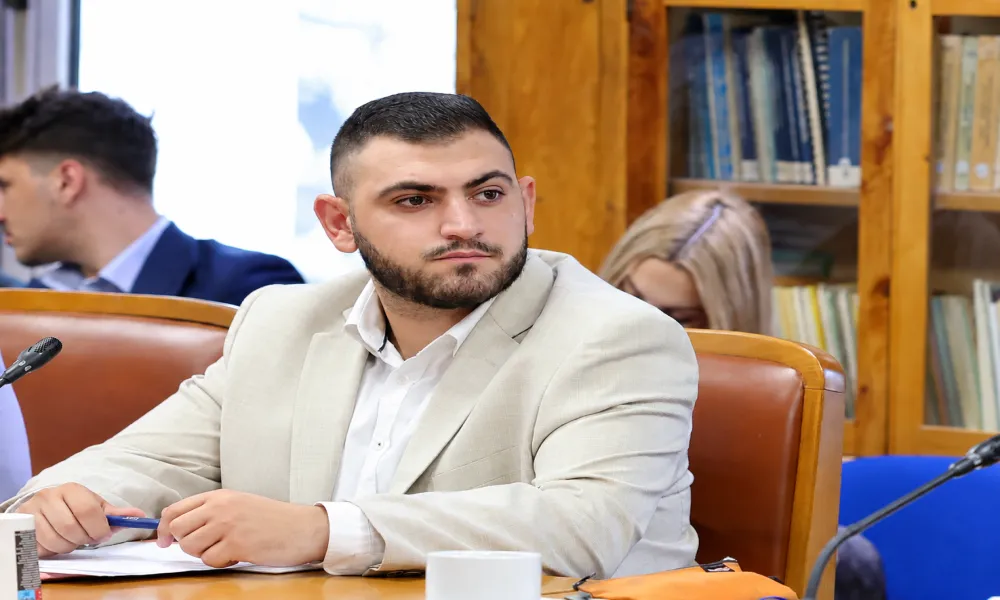
At 24, Efrem Christou became the youngest member of the new House of Representatives. His journey began in a coffee shop in the Limassol mountains and through a connection with tradition that helped him win support from voters much older than himself. From the villages of mountainous Limassol, he now brings to parliament problems that, as he says, have remained stuck in government announcements for years.
How did you decide to run for office?
At first, I did not want to run. It was not something I had planned. Candidates from other parties had already begun campaigning when AKEL approached me. I was cautious about the initial proposals.
However, it is difficult to say no when a party with a hundred years of history asks you to stand as a candidate at the age of 23. It is a great honour. I was not so interested in the result as I was in offering something.
Your candidacy also inspired many older people, who expressed pride in seeing such a young person on the ballot. How do you explain that?
When a party places a young person on its ballot, it mainly thinks about the impact on younger voters. That was also true in my case, given that I was already president of the students' union at university and worked extensively with videos and modern forms of communication.
But I had something special with older people. I grew up in a traditional coffee shop where I was in daily contact with elderly people. I also appeared at traditional events whose audiences were mainly older. I remember elderly people saying that what we were doing for the youth was something they wanted to see brought into the party as well.
Far right
We are seeing a rising far right, particularly among young people, with the internet and algorithms playing a role. Does that concern you?
It concerns me greatly.
I now observe things from the inside, at the moment they are being discussed, and before I even get home I see propaganda being spread that is one hundred per cent false.
There is a comfort with lying. Not just distortion, lies. They repeat them so many times that they make them appear true, and often they even reach people within our own political camp.
It is dangerous because it brings xenophobia, fanaticism and division. And when things escalate, their goal, like that of their ideological predecessors, is to eliminate the Left in Cyprus.
We have nothing personal against anyone and we may agree on a practical everyday issue. But we know that at the first opportunity they will attack us, distort what we say and seek to erase us.
How should the Left respond?
Our own message must reach the public as well.
Social media have become filled with fake accounts, while some people also speak openly under their own names, using false evidence and now even artificial intelligence.
Against this swamp, we must always put the truth first.
Just as our newspaper once had to go from house to house, now our posts must go from wall to wall.
We should not forget that AKEL is now the only party opposing the far right. The other parties, perhaps because of the presidential elections, perhaps because they have more in common with it than they admit, are rolling out the red carpet for it.
Israel and Cyprus
AKEL strongly objects to the close relationship with Israel. Where do you see the problem?
From a young age, I learned that I live in a country where a stronger power came and occupied half our homeland by force.
How can I, as someone from a half-occupied homeland, whose only weapon is international law, support another occupier simply because it is not called Turkey but Israel?
How can I say that an occupier that violates international law from morning until night is in my country's interests?
They respond by saying that the Christofias government also had relations with Israel. We are not saying that we should shut the door on anyone.
As a country, however, we have closed doors to others and tied ourselves to the ship of the West.
But when a state behaves in this way, I cannot support it, nor can I bring a parliamentary friendship group into the House to defend it.
Are you optimistic about the Cyprus issue?
I am not very optimistic.
When years have passed without meaningful negotiations, it is difficult to rebuild the ground that has been lost.
Personally, I believe the choice is between a solution and partition, and partition does not serve us. It serves Turkey.
AKEL is often accused of ideological rigidity, but the Cyprus issue shows that we do not have such rigidities.
We are not speaking about a solution that would come from the Soviet Union. We are talking about a solution that serves the interests of our homeland based on today's realities.
AKEL is making a comeback
Ahead of the presidential election, do you see cooperation with other forces for an administration that prioritises a solution?
We certainly need to unite all those who want change.
But first we must define what kind of change we want.
We want the centre-right Christodoulides government to leave office, but not so that it can simply be replaced by a Democratic Rally administration.
The candidate must be prepared to take initiatives on the Cyprus issue and change the economic situation so that people, and not only the numbers, can prosper again.
Numbers mean nothing when we are falling behind in education, healthcare and public transport.
Among people on the Left there is confidence that AKEL is returning.
Mountainous Cyprus
What is it like for a young person with left-wing roots to live in a more conservative society such as mountainous Limassol?
The countryside may deprive you of many things, but it offers a healthy environment.
I would not describe it as conservative. I would describe it as traditional.
What are the area's main problems?
One major issue, which we have highlighted again and which Politis had also highlighted in the past, is the registration of roads.
If a road is not officially registered, you cannot build and you cannot move forward. Either you break the law or you abandon your plans.
I submitted a parliamentary question and was told that this is the procedure and that regulations exist.
What was not answered was whether there is any intention to modernise the system, even though a road may take twenty years to be registered.
The other problem is the road network.
In July, we received commitments from the Ministry of Transport that tenders would be announced in October. However, in the Transport Committee we do not see budget allocations to continue the studies.
How will the next phase proceed if we remain at the level of announcements?
There is also healthcare.
Although called a hospital, the Platres Hospital effectively operates as a clinic, seven hours a day, Monday to Friday.
It serves around 30 villages as well as tourists visiting the area, yet no upgrade is provided for in the budget.
Schools in rural areas are also often neglected.
In addition, every increase in petrol or heating oil prices places a much heavier burden on people living in mountain communities.
Which issue would you like your name to become associated with?
For now, the registration of roads.
I highlighted the issue during the election campaign and brought it back into the public debate.
The delays certainly disappoint me.
Some delays are understandable, others are not.
An MP exercises parliamentary oversight and applies pressure, and that pressure escalates depending on the answers received.
If I see that a genuine effort is being made, I will also do whatever I can to help bring about change.
How can public trust be won back?
I try not to lose contact with people and, above all, to listen to what concerns them.
That connection, together with consistency in one's actions, can restore people's trust.
Credibility, in essence, is consistency.