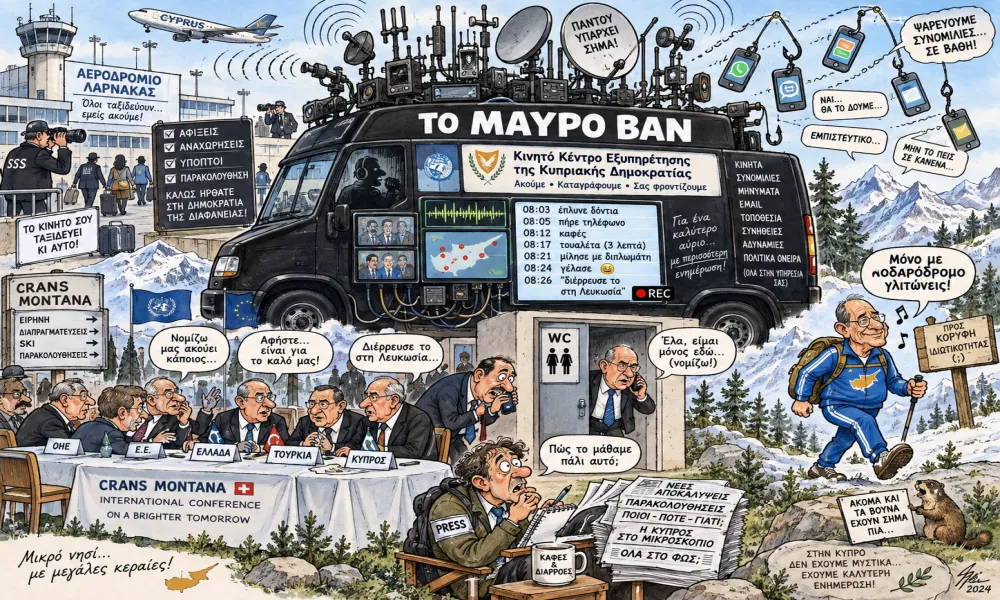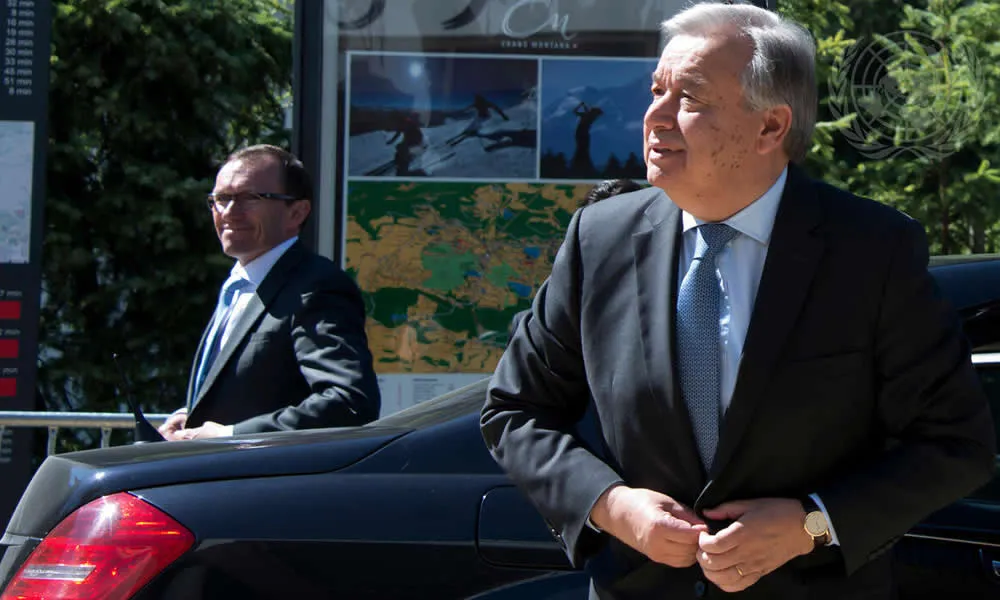

The early hours of 7 July 2017, at the final dinner in Crans-Montana, marked a moment that could have changed the course of the Cyprus issue. Antonio Guterres attempted to table a strategic document for a settlement, but was ultimately restrained at the last minute by Greek Cypriot leader Nicos Anastasiades and Turkey’s then foreign minister Mevlut Cavusoglu.
Guterres had sensed a historic opportunity and sought to ‘lock it in’ through a framework agreement, having already tested the limits of all parties. Instead, he encountered an atmosphere at odds with any genuine desire for resolution. Taken by surprise, and arguably lacking experience in such a moment, he declared a deadlock. The talks collapsed, participants departed hurriedly, and only then Turkish Cypriot leader Mustafa Akinci remained in the empty room.
A critical step missing
Cyprus is drifting towards the cliff edge of partition. Guterres has been engaged with the Cyprus issue for nearly 10 years but has not taken the decisive step to act as a fully fledged mediator.
There is now widespread discussion that he is trying to overcome precisely this limitation: how to present a concise, binding document of three to four pages without provoking the parties into walking away.
The process is formally ‘Cypriot-owned’, meaning that any such move requires prior consent from the sides. The UN’s leverage to secure that consent is limited.
His personal envoy, Maria Angela Holguin, is currently on mission. She has already held separate meetings, twice, with President Nikos Christodoulides and Turkish Cypriot leader Tufan Erhurman. Her itinerary includes Greece and Turkey, followed by London and Brussels.
Guterres is drawing on public statements by both sides that they are willing to resume talks from where they left off in Crans-Montana. Yet key ambiguities remain. Christodoulides has never clarified exactly where negotiations collapsed and favours a process without a deadline. Erhurman insists that if talks fail again, the side responsible must bear a cost.
Turkey remains a decisive actor. President Recep Tayyip Erdogan is reported, somewhat paradoxically, to have given Guterres a green light to convene a new informal five-party conference aimed at laying the groundwork for a settlement.
That settlement is understood as a bizonal, bicommunal federation: a single state with federal reunification, two constituent entities with internal autonomy, and the whole island within the EU. However, Erdogan appears to demand a result: otherwise, Ankara wants a clear outcome that closes the Cyprus chapter on its own terms.
Responsibility and choices
The broader international environment is marked by conflict, instability and risk. In reports to the UN Security Council, Guterres has repeatedly indicated that the Cypriot sides circulate without progress, devising ways to avoid reaching an agreement, despite the fact that all essential elements were already on the table at Crans-Montana.
Christodoulides, a central figure in those talks, acknowledged in an interview with the Financial Times on 11 November 2025: “We came very close. If we start from where we left off, it is possible.”
That admission places responsibility squarely on him to take key decisions.
Guterres is reportedly pressing several core questions to all parties:
First, a firm commitment to the extensive body of convergences already recorded by the UN. There is no reason to reopen them.
Second, authorisation for the UN chief to present a framework for final negotiations.
Third, agreement on a process for a strategic accord and a roadmap towards a referendum.
If these intentions are confirmed, Guterres is aiming to recover lost ground quickly. But this cannot be achieved through any ‘magic wand’, especially in the face of resistance.
Distortions and missed focus
In recent years, there has been a distortion of key aspects of the Cyprus issue. Security matters at Crans-Montana, including the abolition of Turkey’s unilateral right of intervention, were central. Why, critics ask, have these been sidelined by the Greek Cypriot leadership?
Instead, attention has shifted to what are described as unclear counter-proposals on power-sharing.
Public scepticism is fuelled when political discourse downplays the tangible benefits of a settlement, including territorial adjustments, property restitution and EU funding for reunification. In contrast, emphasis is placed on hypothetical energy projects and new geopolitical alignments.
One significant factor is Turkey’s strong interest in resetting its relationship with the EU, including customs union upgrades, visa liberalisation, accession prospects and defence cooperation.
Cyprus stands to benefit from such developments, but the key question remains how they are linked to the substance of the Cyprus issue. While Christodoulides appears to recognise the momentum, he has not clearly articulated whether it will be directed towards a genuine settlement or diverted into partial measures that risk derailing the process.
A climate of scepticism
Public reaction to talk of a new initiative remains muted. On the island, pro-government media narratives often invoke fears of ‘imposed solutions’ or concessions to Turkey, shaping a climate that discourages substantive debate.
In this environment, the challenge for Guterres is not only diplomatic but also political: to create conditions where a serious discussion on a comprehensive settlement can take place.
Whether he can do so without triggering another collapse remains uncertain.