
The Libyan House of Representatives' decision to ratify the Turkey-Libya maritime agreement has reignited disputes over maritime jurisdiction in the Eastern Mediterranean, drawing objections from Greece, Cyprus, Egypt and the European Union.
According to a report by Spanish newspaper El País, the rapprochement between Ankara and the camp of eastern Libyan strongman Khalifa Haftar has been driven not only by geopolitics but also by expanding economic cooperation, investment projects and political calculations.
Concerns for Cyprus and the Great Sea Interconnector
The report notes that the renewed dispute could complicate major infrastructure projects planned for the region.
Among them are the proposed EastMed gas pipeline and the Great Sea Interconnector, the electricity cable project linking Israel, Cyprus and Greece.
According to El País, disagreements over maritime boundaries could affect projects crossing areas claimed by both Greece and Cyprus as part of their continental shelves, while Turkey contests those claims.
The newspaper also notes that Cyprus remains the only EU member state not connected to the European electricity grid.
It further recalls Turkey's warning earlier this month that any cable-laying, pipeline construction or scientific research in areas Ankara considers part of its continental shelf should take place only after coordination with Turkish authorities.
Growing ties between Ankara and Saddam Haftar
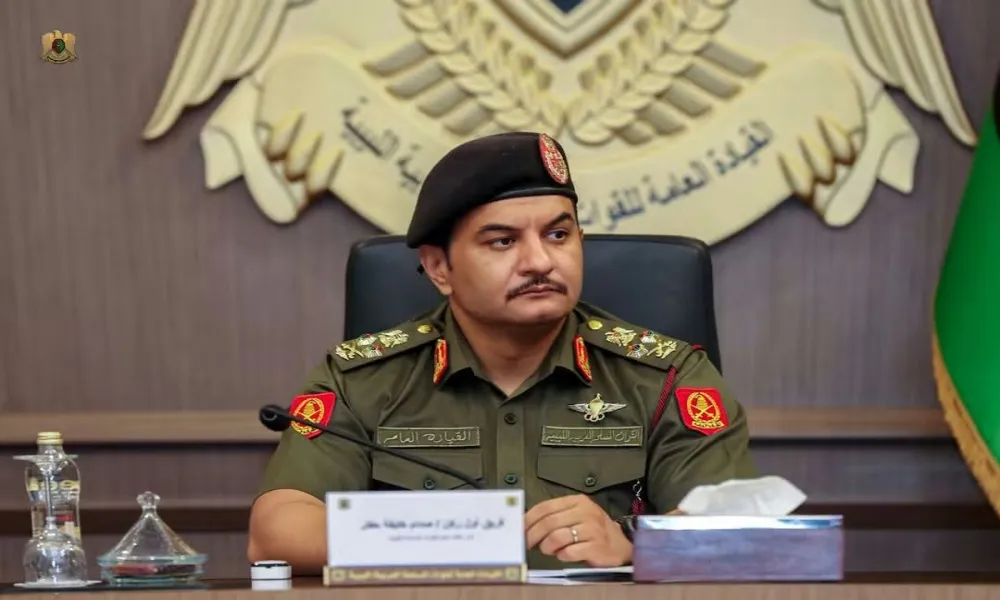
A significant part of the report focuses on the relationship between Turkey and Saddam Haftar, son of Khalifa Haftar and one of the most influential figures in eastern Libya.
According to the newspaper, Saddam Haftar has held at least seven meetings with senior Turkish political and military officials over the past 18 months, either in Libya or in Turkey.
Among those he reportedly met were Turkish Defence Minister Yasar Guler and intelligence chief Ibrahim Kalin.
The contacts are particularly notable given that Turkey previously supported the Tripoli-based government against Khalifa Haftar's forces during Libya's civil conflict.
Scrap metal and steel investments
The report argues that commercial interests helped pave the way for political rapprochement.
According to previous El País investigations, increased exports of scrap metal from eastern Libya to Turkey became an important channel of economic cooperation.
Scrap metal is a key raw material for Turkey's steel industry, which relies heavily on recycled material.
The newspaper also highlights the role of Turkish steel giant Tosyali, which is constructing a direct-reduced iron production facility in Benghazi in partnership with Libya United Steel Company.
According to the report, the chairman of the Libyan company is linked to the Haftar family, while the planned facility is expected to become the largest of its kind in the world.
Presidential ambitions
The article also links the ratification of the maritime memorandum to Saddam Haftar's broader political ambitions.
Libyan analyst Anas El Gomati, quoted by the newspaper, argues that Saddam Haftar is seeking Turkish political and military backing as part of a wider effort to position himself as a future president of Libya under a possible internationally mediated reunification process.
The report notes that the recently elected parliamentary speaker Salehin Abdul Nabi, who advanced the ratification process, is considered close to Saddam Haftar.
His predecessor, Aguila Saleh, had maintained close relations with Egypt and opposed the Turkey-Libya agreement.
According to El Gomati, ratifying the memorandum gives Ankara a strong incentive to continue supporting Saddam Haftar's political rise.
European and regional reaction
The ratification has triggered criticism from several regional actors and EU institutions.
European Commission President Ursula von der Leyen reportedly rejected the agreement, arguing that it violates the sovereign rights of third countries and is inconsistent with the law of the sea.
She also reiterated the EU's support for Greece and Cyprus.
EU foreign policy chief Kaja Kallas called on all parties to respect the sovereign rights of EU member states in line with international law.
The report notes that Turkey is not a signatory to the United Nations Convention on the Law of the Sea (UNCLOS) and rejects the Greek interpretation regarding the effect of islands in maritime boundary delimitation.
Meanwhile, Greek Foreign Minister Giorgos Gerapetritis announced renewed discussions with Egypt on extending eastward the maritime delimitation agreement signed between the two countries in 2020.
Turkish Foreign Minister Hakan Fidan, for his part, defended the Turkey-Libya agreement, describing it as fully legitimate from both a legal and political perspective.
The report also notes criticism from Israel, whose foreign ministry accused Turkey of contributing to instability in the Eastern Mediterranean.