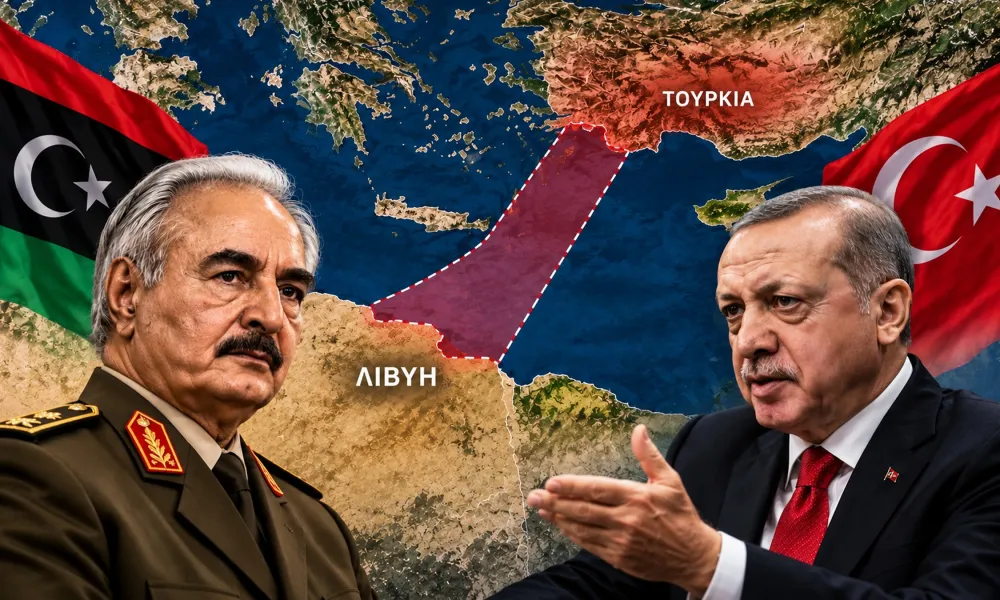

New geopolitical dynamics are emerging in the Eastern Mediterranean following the decision by Libya's House of Representatives to ratify the 2019 Turkey-Libya maritime memorandum, with international reports highlighting Greek efforts to block the move and speculation about possible US involvement in Turkey's growing ties with eastern Libya.
According to a report by journalist Sean Mathews in Middle East Eye, published on 20 October, the Greek government sought in the days leading up to the vote to mobilise regional allies in an effort to prevent ratification by the parliament based in eastern Libya.
Citing multiple regional officials, the report says Athens approached Egypt, Israel and the United Arab Emirates, all countries that maintain relations with the camp of Field Marshal Khalifa Haftar and have cooperated with Greece on regional security issues.
Those efforts ultimately failed, as the Libyan parliament approved the agreement on Tuesday, reversing the position it adopted in 2020, when it rejected the memorandum and severed political ties with Turkey.
Reports of possible US-Turkey coordination
The Middle East Eye report also raises questions about the possible role of the United States in recent developments.
According to an unnamed Libyan source cited in the article, ratification of the memorandum forms part of a broader effort aimed at Libya's political reunification, in which the administration of Donald Trump and Turkey are said to share common interests.
The same source claimed Washington is seeking to utilise Ankara's influence to facilitate understanding between Libya's rival centres of power in Tripoli and Benghazi.
The claim is notable because Turkey, which backed the Tripoli government during Libya's civil conflict, has in recent years developed closer relations with eastern Libya as well.
The allegations of US-Turkish coordination, however, rely on anonymous sourcing and have not been officially confirmed by either Washington or Ankara. As a result, there is no evidence that the United States supported the memorandum's ratification or reached any specific agreement concerning its content.
Why Greek efforts failed
According to the Middle East Eye analysis, Greece's diplomatic efforts were undermined by shifting regional priorities.
Although Egypt maintains close relations with Greece and longstanding links with eastern Libya, Cairo has rebuilt channels of communication with Turkey in recent years.
Similarly, the United Arab Emirates has pursued rapprochement with Ankara, while Israel is viewed as assessing developments in Libya through the prism of its own strategic interests and the political ambitions of Saddam Haftar.
Haftar camp's shift towards Ankara
The Libyan parliament's decision carries additional significance because it comes from the political camp that was once Turkey's principal rival in Libya.
As noted by Reuters, the ratification represents a major reversal by eastern Libya, while the replacement of long-serving parliamentary speaker Aguila Saleh, considered a close ally of Egypt, helped pave the way for the policy shift.
Anas El Gomati, head of the Sadeq Institute, said the decision reflects the depth of current relations between Ankara and Benghazi.
Meanwhile, analyst Jalel Harchaoui of the Royal United Services Institute argued that the development could open the door to an expanded Turkish military presence in eastern Libya.
Saddam Haftar, son of Khalifa Haftar and deputy commander of his forces, welcomed the move, describing the agreement as a tool for protecting Libya's economic interests in the Mediterranean.
Implications for Greece and Cyprus
The development has raised concern in Athens because support for the memorandum now comes from both of Libya's principal power centres.
It has also revived discussion of possible Greek responses, including extending territorial waters south of Crete to 12 nautical miles.
The decision coincides with preparations to resume work linked to the Great Sea Interconnector, the planned electricity connection between Greece and Cyprus, a project that has faced delays amid disputes with Turkey over maritime jurisdiction.
According to Reuters on 15 October, US Secretary of State Marco Rubio expressed support for the project and said Washington was prepared to use diplomacy to help address any obstacles.
While this position has attracted attention when viewed alongside reports of possible US-Turkish coordination in Libya, it does not constitute evidence of a change in US policy regarding the interconnector or acceptance of Turkey's maritime claims.
EU, Greece and Cyprus reject the move
The decision prompted a strong response from the European Union, Greece and Cyprus.
In a joint statement, European Commission President Ursula von der Leyen and European Council President António Costa said the memorandum violates the sovereign rights of third states, contravenes the law of the sea and remains null and void, while reaffirming European solidarity with Athens and Nicosia.
The Greek Foreign Ministry likewise rejected the move, arguing that Turkey and Libya do not possess opposite or adjacent coastlines that would justify the maritime delimitation contained in the agreement.
Cyprus also condemned the ratification, maintaining that the memorandum disregards islands' rights to maritime zones and produces no legal effects for third states.
Following the decision, Greek Foreign Minister George Gerapetritis spoke by telephone with Cypriot Foreign Minister Constantinos Kombos, while also holding consultations with Egyptian Foreign Minister Badr Abdelatty.
Metsola voices support
Addressing the European Parliament plenary session, European Parliament President Roberta Metsola expressed solidarity with Greece and Cyprus.
“Greece and Cyprus can rely on our solidarity,” she said, referring to the joint statement issued by Costa and von der Leyen.
Turkey welcomes ratification
Ankara welcomed the Libyan parliament's decision, with the Turkish Foreign Ministry arguing that the agreement safeguards the mutual rights and interests of both countries in line with international law and equitable principles.
Turkish presidential communications director Burhanettin Duran described the ratification as an important step in strengthening bilateral relations and said Turkey would continue defending its interests within the framework of the "Blue Homeland" doctrine under President Recep Tayyip Erdoğan.
According to Anadolu Agency, Turkish Foreign Minister Hakan Fidan also held separate telephone conversations with Tripoli-based Prime Minister Abdul Hamid Dbeibeh and Saddam Haftar, thanking them for the memorandum's approval and underlining Ankara's growing engagement with both sides of Libya's political divide.