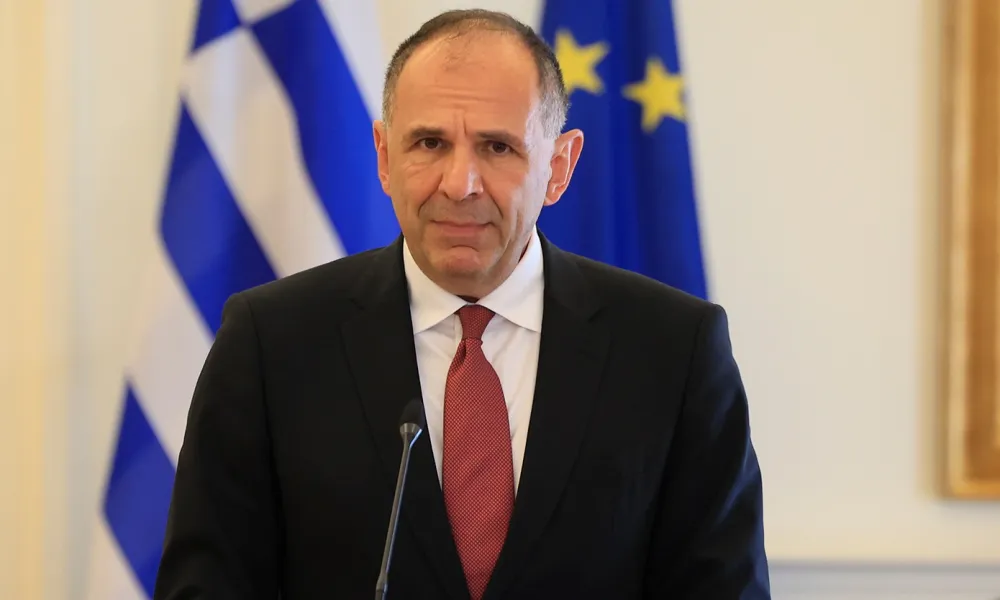

Greece's planned electricity interconnection with Cyprus will proceed along its existing route and there is "absolutely no reason whatsoever" to redraw the course of the cable, Greek Foreign Minister George Gerapetritis said on Tuesday.
Speaking to SKAI radio, Gerapetritis dismissed reports suggesting the route of the Great Sea Interconnector (GSI) could be altered because of Turkish maritime claims.
He noted that the route passes through non-delimited maritime zones.
"It passes through maritime zones that have not been delimited. Where Turkey considers it has sovereign rights, we consider, and this is the correct interpretation under the International Law of the Sea, that it passes only through the Greek continental shelf and therefore the prescribed procedures will be followed."
Referring to media reports, he said the route "never passed and does not pass today through the 'Turkish marine parks'. Therefore, it would in practice not be possible for any change to be made. If something does not intersect, why would you change it?"
"Anyone raising this issue could, by simply looking at the map, see that the route passes much further south, dozens of miles south of the 'Turkish parks'. Therefore, there is absolutely no reason whatsoever for a rerouting."
He added: "The energy map of Greece is not determined by anyone's ambitions, vanity or delusions. We are pursuing an energy plan based on the country's energy diversification."
Gerapetritis said the project would be licensed by Greece in accordance with international law and that Ankara could be informed through established maritime procedures but would not be involved in the permitting process.
"Permission will be granted only by Greece," he said.
Sovereignty issues not up for discussion
Turning to relations with Turkey, the minister said Turkey had spent decades promoting doctrines such as the "Blue Homeland", "grey zones" and demilitarisation.
"We would be completely unrealistic to believe that, because we launched a structured dialogue, Turkey would suddenly have different views on these issues. What we did say, however, is that in an era of geopolitical instability, you would have to be truly crazy to keep banging your fist on the table when you can build a functional relationship that prevents further crises," he said.
He argued that dialogue did not imply concessions on longstanding disputes, including maritime boundaries and sovereignty issues.
He argued that Greece's current policy was consistent with that pursued by successive Greek governments and pointed to the extension of territorial waters and maritime agreements with Italy and Egypt as examples of strengthening national positions.
"Greece has grown over the past eight years. It expanded its territorial waters, which means a larger territory. It concluded Exclusive Economic Zone agreements with Italy and Egypt."
He added that extending territorial waters to 12 nautical miles remained an available option.
Gerapetritis said Greek foreign policy was no longer defined by Turkey's actions.
Greece-Israel relations
Addressing relations with Israel, he said Turkey viewed Greek-Israeli ties as being directed against Ankara.
"The answer, however, is very clear. First, we do not bargain over whom we make agreements with. The way we procure our defence equipment concerns no country other than Greece. Second, the way we develop Greece's defence force structure is a matter of sovereignty and is not up for discussion."
Cyprus participation essential for regional conference
On proposals for an Eastern Mediterranean conference, Gerapetritis said Cyprus' participation was a prerequisite for any such meeting.
"A non-negotiable condition for any multilateral meeting is the participation of Cyprus," he said.
"To the extent that Turkey does not accept or cannot accept Cyprus' participation, it is obvious that such a meeting cannot take place."
The minister also said he saw no immediate prospect of wider regional normalisation in the Middle East, describing current negotiations as a difficult process requiring a "dignified exit" for all sides.
On energy security, he said Greece had invested heavily in infrastructure and diversification and faced no immediate supply concerns.
"Greece currently faces absolutely no issue of energy adequacy," he said, while acknowledging that rising global prices continued to put pressure on consumers.
Source: AMNA