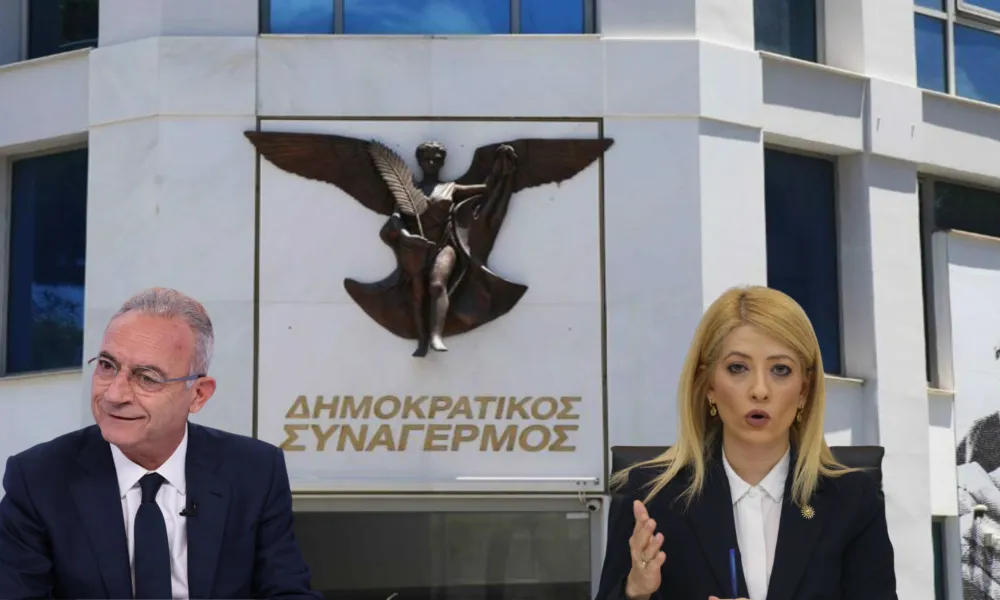



The former ruling party, Democratic Rally (DISY), has formally entered campaign mode after setting a timetable for selecting its candidate for Cyprus's 2028 presidential election, with party members due to choose the nominee on 14 November.
The schedule, announced on Monday following a meeting of the party's Executive Bureau, marks the beginning of an internal campaign that is expected to dominate DISY politics over the coming weeks. Nominations will be submitted on 13 October, leaving candidates with a month to campaign before the vote.
The timeline also increases pressure on former party leader Averof Neophytou, who has yet to clarify whether he will seek the nomination through the party's internal process. Senior party figures have meanwhile warned that prolonged infighting risks damaging DISY and strengthening AKEL's prospects ahead of the next presidential election.
The Executive Bureau decided to recommend the timetable to the Political Bureau, which is due to meet on 2 October. Under the proposal, nominations will be submitted on 13 October between 9am and 12:30pm, while the vote will take place on 14 November between 9am and 6pm.
Who can vote and who can run
The most significant change is that the party's presidential nominee will be selected directly by the wider membership.
According to the Executive Bureau, DISY is opening the process to all eligible party members for the first time in its history. The party described the move as "unprecedented by Cypriot political standards" and said it would ensure the process is conducted in full accordance with party rules.
Under party statutes amended in February 2025, the presidential nominee will be elected by party members at an Extraordinary Nationwide Electoral Assembly.
Eligible voters must be registered party members who are also entitled to vote in presidential elections. They must have been included in the party's membership register at least 90 days before the ballot and have settled their financial obligations to the party. With the vote scheduled for 14 November, the membership cut-off falls in mid-August.
Requirements for candidacy are more demanding. Prospective candidates must submit a signed list of 500 supporters with voting rights, distributed proportionally across the districts. The list must also include at least 100 members of the party's Supreme Council.
Call for unity
The Executive Bureau called on all prospective candidates to publicly commit to respecting the outcome of the vote and actively supporting whoever is chosen as the party's nominee.
It also urged contenders to show "prudence, responsibility and respect for the history of the party" and to avoid statements or actions that undermine rivals or question their commitment to DISY's principles.
Party leader Annita Demetriou was not present during the discussion. Diplaros said that although she was under no obligation to leave the meeting, she chose to do so in order to allow members of the Executive Bureau to express their views freely.
Under the party constitution, the Political Bureau is responsible for convening the electoral assembly and overseeing procedural matters, including the timetable and ballot papers. It also has the authority to exclude candidates who breach party regulations or engage in unethical conduct during the campaign. Rules governing candidates' behaviour are set by the Supreme Council.
The field takes shape
So far, Demetriou has confirmed she will seek the nomination, while DISY MP Giorgos Pamboridis has also expressed interest.
Neophytou, who was the first political figure to announce a bid for the presidency, remains the race's biggest unknown. During a press conference on Monday, he repeatedly declined to say whether he would participate in the internal contest, insisting only that he would make his position known "when the time is right".
The ambiguity gives Neophytou additional political flexibility, but the new timetable leaves limited scope for prolonging the uncertainty. With the process now formally under way, attention is likely to shift from public statements to political positioning.
The announcement comes amid growing unease within the party.
DISY vice-president Savia Orfanidou appeared emotional during an appearance on Omega TV's Enimerosi Tora, expressing disappointment over the public confrontation and warning that internal divisions could pave the way for AKEL's return to power.
"For me, that is unacceptable," she said, calling on Neophytou to make clear that he intends to seek the nomination through the party process, "as befits a former party president".
A different view was offered by fellow vice-president Yiannis Karousos. Speaking to Politis Radio, he said he believes Neophytou's participation in the internal contest is effectively certain, while stressing that this was his personal assessment rather than information received directly from the former leader.
Karousos also called for tensions to ease, arguing that the wounds of 2023 must be allowed to heal. He added that Neophytou had experienced what he described as a "political coup" that year.
Neophytou attacks party leadership
At Monday's press conference, Neophytou sought to shift the focus from procedural questions to the political message behind his candidacy.
Referring to recent remarks by UN envoy María Ángela Holguín that the window of opportunity on the Cyprus issue is narrowing, he said his political priorities were "the reunification of our homeland and a just society", arguing that "great visions cannot flourish in a divided homeland".
He criticised the government's handling of the Cyprus problem and what he described as growing social inequality. He also directed criticism at his own party, accusing DISY of acting as a "silent coalition partner" of the government for the past three and a half years.
In one of his sharpest remarks, Neophytou argued that DIKO leader Nikolas Papadopoulos had publicly distanced himself from the government more often than DISY, a clear challenge to the party's current political direction.