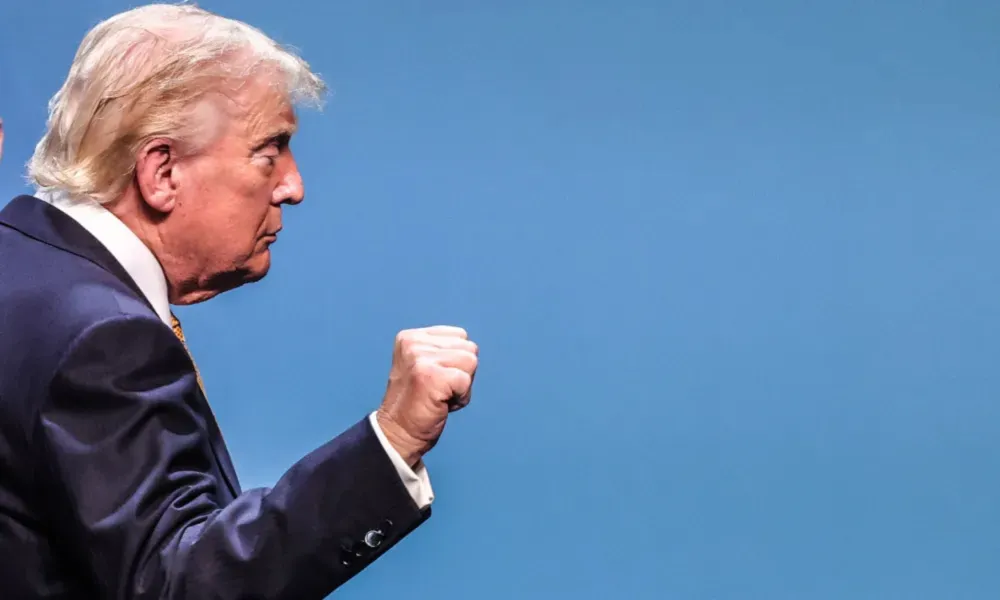

US President Donald Trump used a surprise phone call with Nvidia Chief Executive Jensen Huang to reject growing calls for stricter artificial intelligence safeguards, declaring that fears of AI-driven catastrophe were a "hoax". He argued that the United States must not slow development as it competes with China.
The exchange took place on Monday during the All-In Summit in Los Angeles, where Huang was speaking on stage before an audience of technology executives and investors. Huang put Trump on speakerphone, allowing attendees to hear the conversation live. According to international media such as The New York Times, AP, and TechCrunch, the incident came amid a deepening split within the technology industry over how quickly advanced AI systems should be developed.
"The robots will not be taking over the world. That's not going to happen," Trump said during the call. "The data centres are great, and they make people wealthy, and they make states wealthy."
Trump pushes back against AI safety concerns
Trump's intervention followed growing calls from some AI researchers and executives for a slower rollout of increasingly powerful AI systems. Anthropic Chief Executive Dario Amodei argued over the weekend that companies should reduce the pace of frontier AI development and strengthen safeguards, a position that drew support from OpenAI's Sam Altman and Tesla chief Elon Musk.
The president dismissed such concerns, linking opposition to rapid AI expansion to geopolitical competition with China.
"They're just playing right into the hands of a lot of people that don't want to see it happen," Trump said. "That could be political people, and also China."
'AI is the new oil'
Trump has increasingly portrayed AI and the data centres powering it as strategic national assets. During the call, he described data centres as "the oil of the next 20, 25 years" and reiterated his opposition to additional federal regulation of the sector.
Huang, whose company sits at the centre of the global AI boom due to demand for Nvidia's advanced processors, broadly aligned himself with the view that safety concerns should not lead to a slowdown in development. During his appearance at the summit, he argued that predictions of AI causing human extinction or taking over society lacked a scientific basis, while maintaining that AI safety remains important.
"I think the whistleblowing is fine. I think the scientific prediction about the future is less fine because it's not grounded on science, obviously," Huang said.
The public exchange underscores a widening divide within the AI industry. On one side are executives and researchers warning that increasingly capable AI systems may require stronger oversight and safety controls. On the other are figures including Trump, Huang and several major technology investors who argue that excessive caution could undermine US leadership in a field increasingly viewed as critical to economic and national security.
The dispute comes as governments and companies worldwide race to build data centres and computing infrastructure needed to support next-generation AI models, with competition between the United States and China at the centre of policy discussions.
Sources: The New York Times, Associated Press, TechCrunch, NBC News, CNBC.