
Serious allegations surrounding IVF treatment in the north have been uncovered by a new BBC investigation, which reports that at least 30 children may have been conceived using different sperm or egg donors from those chosen by their parents.
Eleven children who underwent DNA testing were found to have genetic origins in Turkey or neighbouring countries, reinforcing families' suspicions that the donors they selected were not used.
At least 30 children, most of them British, may have been conceived through IVF treatments involving different sperm or egg donors from those chosen by their parents, according to the BBC investigation.
The report follows an earlier BBC investigation published in March that revealed the first seven similar cases.
Parents said they had selected anonymous donors based on information such as medical history, appearance, personality, education and interests. They later began to suspect that different donors had been used during their treatments.
According to the BBC, around half of the 30 cases are linked to the Doğuş IVF Centre in the north.
Eleven of the children have undergone commercial DNA testing, which indicated genetic ancestry from Turkey or neighbouring countries, strengthening concerns that the requested donors were not used.
Most of the children who were tested were conceived through IVF treatment at Doğuş between 2012 and 2024.
The families, the BBC reports, are still seeking answers about the true identities of the donors and their medical histories.
The case of the 13-year-old
Among the cases highlighted by the BBC is that of Rachel, who underwent treatment at Doğuş in 2012.
She had selected an anonymous Danish donor through Cryos International, identified by the pseudonym "Ditto".
The treatment cost approximately €4,000 and, according to Rachel, included sperm supplied by Cryos.
However, after the birth of her son Jonah, she began to doubt whether that donor had actually been used, as the boy's appearance differed significantly from the characteristics listed in the donor profile.
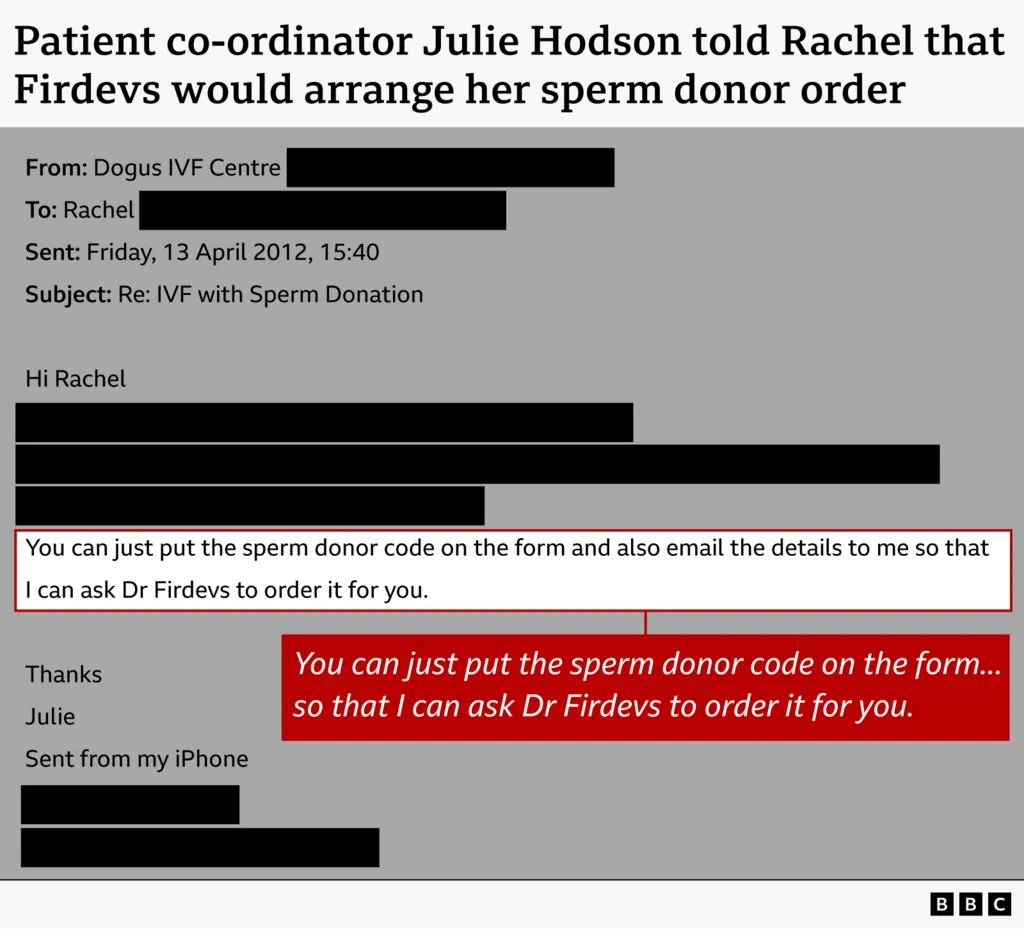
Thirteen years later, DNA tests carried out by Rachel and her son confirmed, according to the BBC, that Jonah is her biological son, but that the Danish donor in question is not his biological father.
The BBC contacted Cryos, which said it had no record of ever delivering sperm to the Doğuş IVF Centre, despite the clinic advertising a relationship with the sperm bank for years.
"Serious indications of negligence or deception"
Fertility experts who reviewed the investigation's findings described the possibility that 30 children could be affected as particularly troubling.
According to the BBC, the use of the wrong donor during IVF treatment is considered an extremely rare occurrence and repeated incidents of this kind could point to "negligence" or "deception".
The British Fertility Society referred to a possible systemic problem that extends beyond a single doctor or clinic.
The BBC links 15 of the cases to Doğuş.
Three clinic employees appear repeatedly in the allegations:
- Dr Şevket Altürk, owner and managing director of the clinic
- Dr Firdevs Uğuz Tip
- Julie Hodgson, patient coordinator
Altürk did not respond to the BBC's questions.
Uğuz Tip denies any wrongdoing and argues that Altürk was responsible for approving procedures.
Hodgson also did not respond to enquiries from the broadcaster.
Cryos blacklisted the clinic in 2016
One of the most significant revelations of the investigation concerns Cryos International, the world's largest sperm bank.
The company told the BBC that it had placed Doğuş on a "blacklist" as early as 2016 after discovering that the clinic had not ordered sperm for a patient despite informing her that it would do so.
Cryos also told the BBC that it has now suspended cooperation with Firdevs Uğuz Tip and the Miracle IVF Clinic until an investigation by authorities in the north is completed.
The health ministry in the north announced following the BBC's initial revelations that it had launched an official investigation. However, according to the broadcaster, it did not respond to repeated requests for updates on the progress of that inquiry.
Concerns over donor identity
The north has become a popular destination for British patients seeking fertility treatment abroad, with clinics promoting lower costs, high success rates and a wide choice of donors.
However, the BBC notes that European Union law does not apply there, while the area is internationally recognised as part of the Republic of Cyprus, with recognition of the Turkish Cypriot administration coming only from Turkey
For the families featured in the investigation, the issue extends beyond their children's ancestry.
It also concerns their right to know the true medical history of their biological donors and the possibility that unknown half-siblings may exist.
Rachel told the BBC that the revelation changes nothing about her love for her son, but worries her because he may have lost the opportunity to one day know his biological donor.
"I wouldn't be surprised if there are genetic siblings out there," she said.
Source: BBC