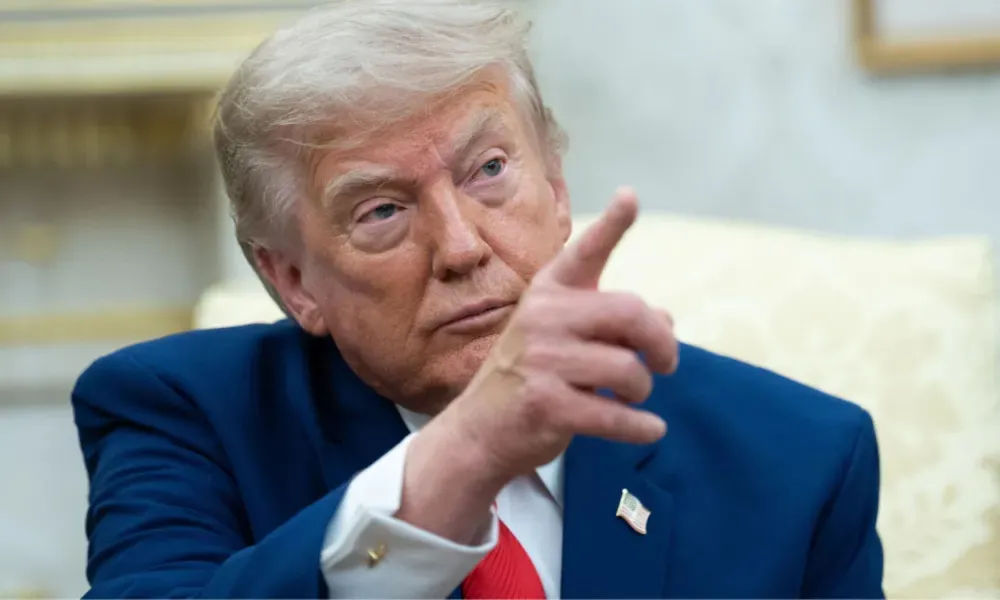



US President Donald Trump on Monday accused ExxonMobil and Chevron of making excessive profits from higher fuel prices and said the companies should return some of that money to the public, an unusual departure from his typically close relationship with the oil industry.
Speaking to reporters three days after both companies reported strong second-quarter earnings, boosted by oil prices kept high by the ongoing war in Iran, Trump made clear his frustration. "Chevron, too much money. ExxonMobil, too much. Too much money," he said, adding that he did not like the situation. Exxon and Chevron did not immediately respond to requests for comment, according to Reuters.
The comments continue a pattern in which Trump has used public pressure to try to shape corporate behaviour, often targeting individual companies through social media posts or remarks to reporters. During his first term he pushed automakers to keep production in the United States, criticised defence contractors over costs and urged pharmaceutical firms to lower drug prices. Since returning to office he has continued applying that kind of pressure informally, without always resorting to government action.
A public rebuke of Chevron's chief executive
Earlier on Monday, Trump singled out Chevron chief executive Mike Wirth over a weekend appearance on Fox News, criticising him for failing to credit the administration's role in supporting the oil industry. Writing on Truth Social, Trump said the industry and the country itself would have collapsed without his administration's leadership, and pointed to Chevron's return to Venezuela as evidence of the benefits his policies had delivered.
Chevron has operated in Venezuela for more than a century and remained in the country even after former president Hugo Chávez nationalised oil projects in 2007, a period during which ExxonMobil and ConocoPhillips chose to exit.
A spokesperson for the American Petroleum Institute, the trade body representing US oil companies, pushed back on the idea that any single company was responsible for the price rises, attributing current prices instead to global supply and demand and to ongoing uncertainty around the Strait of Hormuz and other key shipping routes, "not by any one company."
Tension between growth and price demands
Expanding US energy production has been a central pillar of Trump's agenda, and the industry has broadly welcomed his push for more drilling and higher output. At the same time, he has repeatedly urged producers to keep fuel prices down, a stance that sits uneasily alongside his encouragement of higher domestic production. On Monday he said companies needed to cut retail prices for consumers and predicted that oil prices would fall sharply once the conflict with Iran ends.
Rising fuel costs, driven by the war and broader cost-of-living pressures, pose a political risk for Trump ahead of November's midterm elections, in which Republicans are seeking to hold onto control of Congress. Retail petrol prices are currently averaging around $4.10 a gallon nationally, up more than 30% since the United States and Israel attacked Iran earlier this year. Global oil prices fell sharply after Trump called off a planned large-scale attack on Iran over the weekend, though pump prices typically take longer to follow suit.
Recent earnings from ExxonMobil, Chevron, Valero Energy and Marathon Petroleum underscored the extent to which US oil companies have benefited from higher crude prices and refining margins since the war began in February. Valero reported its strongest quarterly profit since the 2022 energy crisis triggered by Russia's invasion of Ukraine, while Chevron posted its highest quarterly earnings in at least six years.
Source: Reuters