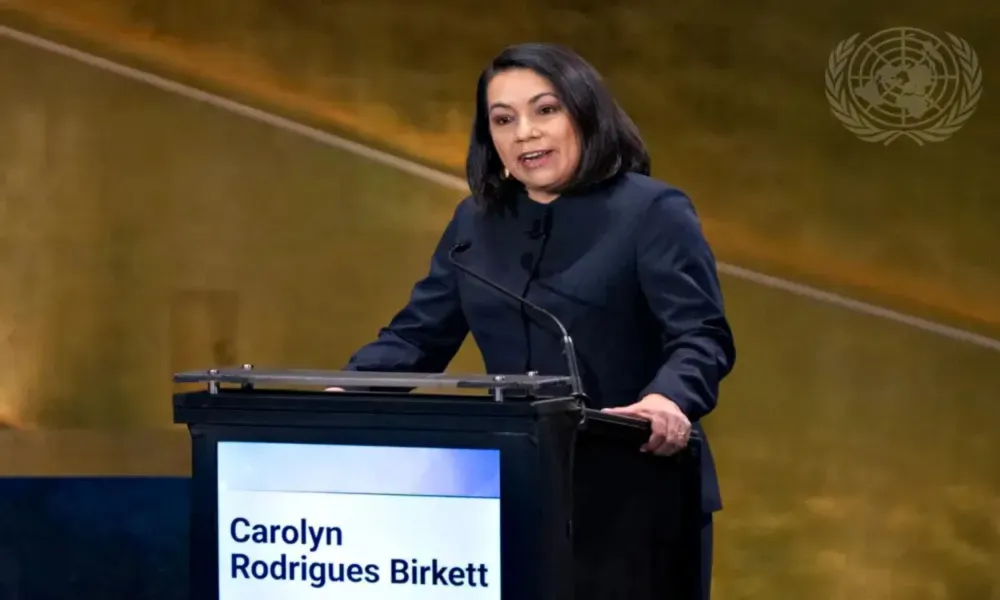

The race to succeed António Guterres as UN Secretary-General gained fresh momentum after the first public debate between the six candidates, held in the UN General Assembly Hall in New York.
The event gave the candidates an opportunity to present their positions on some of the most pressing challenges facing the United Nations today, including armed conflict, the climate crisis, UN financing and the need for institutional reform.
Attention focused on the impression each candidate left on the audience. Following the Town Hall meeting, participants took part in an electronic vote on which contender had been the most convincing.
Clear lead for Guyana candidate
The results produced a notable surprise.
Carolyn Rodrigues-Birkett of Guyana secured 49% of the vote, finishing well ahead of all her rivals.
The full results were:
- Carolyn Rodrigues-Birkett (Guyana): 49%
- Rebeca Grynspan (Costa Rica): 14%
- María Fernanda Espinosa (Ecuador): 10%
- Michelle Bachelet (Chile): 9%
- Rafael Grossi (Argentina): 9%
- Macky Sall (Senegal): 9%
Rodrigues-Birkett's advantage over the rest of the field was striking and suggests that her debate performance resonated strongly with those who took part in the event.
The experienced Guyanese diplomat adopted a measured but substantive approach, emphasising the need to strengthen the UN's credibility, build consensus and reinforce the Secretary-General's role as an independent mediator in international crises.
By contrast, Michelle Bachelet, regarded as one of the most recognisable figures in the contest, was unable to translate her international profile into comparable support in this process.
Rafael Grossi focused on international security and nuclear safety issues, while Macky Sall highlighted the importance of strengthening Africa's voice within the international system.
Both Rebeca Grynspan and María Fernanda Espinosa presented comprehensive proposals for reforming the United Nations, but neither came close to matching the support secured by Rodrigues-Birkett.
The six candidates
Michelle Bachelet (Chile)
- President of Chile from 2006 to 2010 and from 2014 to 2018.
- First Executive Director of UN Women.
- UN High Commissioner for Human Rights from 2018 to 2022.
- Considered one of the most experienced figures within the UN system.
María Fernanda Espinosa (Ecuador)
- Former foreign minister and defence minister.
- President of the UN General Assembly from 2018 to 2019.
- Diplomat known for her focus on UN reform and climate policy.
Rebeca Grynspan (Costa Rica)
- Former vice-president of Costa Rica.
- Former head of the Ibero-American General Secretariat (SEGIB).
- Secretary-General of UN Trade and Development (UNCTAD) since 2021.
Rafael Grossi (Argentina)
- Director General of the International Atomic Energy Agency (IAEA).
- Played a leading role in IAEA missions to Ukraine and Iran.
- Widely regarded as a leading expert on nuclear security and diplomacy.
Macky Sall (Senegal)
- President of Senegal from 2012 to 2024.
- Former Chairperson of the African Union.
- Advocates stronger representation of the Global South within the UN system.
Carolyn Rodrigues-Birkett (Guyana)
- Former foreign minister of Guyana.
- Permanent Representative of Guyana to the United Nations.
- Has extensive experience in negotiations within both the UN General Assembly and the Security Council.