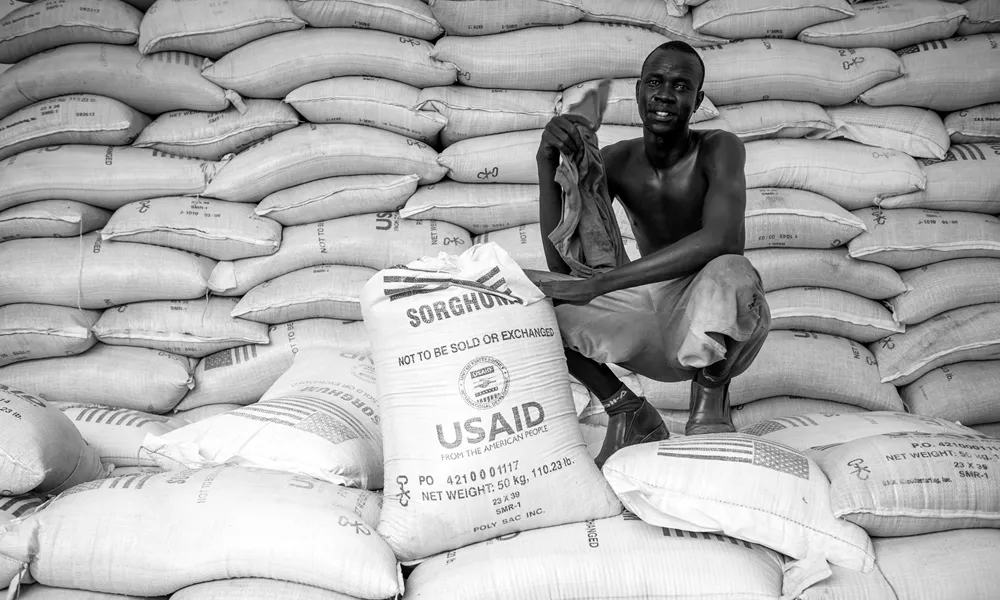



A year after the Trump administration dismantled the US Agency for International Development, most Americans still support foreign aid to provide disaster relief, prevent disease outbreaks and improve security, according to a poll commissioned by the Rockefeller Foundation and released Tuesday. The survey of 2,022 likely voters, conducted June 12 to 16 by Echelon Insights, found that Republicans and President Donald Trump's Make America Great Again base were sceptical of foreign aid before being given more detail about what it actually funds and costs.
Nearly all Americans overestimated by far how much Washington spent on such programmes, with over a third believing they accounted for 20% of the annual federal budget. When told that foreign aid made up just 1% of the budget before 2025 and briefed on what it accomplished, support grew to 70% from 54%. Republican support reached 58%, and even MAGA Republicans, defined as those who primarily back Trump over the party, backed aid by 50%. Once given more information, MAGA voters showed a 27-point swing toward supporting foreign aid, the poll found, including 62% to 24% support among Republicans generally for restoring aid to fight the Ebola outbreak in the Democratic Republic of Congo. "This data is a direct rebuttal to anyone who claims Americans have lost their appetite for the world," said John Gans, a former Pentagon speechwriter and project lead at the Rockefeller Foundation. Only 12% of respondents said foreign aid should be cut across the board regardless of impact, while 80% favoured reform and stronger safeguards over outright cancellation.
"America First"
Trump ordered USAID's closure when he took office in January 2025, fulfilling a central promise of his "America First" campaign. Well over 10,000 USAID personnel and contractors were fired and thousands of programmes cancelled, throwing into turmoil aid operations on which millions of the world's poorest people depended. US foreign aid disbursements dropped to $47 billion in fiscal year 2025 from $72 billion the year before.
The human toll has been severe and is still being counted, in part because the closures eliminated the very clinics and data systems that once tracked it. Boston University epidemiologist Brooke Nichols, whose real-time tracker has become a widely cited reference point, estimated the dismantling had already caused roughly 600,000 deaths, about two thirds of them children, according to reporting in the New Yorker by Atul Gawande, a former USAID assistant administrator for global health. The Center for Global Development separately estimated between 500,000 and 1 million lives lost in 2025 alone, based on documented cuts to health and humanitarian spending, with the potential for considerably higher annual tolls if funding trends continue. Looking further out, a study published in The Lancet projected that global aid cuts, including reductions by Britain, Germany and Canada that compound the US withdrawal, could lead to at least 9.4 million additional deaths by 2030, around 2.5 million of them children under five.
The effects have been documented on the ground as well as in models. In the Democratic Republic of Congo, the abrupt halt of USAID-funded water and sanitation programmes in Goma drove families back to drawing water from Lake Kivu, and cholera deaths rose 361% by December, from 409 the previous year to 1,888. Maternal and child health programmes saw 86% of projects terminated, jeopardising decades of progress that had halved global under-five mortality since 1990. A US State Department official dismissed the Lancet findings, calling the journal "a failed journal" and arguing the prior aid system had created "a global culture of dependency." Secretary of State Marco Rubio has told Congress that "no one has died" as a result of the cuts, a claim that prompted Democrats on the House Foreign Affairs Committee, led by Representatives Brad Sherman and Gregory Meeks, to introduce legislation seeking a formal Government Accountability Office accounting of aid-related deaths.
A study published in Science found that regions which had received USAID support saw a 6.5% rise in the likelihood of conflict after aid was cut, with protests and riots up 10% and battle-related fatalities up 9.3% in the months that followed. Researchers pointed to Yemen, a major former recipient now home to the Iran-backed Houthi movement, as a case where reduced aid could compound instability with direct security implications for Washington. Analysts have also noted a reputational cost, as China's Belt and Road Initiative continues building relationships and infrastructure in countries the US has stepped back from.
Congress has moved to partially offset the cuts, passing a $50 billion foreign aid package in February and signing a $2 billion agreement with the United Nations in late December for humanitarian funding across 17 crisis-affected countries, though both fall well short of prior US contributions. The Trump administration has since sought more than $1.4 billion in new funds to address the widening Ebola outbreak in Congo, Reuters has reported, even as it maintains that aid is more effectively delivered through trade and bilateral agreements than through direct grants.
USAID in Cyprus
Over four decades, US assistance helped shape some of the island's basic infrastructure and institutions in the aftermath of the 1974 invasion, funding the construction of hospitals in Limassol, Larnaca and Paphos, scholarship and training programmes that built up a generation of Cypriot professionals, and bi-communal reconciliation work that gave Greek Cypriots and Turkish Cypriots some of their only structured opportunities to interact across the Green Line, including $60.5 million channelled into the Bi-Communal Development Programme during the Annan Plan years of 1998 to 2004. That assistance relationship had already wound down by around 2015, well before the 2025 shutdown, with Washington framing it as the natural conclusion of a long recovery effort rather than a sudden withdrawal. By fiscal year 2024, aid to Cyprus had fallen to a token $522,200, and just $5,800 was reported for fiscal year 2025, so the agency's closure registered more as a symbolic loss than an operational one, the quiet end of a relationship that had already become largely historical. What lingers instead is a degree of retrospective controversy: in February 2025, two members of the European Parliament asked Elon Musk's Department of Government Efficiency to review past USAID allocations to the island, alleging the agency had used a UN programme and other intermediaries to shape public opinion in favour of reunification, a claim that has not been substantiated by any official US review but speaks to how, even decades on, the legacy of American funding on the island remains entangled with the unresolved politics of the Cyprus problem.
Sources: Reuters; Harvard T.H. Chan School of Public Health; Center for Global Development; CNN; GBH; Time; Oxfam America; Forbes