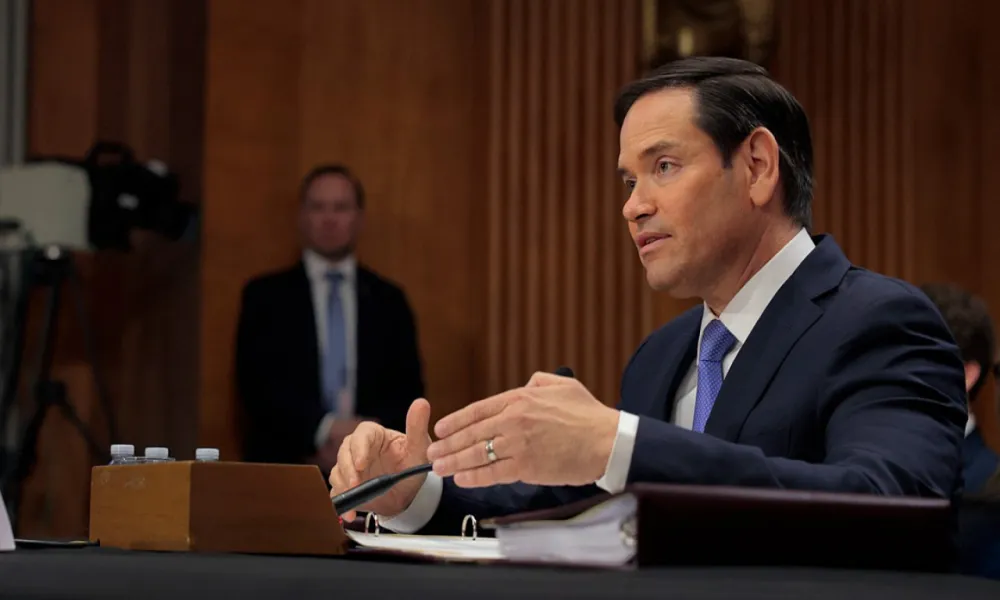

U.S. Secretary of State Marco Rubio is set to visit Gulf states this week in a bid to reassure allies over a United States-Iran agreement to end the recent conflict, amid concerns the deal may favour Tehran.
Rubio arrived in the United Arab Emirates on Tuesday before heading to Kuwait and Bahrain for talks with officials from the Gulf Cooperation Council, which also includes Saudi Arabia, Qatar and Oman.
Regional leaders have voiced unease over elements of the draft understanding, which does not restrict Iran’s ballistic missile programme and includes a $300 billion reconstruction fund for Iran. Analysts say such provisions could strengthen Tehran’s regional influence and alter the security balance.
Disappointment and surprise
The six Gulf states are key U.S. allies and provide logistical support to American forces, forming the backbone of Washington’s military presence in the region. All were targeted by Iranian retaliatory strikes following U.S. and Israeli attacks on Iran on February 28.
Some Gulf monarchies have reacted with disappointment and surprise to the agreement with Shiite Iran, long considered a principal rival by the Sunni-led states.
Their views are closely watched by U.S. policymakers. Countries including the UAE, Saudi Arabia, Qatar, Kuwait and Bahrain host American military bases, meaning any reassessment of security ties could have significant consequences for U.S. strategy in the Middle East.
Balancing act
Rubio faces a delicate balancing act, seeking to calm allies without appearing to criticise the agreement, which President Donald Trump continues to support despite criticism from some Republicans in Congress.
Andrew Peek, a former U.S. deputy assistant secretary of state for Iraq and Iran, said Rubio could reassure Gulf partners by stressing Trump’s traditionally hard line on Tehran.
“If this understanding collapses, the president would have no hesitation in returning to a tougher stance,” said Peek, now with the Atlantic Council.
Before the conflict erupted, Gulf leaders had publicly advocated a diplomatic solution and continued to push for de-escalation during the fighting, even as they supported U.S. operations.
However, details of the agreement have unsettled regional officials, diplomats and analysts say.
One major concern is the omission of Iran’s missile programme. Throughout the conflict, the Trump administration had cited dismantling Tehran’s ballistic capabilities as a key objective, a position aligned with Gulf states, which lie within range of Iranian missiles.
Yet the memorandum makes no reference to the programme, and Trump recently said it would be “unfair” to deny Iran such capabilities.
The planned reconstruction fund has also raised alarm, with Gulf states fearing it could help Iran rebuild its military capabilities and increase support for armed groups across the region.
In Bahrain, analysts say the Sunni leadership is concerned that a financially strengthened Iran could embolden unrest among the country’s Shiite majority. Iran denies meddling in Bahrain but has previously expressed support for Shiite activists there.
Hormuz oversight
The agreement also appears to acknowledge a potential future role for Iran in overseeing the Strait of Hormuz, a vital shipping lane for global energy exports, raising concerns in Kuwait, Qatar and Saudi Arabia.
More broadly, U.S. officials have floated the idea of a wider reset in relations with Iran, a prospect viewed cautiously across the Gulf. Vice President J.D. Vance said on Saturday Washington was open to “a fundamental shift” in ties with Tehran.
“The deal restores Tehran’s status as a regional power,” Saudi commentator Abdulrahman al-Rashed wrote in Arab News last week, warning that much of the funding Iran receives could be channelled into military strengthening rather than domestic development.
Source: CNA, AMNA, Reuters