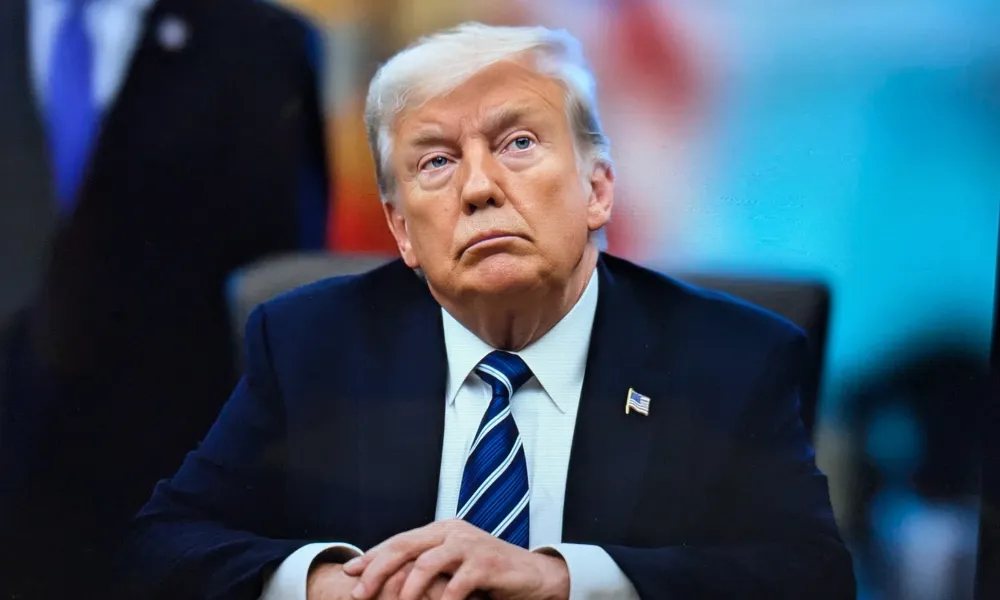
US President Donald Trump said on Monday that Iran genuinely wants to reach an agreement with the United States and that it would be a good deal for Washington and its allies. "Iran really wants to make a deal and it will be a good deal for the US and those with us," Trump wrote on Truth Social.
The statement came as both sides announced they had carried out strikes against each other overnight from Sunday into Monday, dealing a further blow to the existing ceasefire while negotiations to end the war remain deadlocked.
Talks stall as US hardens its position
Reports in American media over the weekend suggesting the US had presented new demands to Tehran dampened hopes of an imminent agreement, hopes that Trump himself had helped fuel in recent days. According to the New York Times, Trump hardened the terms of his proposal and sent a revised version of the text to Tehran. Axios reported that Trump is seeking a stricter position, primarily on the question of Iran's nuclear programme. CBS News reported on Sunday evening that the new US proposal includes a 60-day ceasefire extension with clauses providing for the opening of the Strait of Hormuz and a framework for resuming nuclear negotiations.
Strikes exchanged overnight
On the military front, US Central Command announced on Sunday evening that it had carried out another wave of what it described as defensive strikes against southern Iran on Saturday and Sunday, the third such strikes in less than a week. The targets were Iranian radar control systems and drones in the city of Goruk and on Qeshm Island in the Strait of Hormuz. Centcom said the strikes were carried out in response to "aggressive Iranian actions" that included the downing of a US MQ-1 drone operating over international waters. Shortly after that announcement, Iran's Islamic Revolutionary Guard Corps said it had launched an attack targeting a base used by the US military for strikes against Iranian territory. The location of the base was not specified. Kuwait's military announced on Monday morning that it was facing a drone and missile attack, with sirens sounding across the country.
Washington and Tehran had already exchanged accusations of ceasefire violations on Thursday, after American strikes on southern Iran and an attack on Kuwait. The ceasefire has been in force since 8 April. The war was triggered on 28 February by a joint Israeli-American strike on Iran, while Tehran and Washington were still in negotiations over Iran's nuclear programme. The conflict has left thousands dead and sent shockwaves through the global economy, driving up oil prices sharply.
The nuclear sticking point
Iran's chief negotiator Mohammad Baqer Qalibaf warned on Sunday that Tehran would not approve any agreement without certainty that the rights of the Iranian people are fully guaranteed. Iran maintains its right to a nuclear programme for non-military purposes and has repeatedly denied seeking nuclear weapons, despite suspicions expressed by the US and many other countries. It has said it is prepared to address that issue at a later stage, should an agreement with Washington be reached, and considers the lifting of American sanctions and the unfreezing of Iranian assets a fundamental condition of any deal. Trump insisted on Truth Social that the draft agreement "states very clearly that Iran will not have nuclear weapons," and does so "under very strict terms."
Tehran is also insisting that any agreement include an end to hostilities in Lebanon, where Israel continues operations with the stated aim of eliminating Hezbollah. The Israeli military is advancing daily in southern Lebanon, while Hezbollah continues its attacks, particularly in northern Israel, despite a ceasefire that has theoretically been in force since 17 April.
On Sunday, the Israeli military announced it had seized Beaufort Castle, a medieval fortress of strategic significance that offers control over southern Lebanon and northern Israel. It is the first time Israeli forces have held the 12th-century Crusader castle since their withdrawal from southern Lebanon in May 2000, after 18 years of occupation.
Diplomatic efforts continue
US Secretary of State Marco Rubio spoke in the past 48 hours with Lebanese President Joseph Aoun and Israeli Prime Minister Benjamin Netanyahu in an effort to advance a new ceasefire plan, according to an Axios journalist citing a senior American official. As a first step, the US has proposed that Hezbollah halt its attacks on Israeli territory and that Israel suspend strikes on the Beirut area. The American official said President Aoun appeared willing to advance the proposal, though Lebanese parliament speaker Nabih Berri made clear that Israel must first stop its attacks.
The UN Security Council is due to meet late on Monday afternoon to discuss the situation in Lebanon, following a request submitted by France, diplomatic sources told Agence France-Presse.
Source: AMNA