


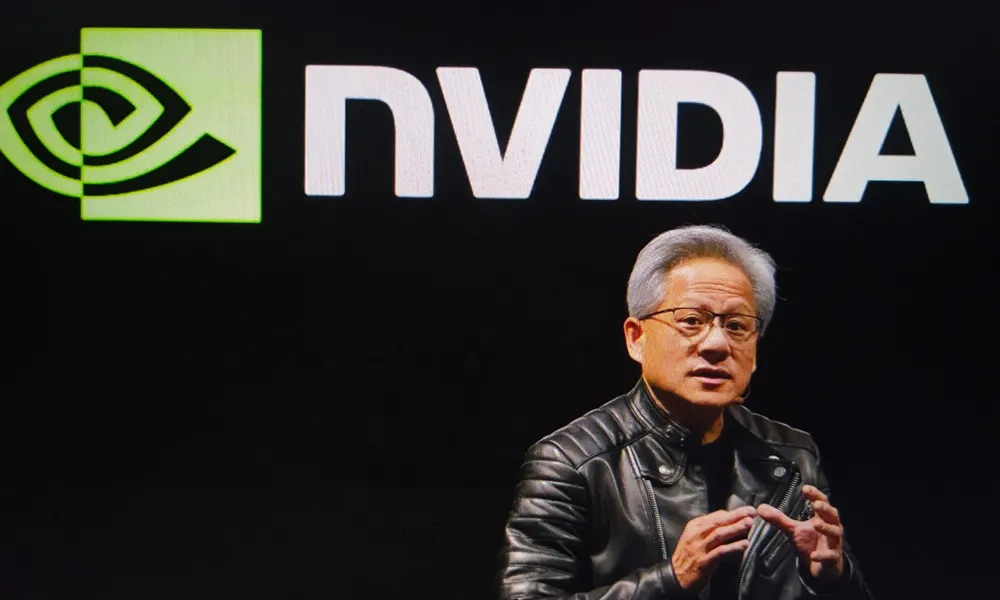

Nvidia has unveiled a new chip that puts artificial intelligence capabilities directly into laptops and desktop computers, setting up a new front of competition with Apple and Intel. CEO Jensen Huang announced the RTX Spark at a keynote address in Taipei ahead of the annual Computex trade show, describing it as part of a three-year collaboration with Microsoft to "reinvent the PC" for the AI era.
The chip is designed to run AI agents locally on the device rather than relying on cloud computing, a shift that industry analysts say will fundamentally change how people interact with their computers. "The RTX Spark looks to transform the traditional app-centric PC to a real useful agentic AI personal computer which will eventually be in every home in coming years as private edge AI agents become pivotal," said Neil Shah, co-founder of Counterpoint Research, comparing the moment to the debuts of the iPhone, ChatGPT and DeepSeek.
Huang said the chip was developed with the help of Taiwan's MediaTek. Nvidia also announced the Vera central processing unit, designed for AI agents, whose early adopters include OpenAI, Anthropic and SpaceX. During an earnings call in May, Huang described the Vera CPU as access to a new $200 billion market and "our new major growth driver."
The focus on AI running locally on personal hardware was echoed by Qualcomm CEO Cristiano Amon, who also spoke ahead of Computex and framed 2026 as a turning point for what the industry calls agentic AI, meaning systems that operate autonomously rather than simply responding to user prompts. "Two years ago we talked about how AI will change the human computer interface. That is starting to become a reality in 2026. That's why we call 2026 the year of agents," Amon said, adding that today's devices were built for actions initiated by users, not by autonomous agents, making a shift in hardware architecture unavoidable.
Huang used his address to push back on concerns about AI's effect on employment, dismissing as "complete nonsense" the idea that the technology would reduce demand for software engineers. "The number of engineers, software engineers, is actually increasing," he said. "It's causing more software engineers to be hired."
Huang, who was born in the southern Taiwanese city of Tainan, announced last week plans to invest around $150 billion a year in Taiwan, which he described as the epicentre of the AI revolution. His Taipei speech comes roughly two weeks after he accompanied US President Donald Trump on a visit to Beijing, where he was part of a corporate delegation that met Chinese leader Xi Jinping. The Computex trade show runs from 2 to 5 June.
Source: Reuters


