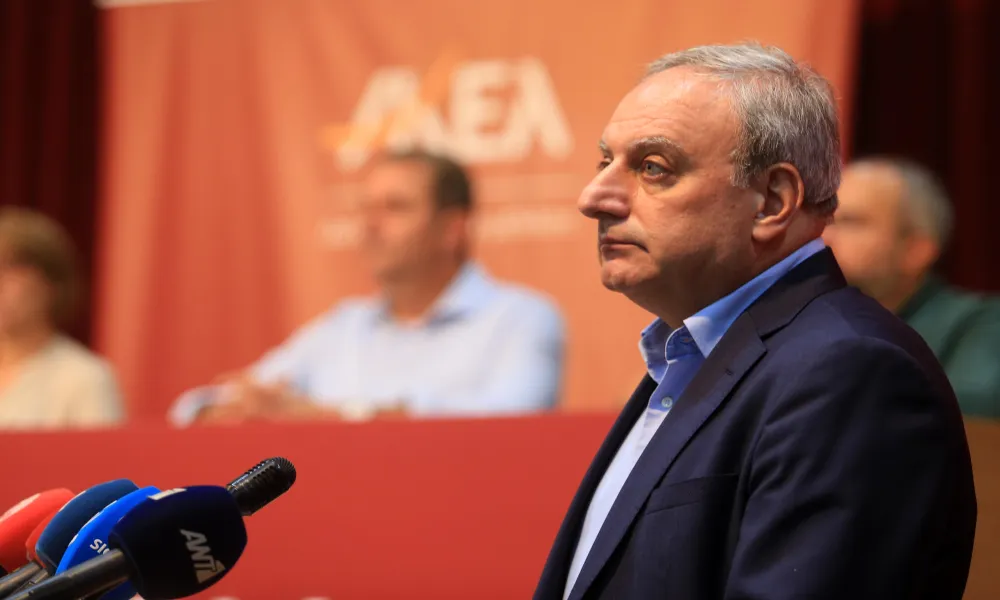

Stefanos Stefanou sees little scope for programme-based convergence between Akel and Diko as discussions ahead of the 2028 presidential election continue.
Speaking on Sigma TV's Protoselido, the Akel secretary-general questioned how Diko could simultaneously be open to cooperation with both the far right and Akel.
"How can that be?" he asked, arguing that the political distance between the two camps is too great.
Little prospect of agreement with Diko
Asked whether a minimum common programme could open the door to cooperation, Stefanou said that, based on current circumstances, this does not appear feasible.
He argued that Diko's current leadership, particularly in recent years, has largely aligned itself with Disy and has given no indication of a meaningful shift in direction.
While stressing that Akel is prepared to engage in dialogue with all political parties except the far right, he said the differences separating Akel from both Diko and Disy are substantial and objective.
Stefanou also emphasised the importance of political consistency, saying politicians cannot be opposed to a federal solution one day and support it the next simply because it appears politically advantageous.
Referring to the 2023 presidential election, he noted that some had urged Akel to support Nikos Christodoulides in order to share power and cabinet positions, an approach he said the party has never adopted.
Positive assessment of meeting with Michaelides
In contrast, Stefanou gave a positive assessment of Akel's recent meeting with Odysseas Michaelides and the Alma movement.
He agreed with Michaelides' description of the meeting as constructive and said it revealed significant common ground on key issues.
On potential presidential candidates, Stefanou said discussions about individuals will follow the completion of Akel's consultations with opposition parties seeking political change.
He declined to comment on the names of Nicolas Papadopoulos and Christiana Erotokritou, saying that what matters is the political positions each person represents.
Regarding Andreas Mavroyiannis, he reiterated that Akel "neither excludes nor endorses him" at this stage. Asked about Alma's stated opposition to a Mavroyiannis candidacy, he said such issues would be addressed when the time comes.
Cyprus issue remains key criterion
Stefanou said the Cyprus issue remains a decisive factor in selecting any future presidential candidate.
He linked the unresolved problem to developments in the energy sector, citing the Great Sea Interconnector (GSI) project. A settlement, he argued, could create opportunities for energy, tourism and shipping.
'We will be left without electricity'
Turning to energy policy, Stefanou referred to a parliamentary discussion requested by Akel and warned of serious consequences if delays continue.
He noted that EU requirements will lead to the closure of ageing polluting power-generation units by the end of 2029, affecting the entire Dhekelia power station and part of Vasilikos, representing about 720MW, or roughly half of Cyprus' electricity-generating capacity.
He criticised both the previous and current governments for delays, arguing that a December 2022 decision on new generation units at Dhekelia was not activated until 2024.
Asked whether Cyprus risks electricity shortages, Stefanou replied: "Yes, we will be left without electricity."
He warned that temporary emergency measures could push electricity prices from around 29 cents per kilowatt-hour to more than 40 cents.
Cost of living and collective agreements
Stefanou also challenged claims that strong economic indicators reflect the reality facing ordinary households.
He argued that many families, including middle-income households, continue to struggle with rising living costs while corporate profits increase and wages remain stagnant.
According to Stefanou, collective agreements currently cover only 40% to 45% of workers, compared with the 80% target promoted by the EU. Expanding collective bargaining coverage, he said, remains a key objective for Akel.
He was also sharply critical of the current EU leadership, which he described as the worst in the bloc's history.
Stefanou argued that efforts should focus on ending the war in Ukraine, saying a nuclear power such as Russia cannot be defeated militarily. He also warned that the EU's planned €800 billion rearmament programme could ultimately be financed through cuts to social policies.