

Cyprus Police recorded 44 hate crime cases in 2025, yet not a single one resulted in a sentence, according to the latest annual data published by the OSCE Office for Democratic Institutions and Human Rights (ODIHR). The report, released on 16 November, also finds that the way Cyprus records hate crime still does not adequately distinguish it from other crimes. That raises questions about how many cases go unrecognised.
What the ODIHR report is
ODIHR is the human rights office of the Organization for Security and Co-operation in Europe (OSCE). The OSCE brings together 57 participating States across Europe, Central Asia and North America, and Cyprus is one of them.
Every year on 16 November, ODIHR publishes a report for each country. It brings together three things:
- hate crime figures submitted by national police
- incidents reported by civil society and international organisations, including UN agencies
- ODIHR’s own assessment of each country
For the report, a hate crime is a criminal act committed with a bias motive, such as prejudice against a person’s ethnicity, religion, sexual orientation or other characteristic.
Police figures for 2025
According to the data Cyprus submitted, police recorded 44 cases in 2025, down from 54 in 2024 and 57 in 2023.
- 26 incidents were recorded but not investigated
- 18 became criminal cases
- 13 were listed as prosecuted, which ODIHR defines as cases under investigation or pending trial
- 0 ended in a sentence
ODIHR notes that the Cyprus figures include hate speech offences. These fall outside the OSCE definition of hate crime and cannot be separated from the rest of the data.
Threats make up most recorded crimes
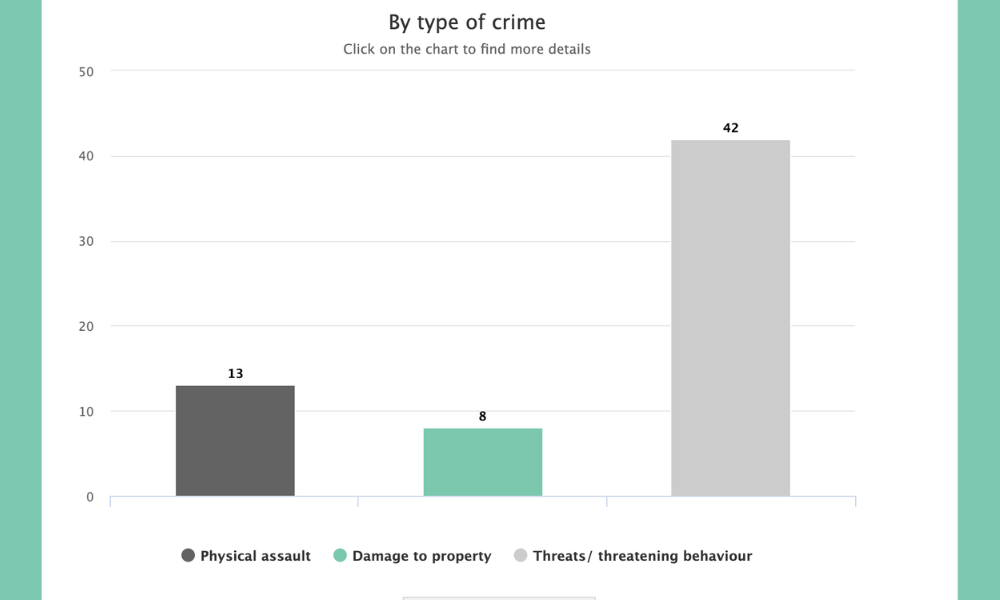
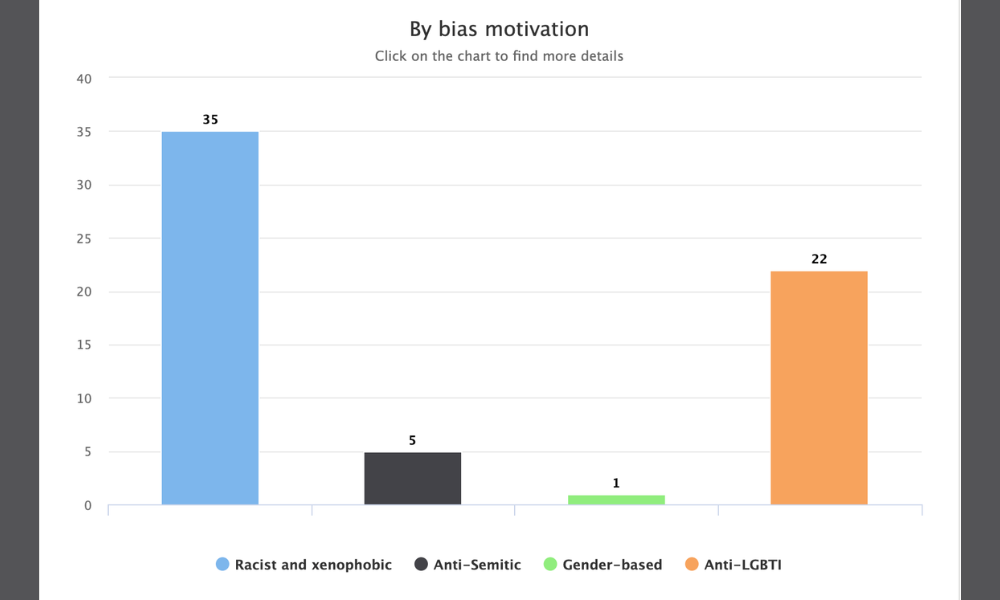
The police breakdown by bias motivation and type of crime shows that threats and threatening behaviour dominate the data. Because one case may involve more than one type of crime, the figures below add up to more than 44.
Racist and xenophobic hate crime was the largest category:
- 24 cases of threats or threatening behaviour
- 7 physical assaults
- 4 cases of damage to property
Anti-LGBTI hate crime was the second-largest:
- 14 cases of threats or threatening behaviour
- 6 physical assaults
- 2 cases of damage to property
Police also recorded:
- antisemitic hate crime: 3 cases of threats and 2 cases of damage to property
- gender-based hate crime: 1 case of threats
Prosecutions and sentences over the years
Prosecutions fell from 30 in 2024 to 13 in 2025. Sentences fell from 2 to zero.
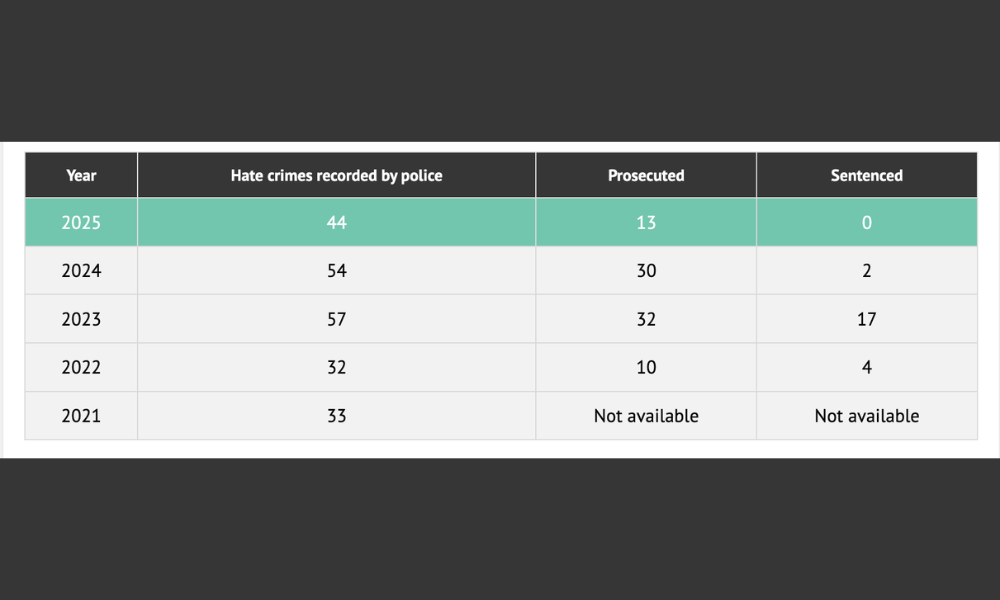
The 2025 figures are well below 2023. That year police recorded 57 cases, 32 were prosecuted and 17 resulted in a sentence, the highest number since Cyprus began reporting to ODIHR in 2018.
Zero sentences is not new for Cyprus. No sentences were recorded in 2018, 2019 or 2020 either.
What ODIHR recommends
ODIHR recognises the efforts of Cyprus to strengthen police capacity to identify, record and investigate hate crimes. However, it states that hate crime recording and statistics in Cyprus do not adequately distinguish hate crimes from other crimes.
It also says Cyprus would benefit from raising awareness among prosecutors and building their capacity to prosecute hate crimes.
ODIHR refers to OSCE Ministerial Council Decision 9/09. Under that decision, participating States committed to reporting reliable hate crime data regularly and to training law enforcement officers, prosecutors and judges. ODIHR offers support in these areas, including data collection resources and training programmes for police, prosecutors and the judiciary.
National developments in 2025
The report also lists several measures Cyprus took during the year:
- Penal Code amendments added disability and age as protected characteristics in the offence of incitement to violence or hatred. Police were informed of the changes.
- A Police Circular was issued to guide officers on identifying, recording and handling possible hate crime and hate speech incidents. It covers assessing bias motives and following reporting procedures.
- The Office on Human Rights and Combating Discrimination and the Cyprus Police Academy held a one-day seminar, Understanding Antisemitism: Historical and Contemporary Perspectives, with the Embassy of Israel in Cyprus.
The Cyprus Police and its Human Rights and Combating Discrimination Office collect hate crime data every year and publish it online. In 2017, the police signed a Memorandum of Understanding on human rights with 14 civil society organisations.
Incidents reported by UNHCR and civil society
Alongside the police figures, ODIHR published seven incidents affecting six victims. Five were submitted by the UN Refugee Agency (UNHCR) and two by the International Institute for Religious Freedom (IIRF).
UNHCR reported the following racist and xenophobic incidents:
- In January 2025, a Kurdish peace activist, conscientious objector and political refugee was attacked in his home by 15 to 20 masked youths. According to the report, they threw stones at him and his two housemates while shouting racist slogans. He had already been attacked 10 days earlier.
- Also in January, a foreign food delivery driver was assaulted after a minor traffic dispute and struck across the face with a navigation tablet. The report says the incident forms part of a pattern of attacks against foreigners in the area.
- In May, a 34-year-old delivery driver was lured by a person claiming to be a delivery recipient, then beaten and robbed of his waist pack. It contained a mobile phone, cash, personal documents and other items. The report refers to a pattern of attacks against migrant workers in the area.
UNHCR also reported two anti-LGBTI incidents:
- In April, outside a church in Limassol, LGBT signs were thrown into the traditional bonfire. Photos and videos were widely circulated online.
- In May, a 17-year-old boy was physically assaulted in a homophobic attack while walking alone at night. Two unidentified suspects travelling in a car stopped and attacked him. He sustained injuries.
The IIRF reported two anti-Christian incidents:
- In April, an Orthodox church was damaged by unidentified perpetrators, in one of a series of attacks targeting the church.
- In June, a Catholic church was damaged when a man smashed items inside the building.
Gaps in reporting
ODIHR notes the low number of incidents reported for 2025. It received no reports of anti-Muslim, anti-Roma, antisemitic, disability-related, gender-based or other religion or belief-based incidents from civil society. ODIHR says this points to possible gaps in reporting.
ODIHR also stresses that civil society submissions are voluntary. They do not show the true number of incidents or which communities are targeted most.
Why UNHCR reports to ODIHR
UNHCR’s protection mandate covers refugees and asylum seekers. The agency monitors hate crime and xenophobic incidents because they directly affect the safety of the people it serves. It reports these incidents to ODIHR, which publishes them with UNHCR named as the source. That places them next to the official police figures and shows what the police data does not capture.