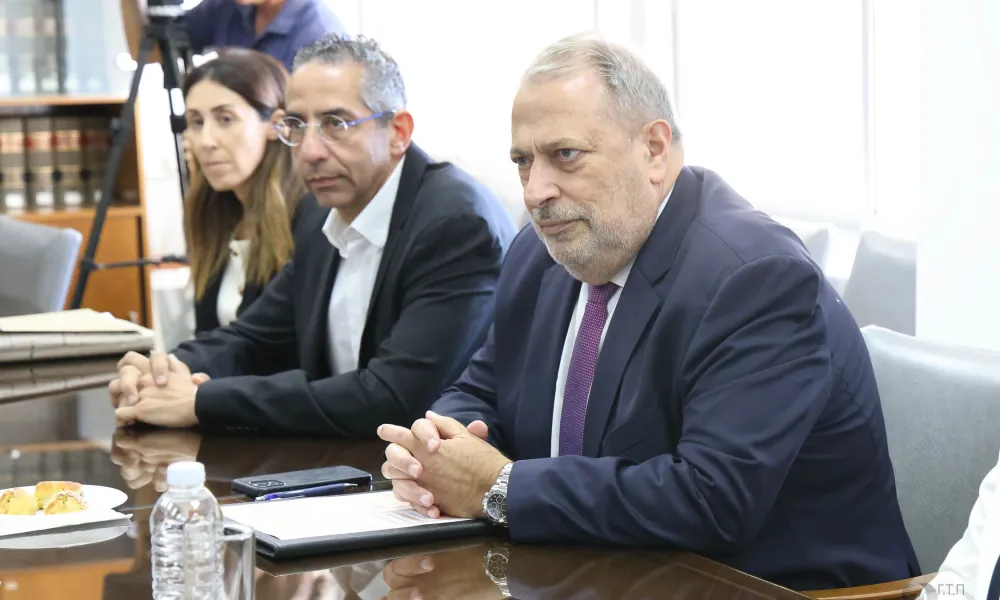

The House Legal Affairs Committee on Wednesday discussed the proposed changes to the institution of the Attorney General and the constitutional problems they may raise, with Justice and Public Order Minister Costas Fytiris telling MPs that 39 bills have been prepared and amendments to further legislation are under consideration. Three of the bills bring significant changes, he said. The proposals provide for separating the role of the Attorney General from that of a new General Public Prosecutor, with both officials appointed by the President of the Republic for a single eight-year term without the possibility of reappointment. They also provide for the autonomy of the Law Office from the civil service, the creation of a post of Director General of the Law Office and the establishment of a Prosecutorial Council to handle staff appointments and disciplinary procedures. The provisions for the General Public Prosecutor and the Deputy General Public Prosecutor will mirror those for the Attorney General and the Deputy Attorney General, and a cooperation protocol between the Republic, the Attorney General and the General Public Prosecutor is also foreseen. Fytiris said the legal systems of the United Kingdom, Ireland and Malta, which provide for judicial review, were studied. Referring to the Attorney General's reservations about the constitutionality of separating the powers, he said the executive is determined to proceed, with the aim of finding the right balance, and added that the Supreme Court will review the decisions of the General Public Prosecutor. "The government is not in conflict with the Attorney General," he said, adding that he respects the desire for separation and the government respects the Attorney General's reservations. The minister said he signed the explanatory memorandum of the bill proposed by the Council of Ministers, attaching the Attorney General's reservations and the positions of the committee of constitutional experts he had appointed on the matter.
The attorney general's objections
Attorney General George Savvides described the proposed change as the biggest constitutional amendment since the founding of the Republic of Cyprus, saying that both judicial review and the separation of the Attorney General's powers constitute an intervention in the Constitution. On the fact that the Attorney General's decisions cannot currently be reviewed, he said the constitutional intervention required is not insurmountable. His main concern, he added, is the creation of the role of General Public Prosecutor, on which he maintains constitutional reservations. Savvides said the proposed amendment affects the bicommunal character of the Constitution, since the new post of Deputy Public Prosecutor would have to belong to the Turkish Cypriot community. In his view, the separation of powers may touch the core of the Constitution and Article 112.1, since it affects the basic structure of the Constitution, which provides for only three senior officials: the Attorney General, the Auditor General and the Accountant General. He noted that the doctrine of necessity does not permit amendment of fundamental articles of the Constitution, and said it is particularly precarious to legislate for new bicommunal posts in the Constitution at a time when the doctrine of necessity is invoked to justify not applying bicommunal provisions. He told the committee he holds very serious doubts and reservations about the constitutionality of the bills, warning of visible constitutional risks if they are passed, with "enormous and insurmountable consequences" should they be challenged in court. On the structure of the Law Office, Savvides said a bill for its autonomy was prepared on the basis of GRECO recommendations, although the question of transferring staff from the public sector to the Law Office remains pending.
Speaking after the session, Savvides said the difference of view between the Law Office and the government stems from the fact that the Attorney General, as his duty requires, expressed reservations about the constitutionality of the reforms. He said that after studying the matter and setting up an expert committee of seven eminent constitutional scholars, four of the seven concluded that the proposed amendments are unconstitutional, a view the Cyprus Bar Association also appears to share, while the final arbiter is the Supreme Constitutional Court. It is now up to the House to decide whether to pass the changes, he said, predicting that if the reform goes ahead, the constitutionality of the laws will be challenged in the first case or cases filed by the new General Public Prosecutor. On the question of review, he said the intervention in the Constitution is smaller than that involved in the separation of powers. If the bill concerns review of the General Public Prosecutor's decisions, constitutional reservations remain, whereas review of the Attorney General's decisions could proceed on the basis of case law without significant intervention in the Constitution. Asked about his participation in the debate given that his term ends in a few months, Savvides said that precisely because he is leaving soon he has no personal interest in whether the reform is passed, nor will the decisions affect his own term. He stressed that the Attorney General's constitutional role is to assess and comment on the constitutional soundness of the reform, adding that he did not confine himself to his personal opinion but convened a group of experts who gave their view. If the bills are passed, he said, he does not expect the President to exercise his right of referral to the Supreme Constitutional Court at an early stage. Once the law is signed, the recruitment of a General Public Prosecutor and Deputy, the creation of structures and service schemes and the staffing of the new service would proceed. He expects the constitutional objection to be raised by the first or second defendant in a case filed by the General Public Prosecutor, and if the law is found unconstitutional, the structures created would have to be abolished and the Law Office restored to its current form.
Civil servants, lawyers and parties weigh in
Public Service Commission chairman Giorgos Papageorgiou said the commission has constitutional and legal concerns about staffing. At present, apart from the Attorney General and the Deputy Attorney General, all Law Office staff are civil servants, he said, adding that the matter will be examined when the time comes. He noted that a 2016 GRECO report found the current recruitment and disciplinary procedures for Law Office counsel to be satisfactory. PASYDY general secretary Stratis Matthaiou expressed reservations about the autonomy of the Law Office and said a meeting with the Attorney General has been arranged for early October. Cyprus Bar Association president Michalis Vorkas said the constitutionality of the amending laws will ultimately be tested before the Supreme Constitutional Court. "Society seeks transparency," he said, so that no questions or suspicions arise about the independence and duration of appointments, adding that bicommunality is a fundamental element of the Constitution.
Committee chair and Disy MP Fotini Tsiridou said that, beyond the 37 related bills, law proposals from the previous parliamentary session are also before the committee. Committee members will discuss all the issues and the procedure to be followed with their parliamentary groups in two weeks, she said. Tsiridou said Disy supports the reform and modernisation of the institution, as there is room for improvement, but stressed that the change must be made in a way that does not create a constitutional problem. She added that the Attorney General is ready to answer MPs' constitutional concerns, either before the committee or before the parliamentary groups. Akel MP Andreas Pasiourtides said the party had identified the need to amend the institution of the Attorney General and Deputy Attorney General as far back as 2019 and had submitted a law proposal, yet seven years later the debate continues. He described it as paradoxical that the government's legal adviser signs bills reforming the Law Office that he considers unconstitutional, while the executive pushes for their passage. Timetables must be set in the coming weeks so that the reform reaches the plenum and every party takes a position, he said, adding that if passed, the reform may be tested before the Supreme Constitutional Court and that the bicommunal character of the Constitution constrains decisions in many cases. Elam MP Linos Ioannis Hadjigeorgiou said the debate must mature so that the reform is both functional and constitutional, noting that the party has its own proposals and possible amendments aimed at a change that contributes to the proper administration of justice. He said it was discussed that the non-reviewability, term and independence of the Attorney General and the Public Prosecutor should be examined separately, and that the parties will set out their positions on the procedure and timetable in two weeks. Direct Democracy MP Yiannis Laouris argued that Cyprus is captive to an anachronistic and outdated Constitution, noting that even seven constitutional experts disagree among themselves on whether the change can be made, which in his view shows the picture is unclear. People want Cyprus to move forward and stop being a prisoner of its Constitution, he said, adding that Direct Democracy has launched an initiative for cross-party cooperation and is inviting lawyers to help identify the Constitution's problems, whether through piecemeal or comprehensive changes.
Source: CNA