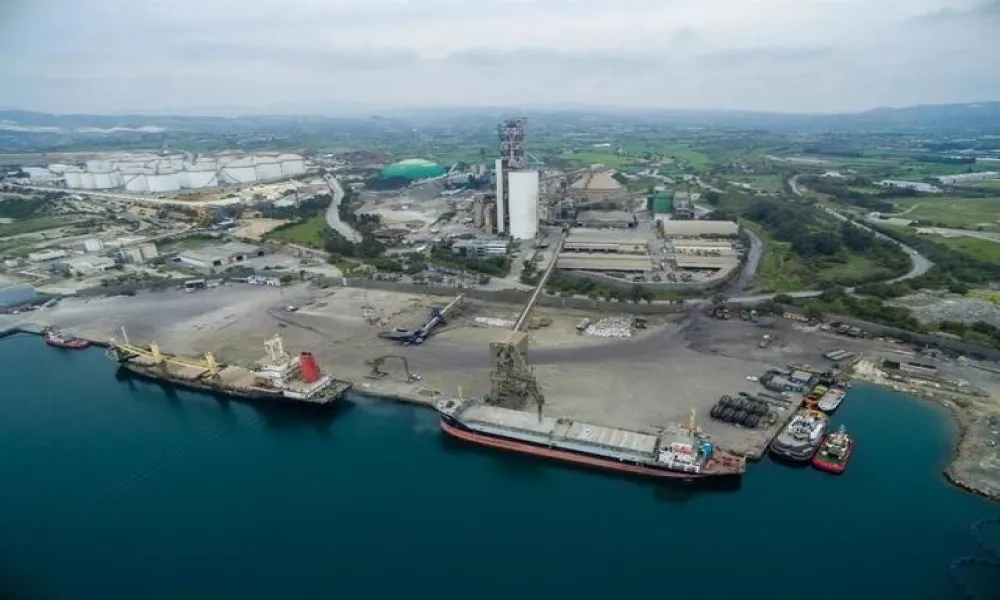

Serious concern over Cyprus’ electricity adequacy up to 2030 was expressed by MPs during a closed-door session of the House Audit Committee on Thursday, which examined the Auditor General’s 2024 report on the natural gas terminal at Vasiliko. The discussion was held behind closed doors due to ongoing legal proceedings against the state-owned Public Natural Gas Company (DEFA).
Speaking after the session, AKEL Secretary-General Stefanos Stefanou described Vasiliko as one of the biggest scandals of recent years, “among many under the Anastasiades administration and DISY,” arguing that it has left Cyprus exposed in terms of electricity supply. He said the case is under investigation by the European Public Prosecutor’s Office (EPPO), as is the electricity interconnection project.
“We risk running out of electricity after 2030, and the solutions from a financial point of view will be painful,” Stefanou said, adding that the failure to bring natural gas keeps electricity prices high due to emissions costs. He noted that Cyprus has paid €1.2 billion for emissions between 2018 and the first half of 2025.
Stefanou also blamed the current administration, saying that “in the face of this huge scandal, the Christodoulides government has moved at a snail’s pace,” adding that not only has it failed to defuse the problem, but has “added more pressure to a ticking time bomb threatening Cyprus”.
He warned again of the risk of power shortages after 2030, issuing what he described as an urgent SOS for electricity and energy in Cyprus.
Power units to be decommissioned
He said that by the end of 2029, generators at Dhekelia and three units at Vasiliko must be taken out of operation, meaning 720 megawatts will be lost. This capacity must be replaced to ensure both adequacy and stability of the grid.
“The government must take responsibility, provide convincing answers and, most importantly, take the actions needed to ensure energy adequacy and security,” he said.
Stefanou clarified that AKEL agreed to the closed-door format to protect the Republic’s interests because of the pending arbitration process in London.
Asked about possible developments regarding a contractor offer, he said only that matters were “at a preliminary stage”, noting that the closed session was not coincidental.
He added that AKEL has repeatedly submitted proposals to parliamentary committees and the government, pointing out that “it is not AKEL that will find the solutions, nor even parliament. It is a matter for the executive,” stressing that the government must move forward with completing and operating the Vasiliko terminal.
He said that some questions raised during the session were answered, while others still require government responses, with officials committing to reply soon.
Risk now visible, says Pamborides
DISY MP Giorgos Pamborides said the government must clarify its implementation plan for the project, noting that although it is necessary to proceed, “we have seen no developments over the past three years that encourage us”.
He added that following changes to the boards of relevant bodies, meetings should restart.
Pamborides stressed the need to overhaul how such projects are awarded and supervised, so Cyprus can “rid itself of the major delays affecting critical infrastructure projects essential for the economy and the country”.
He said these changes do not fall within parliament’s remit, pointing instead to the Treasury, adding that procedures must become faster and more flexible for contracting authorities.
Asked whether he shares concerns about electricity supply after 2030, Pamborides replied that the risk is now visible.
“That is why I too have expressed concern over the apparent inertia of recent years. We must move forward with concrete solutions, and the responsibility lies with the government,” he said.
On the Vasiliko scandal, he called for a comprehensive investigation into all aspects of the project, stating that “it is evident from the outcome that the process failed”, not only in completion and timelines but also in delivering the much-needed introduction of natural gas.
“There are clearly undeniable political responsibilities,” he added, noting that further potential liabilities are already under examination by the EPPO.
Responding to a question about his involvement in a law firm previously engaged in arbitration in London, Pamborides said he had represented the Natural Gas Infrastructure Company (ETYFA) and, by extension, the Republic of Cyprus, but has since resigned due to incompatibility with his role as an MP.
He also welcomed the Audit Committee’s approach, saying it should function as a mechanism for problem-solving rather than endless political confrontation.
Michaelides: costs rising, responsibility shared
ALMA party leader Odysseas Michaelides said that while the Christodoulides administration “inherited” the problem, actions taken over the past three years show that it is worsening and increasing costs for citizens.
He said both the previous and current governments bear heavy political responsibility.
“Today it was confirmed that there was tolerance of the contractor after 2023, when the Christodoulides government took office, until the contract was terminated, and even afterwards there were prolonged delays,” he said.
He noted that even now plans to issue a new tender have been pushed back, despite earlier assurances that this would happen in summer 2024.
Moves to raise Auditor accountability
Michaelides also said he will raise a separate issue regarding the accountability of the Auditor General before the Audit Committee.
He noted that in countries with similar models, including Australia, the United Kingdom and Ireland, the Auditor General is clearly accountable to parliamentary oversight committees.
He said he would formally register the issue next Thursday, seeking implementation of the 1985 legislation, despite the Auditor General’s position that the law is unconstitutional and that he does not intend to comply.
“The issue concerns the obligation of the Auditor General to submit information to parliamentary committees, particularly the Audit Committee,” he said, adding that during his own decade-long tenure he had both advocated and applied this principle.
He stressed that in a properly functioning state, no one should be exempt from accountability.
Michaelides also said he would publish a legislative proposal to regulate the Audit Office, introducing safeguards for the independence of the Auditor General while ensuring the effective functioning of its leadership team as an institutional counterbalance, as recommended by British experts.
Source: CNA