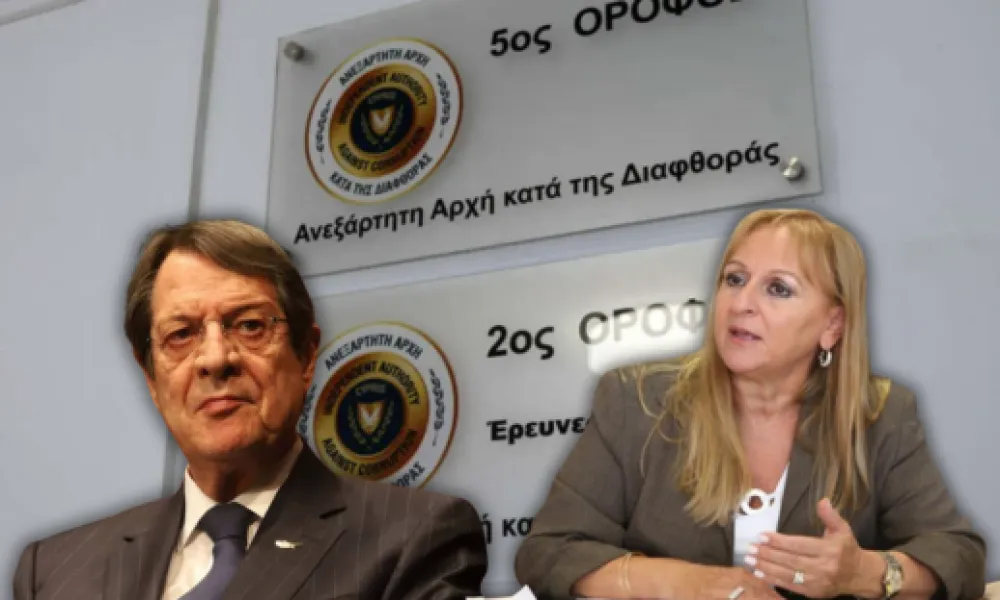

One of the most sensitive chapters in the Anti-Corruption Authority’s findings on Makarios Drousiotis’ book Mafia State concerns the role of MOKAS, Cyprus’ Unit for Combating Money Laundering, and the way it examined allegations involving the law firm Nicos Chr. Anastasiades & Partners in 2019.
According to the Authority’s announcement, the case raises questions not only about the substance of the financial allegations, but also about whether a state mechanism tasked with investigating suspicious flows of money acted with sufficient independence when the matter touched the personal and family interests of then President Nicos Anastasiades.
The findings refer to an August 2019 report by the Organized Crime and Corruption Reporting Project, titled “Bank Records Link President of Cyprus to ‘Troika Laundromat’”. The report alleged that the law firm bearing Anastasiades’ name had facilitated suspicious financial movements through shell companies and acted as an intermediary for high-risk clients.
Anastasiades publicly rejected any involvement, stating that since becoming president of DISY in 1997 he had been a silent shareholder and had no role in the law firm’s operations. The Authority, however, says evidence before it indicated that until his resignation as general partner on February 26, 2013, he maintained an active role in the firm and general oversight of its activities.
At the centre of the issue is Anastasiades’ public call for MOKAS to investigate the OCCRP allegations. The Authority considers that the use of the presidential office in a matter directly touching his personal and family interests raises serious concerns over possible institutional interference, improper use of political or executive influence and potential abuse of power.
The Authority notes that the private company carried his name and that his two daughters were shareholders, making the then president’s intervention particularly problematic from an institutional perspective.
The timing of MOKAS’ actions is also treated as significant. According to the announcement, the then head of MOKAS, Eva Rossidou-Papakyriakou, said the unit acted on its own initiative after reading the OCCRP report. The Authority, however, records that MOKAS had already received an official referral from an audit firm eight days before Anastasiades’ public appeal, concerning the same transactions. No action was taken until after the former president’s public intervention, according to the Authority.
The announcement is sharply critical of the quality of the MOKAS inquiry. It says the unit, as Cyprus’ national financial intelligence body, had a duty to investigate actively and secure evidence, but instead accepted explanations without sufficient independent verification.
According to the Authority, MOKAS did not obtain adequate documentation on the origin and destination of the funds under review, despite the existence of material that could have justified further criminal investigation.
The Authority also points to the public statement issued by Rossidou-Papakyriakou on December 20, 2019. Although MOKAS findings are not normally made public, the then head of the unit announced that the inquiry had found “nothing reprehensible”, effectively clearing both the then president and the law firm.
The Anti-Corruption Authority takes a different view. It says the MOKAS conclusion did not accurately reflect the material gathered and that clear warning signs were overlooked.
Those warning signs, according to the announcement, included shell companies registered in the Caribbean, transactions worth 220 million dollars through high-risk jurisdictions, intra-company financing, loans to related parties and amendments to significant loans carrying zero interest. The Authority says such structures could have obscured illegal transactions, but were not properly pursued by MOKAS during its inquiry.
In its conclusions, the Authority says there are sufficient indications, on the balance of probabilities and not at the criminal standard of proof beyond reasonable doubt, of possible abuse of power or attempted abuse of power by Anastasiades. His public appeal to MOKAS is presented as a possible attempt to prompt the use of a state financial intelligence unit to protect his public image and that of the law firm bearing his name.
The Authority also records possible criminal responsibility on the part of Rossidou-Papakyriakou, the former head of MOKAS, for abuse of power and neglect of official duty. It refers to the allegedly incomplete nature of the inquiry, the acceptance of explanations without independent checks, the failure to act on material pointing to serious warning signs and what it describes as unjustified inaction.
The MOKAS chapter has therefore become one of the most institutionally sensitive parts of the Authority’s announcement. The question now is whether an inquiry presented in 2019 as clearing the former president and his law firm was in fact complete and independent, or whether it functioned as a form of institutional protection at a moment of political pressure.