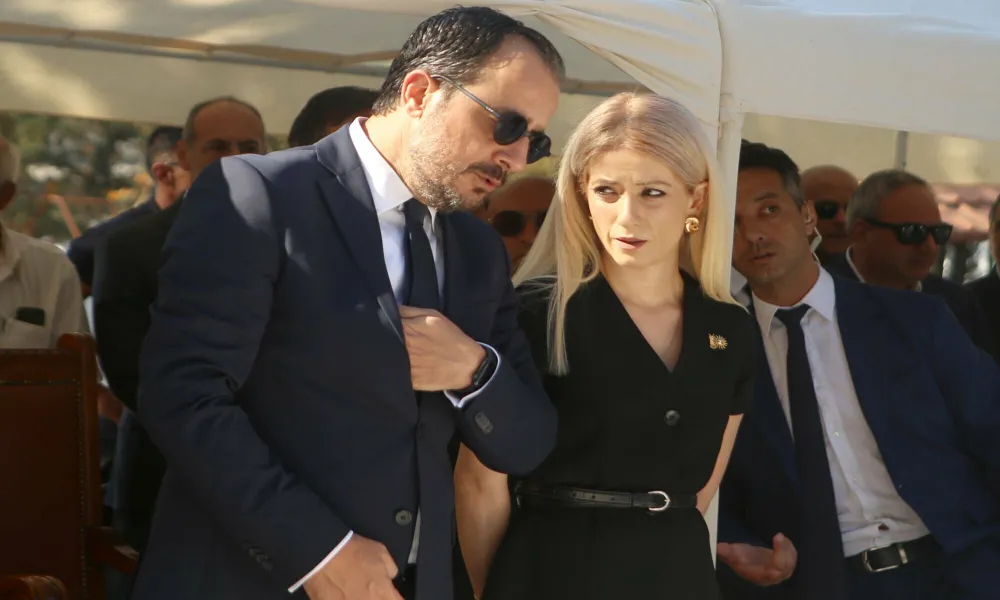
The re-election of Annita Demetriou as Speaker of the House of Representatives carries both symbolic and political significance. Backed by votes from the Direct Democracy movement and DIKO, her victory has begun to unravel the political dynamics that may shape Cyprus' 2028 presidential election.
The contest for the speakership was about far more than the country's second-highest constitutional office. It represented the first major political battle of the next presidential cycle and an early test of strength among those seeking to lead the broader centre-right.
At the same time, AKEL has emerged as the political pole around which the centre-left is likely to organise its challenge for power in 2028.
DISY reasserts its leadership claim
Having secured 27.2% of the vote in the recent parliamentary elections, DISY not only retained its position as the largest party but also held on to the speakership. The party can now argue that it possesses the political legitimacy to shape – or at least play a leading role in shaping – the selection of a presidential candidate for 2028.
In practical terms, DISY is reclaiming its role as the natural leader of a wider centre-right alliance.
Until recently, President Nikos Christodoulides appeared to hold the advantage in that contest for leadership. As the incumbent head of state, he remained the obvious focal point around which a future governing coalition could be built. That explains why his camp fought hard over the political symbolism surrounding the election of the new Speaker.
A setback for the President
Christodoulides' first priority was to prevent DIKO leader Nikolas Papadopoulos from being elected Speaker with AKEL's backing. Such an outcome would have reinforced perceptions of a president lacking meaningful parliamentary support and without a party in the House prepared to champion his agenda.
His second objective was for Papadopoulos to secure the post with the support of ELAM and Direct Democracy. That would have allowed Christodoulides to argue that, despite the decline of EDEK and DIPA, he remained capable of assembling political majorities and leading the coalition that brought him to power in 2023.
In the end, neither scenario materialised. Demetriou's victory deprived the President of both the political narrative and the symbolism he had hoped to secure.
Early loss
Arguably, however, that battle had already been lost.
Over the past three years, Christodoulides has often appeared to assume that a future rapprochement with DISY was inevitable. In doing so, he was widely seen as treating the parties that supported his 2023 candidacy – DIKO, EDEK and DIPA – as temporary allies rather than long-term strategic partners.
On several occasions, his statements and political decisions were interpreted by figures within those parties as dismissive or even humiliating. Papadopoulos repeatedly voiced dissatisfaction with decisions taken by the President and what he regarded as disrespectful treatment of his party. Similar complaints emerged from EDEK, which at times threatened to withdraw from the governing coalition.
The parliamentary elections have now altered the landscape. The collapse of EDEK and DIPA, both of which failed to secure representation, and DIKO's fall to fourth place significantly weakened the President's political base.
Demetriou's election meanwhile served as a reminder that predictions of DISY's marginalisation after the elections were premature. The party remains the dominant force on the centre-right and is now openly seeking to reassert its political leadership.
That reality could create difficulties for those within DISY who advocated closer alignment with Christodoulides and who were widely tipped for cabinet positions during the coming reshuffle. Only last week, former President Nicos Anastasiades once again described Christodoulides as "a child of DISY" and urged the party leadership to overcome old divisions and work with him ahead of 2028. Such a proposition might have appeared realistic had DISY emerged from the elections with around 22% or 23% of the vote. With 27%, it looks considerably less plausible.
Can Christodoulides recover?
The central question is increasingly difficult to avoid: can Christodoulides re-establish himself as the undisputed leader of a political camp that now appears to be regrouping around DISY, or does he risk becoming a spectator awaiting the end of his term?
The parties that backed him in 2023 have suffered significant setbacks. EDEK and DIPA are now outside parliament, while DIKO has slipped behind both ELAM and DISY. At the same time, DISY is rallying around the prospect of returning to power in 2028.
Under these circumstances, Christodoulides may require either a political miracle to reach the second round of the presidential election or a major breakthrough on the Cyprus issue that fundamentally reshapes the political agenda.
The answer may emerge in the coming weeks if new momentum develops in negotiations over Cyprus, or it may not become clear until 2028 itself.
Some observers argue that the answer may already be visible in the outcome of the Speaker vote.
Direct Democracy leader Fidias Panayiotou offered a simple explanation. His movement did not align with AKEL despite sharing common ground on several issues because such a coalition could not secure the speakership. Nor did it join forces with DIKO, apparently unwilling to become part of a DIKO-ELAM axis with uncertain prospects. Instead, it backed DISY because, as Panayiotou argued, voters had made it the largest party and therefore the one with the strongest political momentum.
AKEL rmerges as the alternative axis
If DISY now appears to lead a broad centre-right bloc, the same vote also highlighted a credible rival centre of political gravity.
AKEL's refusal to support Papadopoulos was not simply a tactical decision. By rejecting the candidacy of a politician whose party remains part of Christodoulides' governing camp, AKEL sent a clear message that it would not legitimise a figure associated with the administration.
Had Papadopoulos been willing to withdraw from the governing arrangement, the political equation might have looked very different. Instead, AKEL avoided a move that could have been interpreted as politically contradictory and preserved its credibility as the principal opposition force.
The party aligned itself with ALMA and sought dialogue with Direct Democracy in an effort to begin constructing an alternative parliamentary bloc on the centre-left. While this cooperation does not yet amount to a strategic alliance, it may signal a willingness to coordinate on a range of parliamentary issues over the coming five years.
The battle for 2028 has begun
More importantly, the Speaker vote suggested that AKEL is already looking beyond parliamentary arithmetic towards the next presidential election.
If DISY hopes to lead a centre-right coalition back to power, AKEL is attempting to build the opposing camp by extending its reach beyond its traditional electorate and engaging with forces that channel dissatisfaction with the political establishment.
In that sense, the vote for Speaker did more than identify the dominant force on the centre-right. It also highlighted the emergence of a second political pole centred on AKEL, which appears to recognise that the path to 2028 runs through the construction of a broader opposition alliance.
Both AKEL and DISY will also be conscious of another important electoral reality: a sizeable share of voters who backed smaller parties in the parliamentary election – approaching 17% of the electorate – is now left without representation in parliament. Those voters could prove decisive in determining which political bloc ultimately prevails in 2028.