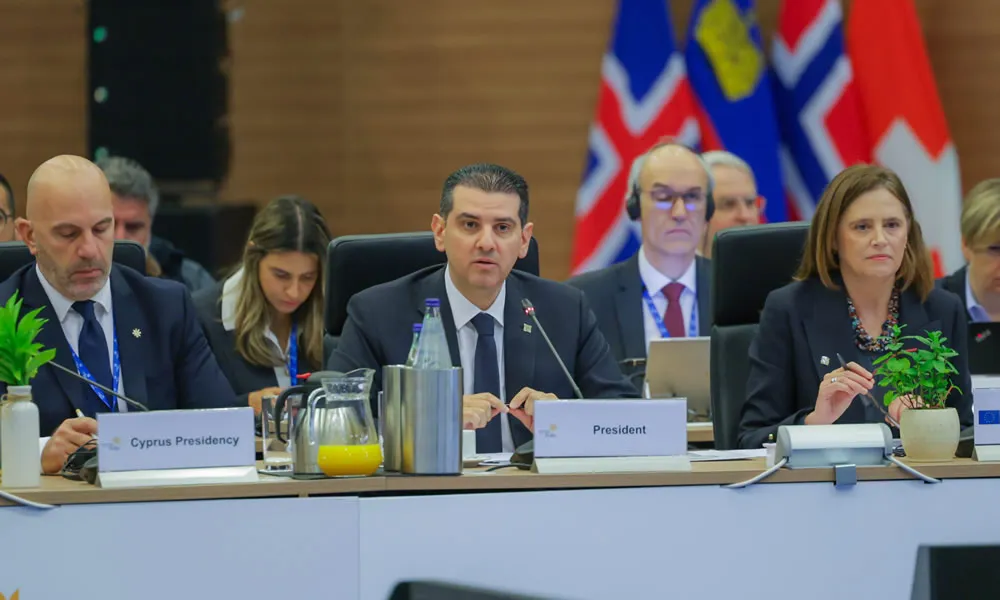

The EU’s future competitiveness will depend on investments in knowledge, human capital, and strategic technologies, Deputy Minister of Research, Innovation and Digital Policy, Nikodemos Damianou said on Friday, in Brussels.
Damianou was speaking during a press conference after the EU Competitiveness Council (Research) concluded, focusing mainly on the progress of the “Horizon Europe” programme, science diplomacy, and strengthening the competitiveness of European research.
He said that it had been a productive session, stressing that it was the last Council meeting on research under the Cyprus Presidency.
Horizon Europe
He noted that today’s agenda reflected the Presidency’s key priorities concerning competitiveness, knowledge, and innovation in the EU.
Regarding the “Horizon Europe” programme, the Deputy Minister said that substantial progress had been achieved in the negotiations under both the Danish and Cypriot Presidencies, with most technical issues having been stabilised. He added that today’s exchange of views provided political guidance on the remaining issues, such as alignment with the European Competitiveness Fund, European partnerships, widening participation, and collaborative research and innovation.
The Deputy Minister underlined the need to accelerate procedures in order to achieve a timely agreement and avoid uncertainty for researchers, innovators, and industry, with the aim of ensuring the smooth launch of the programme in 2028.
Recommendation on science diplomacy
Damianou stated that a Council Recommendation on science diplomacy had been approved, aiming to strengthen international cooperation in research and promote a more coordinated European approach amid increasing geopolitical competition in science and technology.
He also stressed that this framework would utilise science and innovation as tools to promote European values, strategic interests, and technological sovereignty, while at the same time safeguarding research security.
The Recommendation, he continued, is aligned with the Presidency’s overarching motto, “An Autonomous Union, Open to the World” — outward-looking rather than inward-looking. “Implementation now becomes the priority, together with the Member States, the Commission, and the European External Action Service, in order to turn the framework into concrete actions,” he added.
In closing, the Deputy Minister stated that the discussions confirmed the shared commitment of Member States to strengthening Europe’s leadership in research and innovation, noting that the EU’s future competitiveness will depend on investments in knowledge, human capital, and strategic technologies.
Source: CNA