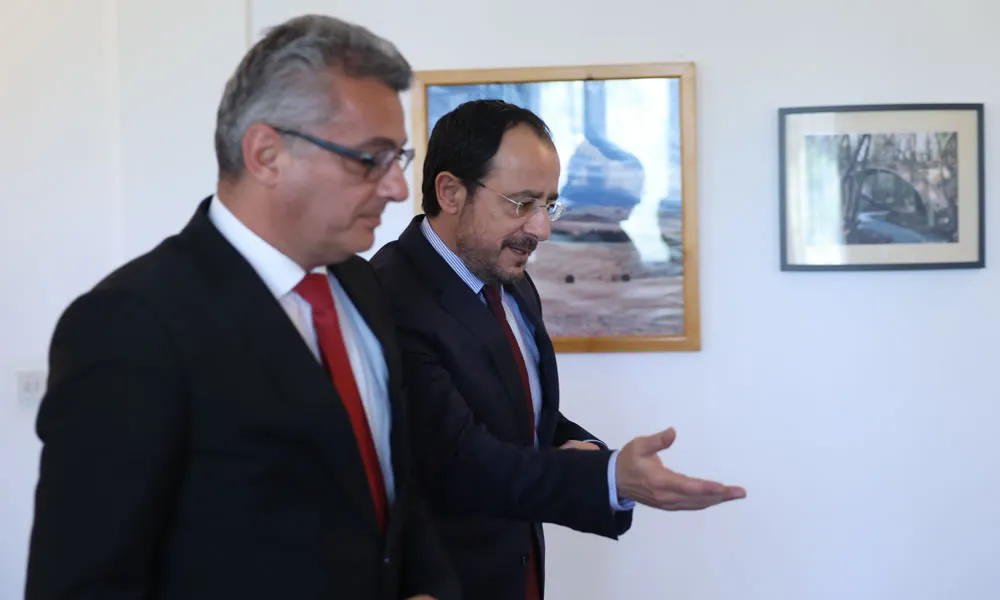

Turkish Cypriot leader Tufan Erhurman has accused Republic of Cyprus President Nikos Christodoulides of abandoning what he described as the more balanced foreign policy of previous Greek Cypriot administrations and steering Cyprus into a dangerous dependence on the US, Israel, France and Greece.
Speaking to Turkish broadcaster A Haber, Erhurman claimed that since taking office, Christodoulides had moved away from earlier policy and adopted a position based on drawing “big brothers” into Cyprus affairs in order to reduce concerns over Turkey.
He argued that this approach would not create a balance against Turkey, but would instead place the Greek Cypriot side at risk, weaken its own political will and make it dependent on those countries.
Erhurman also claimed that the Greek Cypriot side was seeking to join new geopolitical alignments through military agreements with the US, Israel, France and India. He linked these developments to plans for an India-Europe trade corridor, arguing that Nicosia was trying to secure a role in the route while excluding Turkey and Turkish Cypriots.
Referring to India, he said the issue involved a trade route “coming from India, with US support, as an alternative to the Chinese trade route”, and that the route could also pass through southern Cyprus.
According to Erhurman, the core objective behind the relationship with India was an attempt by Nicosia to secure a position in that trade route. He also cited a previous statement by Turkish President Tayyip Erdogan that a route excluding Turkey and Turkish Cypriots could not function in the region.
Erhurman further claimed that Christodoulides was seeking alliances that continuously exclude Turkish Cypriots and Turkey on military issues, maritime jurisdiction zones, energy and trade corridors.
He argued that this was wrong from the perspective of legal status, saying Turkish Cypriots were one of the two equal founding partners on the island and that Turkey had guarantor status over the whole of Cyprus.
Every day that Nicosia tries to exclude Turkish Cypriots and Turkey, he said, it also endangers its own ability to benefit from hydrocarbons and increases tension through agreements on maritime zones.
Erhurman said his position, together with Turkey’s, was clear. Cooperation was possible in all these areas, he argued, adding that lasting stability and peace for Cyprus and the wider region could be achieved only through inclusive, rather than exclusionary, approaches.
He also claimed that the Greek Cypriot side was turning the Andreas Papandreou air base in Paphos into a centre for military cooperation with Israel and Western countries, saying this endangered the security of the entire island.
Erhurman said the initiative was being carried out without the will of Turkish Cypriots, as were agreements concerning use of the base.
He argued that the Greek Cypriot side had attempted to exclude not only Turkish Cypriots but also Turkey, which he described as one of the three guarantor powers responsible for the security of the whole island.
“The island is small,” he said, arguing that if Paphos was in danger, Turkish Cypriots living in Nicosia, Lefka or elsewhere were also at risk.
Erhurman said that, in his view, the unfairness lay in the fact that Turkish Cypriots were not involved in decision-making, but were nevertheless made part of the risk.
He also claimed that after an Iranian missile attack, an evacuation took place only in the Paphos area, creating, as he put it, the impression that the base there was under threat.
“They do not make us partners in the decisions, but they make us partners in the risk,” he said.
Erhurman also referred to relations between Israel and the Republic of Cyprus, saying there was growing concern even among Greek Cypriots over Israeli investments and property purchases in southern Cyprus.
He claimed there were reactions to purchases of villages and land by Israeli businesspeople, while also attacking the government of Benjamin Netanyahu, saying he could not “respect or trust” a leadership that, as he put it, takes decisions leading to the deaths of children.