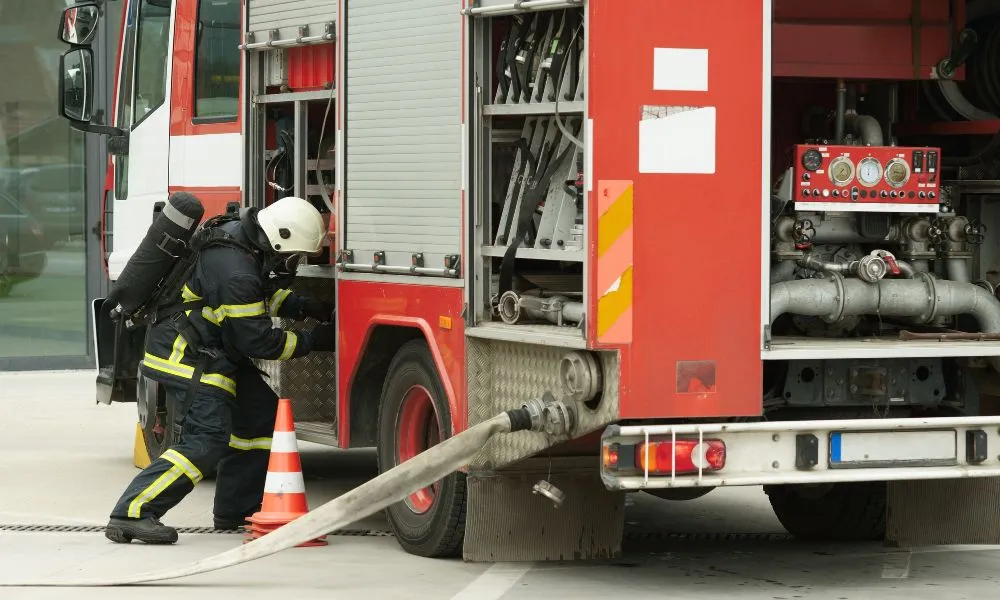



The directive on protecting workers from carcinogenic, mutagenic and reprotoxic agents makes specific reference to firefighters and other emergency service personnel. The European Parliament approved it in plenary on Tuesday, with 499 votes in favour, 49 against and 104 abstentions.
The text notes that firefighters and other emergency service personnel may be exposed at work to a range of hazardous agents, including carcinogenic, mutagenic and reprotoxic substances. Employers should assess and reduce the relevant risks. It also refers to the possibility that the European Agency for Safety and Health at Work could develop a dedicated online risk assessment tool.
Setting limits
The European Parliament approved at first reading an amendment to Directive 2004/37/EC, which provides for the addition of substances and the setting of new occupational exposure limit values.
The changes aim to strengthen worker protection and ensure a common minimum level of protection throughout the EU. Occupational exposure limit values should be set or revised on the basis of available scientific and technical data, as well as an assessment of their socioeconomic impact and practical application.
The changes include coverage of work involving exposure to welding fumes when these contain substances or mixtures classified as carcinogenic, mutagenic or reprotoxic category 1A or 1B. Welding fumes may include, among other things, hexavalent chromium compounds, nickel compounds and cadmium, as well as its inorganic compounds.
Cobalt
The directive also introduces limit values for cobalt and inorganic cobalt compounds. The text states that metallic cobalt and various cobalt compounds meet the criteria for classification as category 1B carcinogenic and reprotoxic substances, while exposure may cause skin and respiratory sensitisation.
For isoprene, which is classified as a category 1B carcinogen, a long-term occupational exposure limit of 8.5 mg per cubic metre, or 3 parts per million, is set.
For 1,4-dioxane, the directive provides for a long-term limit value of 7.3 mg per cubic metre and a short-term limit value of 73 mg per cubic metre. A biological limit value is also provided for monitoring workers’ exposure.
Mercury
The directive also clarifies the rules for mercury and its divalent inorganic compounds, so that the relevant limit value applies to compounds falling within the scope of the legislation on carcinogenic, mutagenic and reprotoxic agents.
Specific reference is also made to workers who come into contact with hazardous medicinal products, where these contain carcinogenic, mutagenic or reprotoxic substances.
Workers who are exposed or may be exposed to these substances should also receive appropriate training. This should be adapted when new or changing risks emerge and repeated when necessary.
Source: CNA