Europe is looking for ways to shield households and businesses from higher energy costs without jeopardising fiscal stability. That was the main message from the Eurogroup and ECOFIN meetings on 8 and 9 October. Finance ministers and European institutions gave no clear answer on how fiscal stability can be reconciled with support for the real economy.
Cyprus among states seeking flexibility
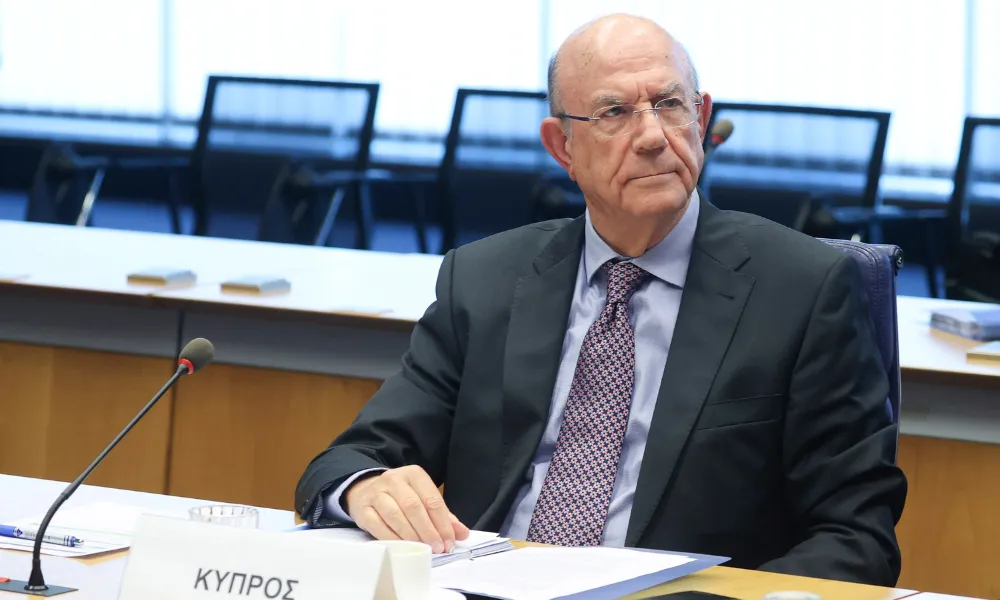
A bloc of member states, including Cyprus, favours easing the rules. Cyprus is a special case. Its debt is below the 60% threshold and it consistently produces high surpluses, but spending ceilings do not allow more generous support.
“A way must be found to allow additional spending, through greater flexibility in the economic governance we have today, so that we can support our economy, our society, our citizens,” said Finance Minister Makis Keravnos.
“Citizens’ needs are rising in line with inflation, and by extension that means spending rises too. We therefore cannot remain under an economic governance framework that does not take into account inflation, which is rising rapidly at this time. I expect there will be further discussion and that a solution will be found,” he added.
Northern bloc opposed
Facing the bloc seeking flexibility is another group of northern countries, which says that increasing spending is not an option. The Netherlands, Germany and Belgium are leading this bloc. National support measures are required to be strictly targeted and temporary.
France’s borrowing costs
The case of France makes even a temporary fiscal easing harder:
- Borrowing costs. French borrowing costs have reached levels not seen in about 24 years. Investors are worried about the country’s fiscal position, political uncertainty and the government’s ability to rein in the deficit.
- Deficit forecast. The IMF forecasts a deficit of around 5.2% for 2026.
- Bond yields. Yields on French government bonds are approaching 5%.
The Eurogroup asked France to present a budget that addresses these concerns, in other words one that credibly provides for a reduction in the deficit.
Eurogroup president on the dual challenge
Eurogroup President Kyriakos Pierrakakis captured the mood when he spoke of the dual challenge facing Europe: high energy prices and pressure on bond markets. He described the situation as a “difficult equation”.
The priority, he said, is to protect “households and businesses and every European who is experiencing the cost of the energy shock”. At the same time, “the credibility of our fiscal rules” must be safeguarded, so that both objectives are achieved together.
Southern countries, including Greece and Italy, have called for more flexibility in dealing with the energy issue. Asked about these requests, Pierrakakis noted that member states have already taken initiatives and measures, with different emphasis on one side or the other of the dual challenge.
“All of us are aware that we have to do both,” he said. He stressed that this must be done “within the framework of the rules before us” and the existing fiscal framework.
Pierrakakis acknowledged that member states do not face the same economic pressures. Some countries are more affected by the energy shock, while others are more concerned about fiscal pressures and the spreads on their bond yields. However, he stressed that the focus remains European. He expressed confidence that “we can achieve the right balance”, as has happened in the past.
Funding without new borrowing
In this context, finding funding without widening fiscal deficits becomes particularly important. One option under discussion is a tax on energy companies’ windfall profits, a proposal also backed by Germany.
Improving the efficiency of public spending and reallocating existing resources are also being examined. The reasoning is that governments should first make better use of the fiscal tools already available, rather than automatically resorting to new spending and additional borrowing.
Longer-term strategy
Beyond immediate interventions, the debate highlights the need for a longer-term European strategy.
“Energy security, competitiveness and the transition to clean energy are interlinked priorities. Europe must make progress on all three,” Pierrakakis said.