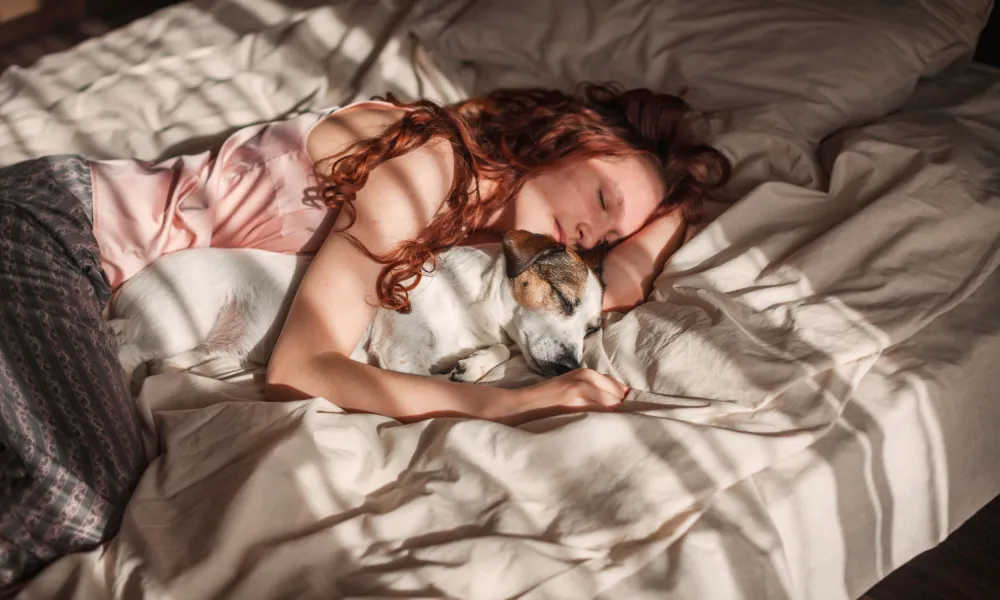

Dog owners often blame their pets for restless nights, but a new study published in PLOS One suggests the opposite may be true.
Researchers from Duke University's Department of Evolutionary Anthropology and the University of Toronto Mississauga tracked 25 owners and 38 dogs over four weeks and found that when dogs and owners became active at around the same time during the night, the owner was more often the one who moved first.
Dogs not linked to poorer sleep
The study found that sharing a bed with a dog did not significantly reduce sleep duration or increase nighttime wakefulness among owners.
Researchers monitored owners using wrist-worn motion sensors and fitted similar devices to their dogs' collars. The dogs were all huskies or malamutes, breeds selected because the project formed part of a wider investigation comparing dogs with wolves.
Owners often woke first
Among owner-dog pairs that frequently became active at similar times overnight, owners initiated movement more often than their pets.
In 22 pairs where movement occurred within five minutes of each other:
- Owners moved first in 10 cases.
- Dogs moved first in four cases.
- In eight cases both moved within the same minute.
The findings contrast with a 2020 study that suggested dogs were more likely to trigger nighttime disturbances.
Sleep quality and perceived rest
Participants also completed a standard sleep questionnaire measuring perceived sleep quality.
While motion-tracking data showed little difference between people with one dog and those with multiple dogs, owners with more than one dog tended to rate their sleep less favourably, suggesting a gap between subjective experience and objective measurements.
Psychological benefits
Only 12 participants reported being disturbed by their dog during the night, while 72% said they felt safer sleeping with their pet nearby.
Researchers said the findings underline the psychological benefits dogs can provide despite occasional disruptions. Previous work has also examined how pandemic-related stress affected relationships between pets and owners.
More research needed
The researchers cautioned that the study was small and involved only two breeds. They noted that future studies should examine whether older dogs or different breeds show similar patterns.
Because the sensors tracked movement rather than sleep itself, the team could not determine exactly why either the dog or owner moved during the night. Future research including video and audio recordings may provide a clearer picture.
Source: Earth.com