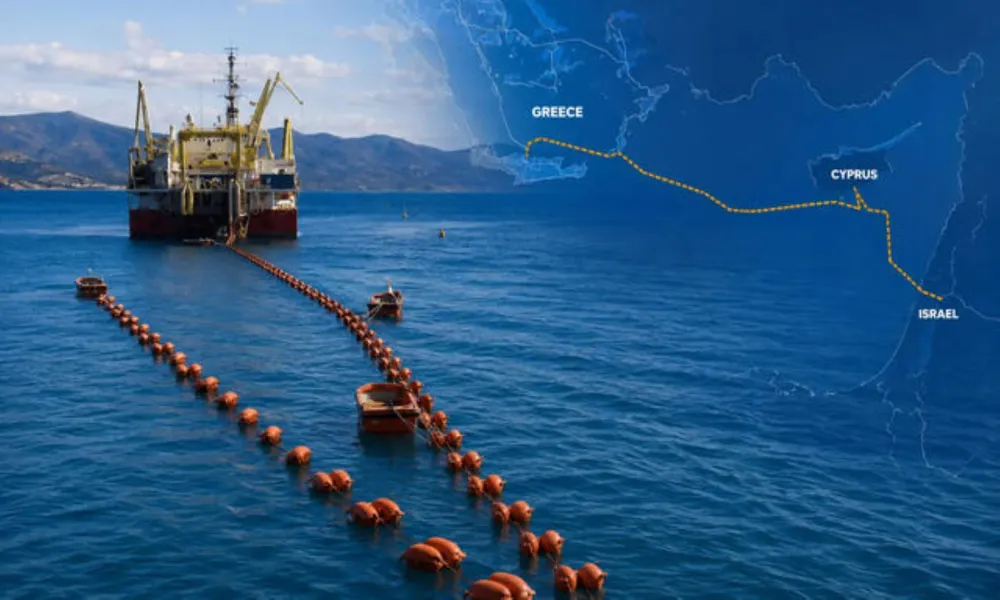

The issuance of a NAVTEX notice for the resumption of seabed surveys linked to the Great Sea Interconnector (GSI) is expected in the coming weeks, a development considered essential for the next phase of the subsea electricity interconnection between Greece and Cyprus.
While public debate surrounding the project has focused primarily on its financial aspects, the most significant challenge to its implementation remains its geopolitical dimension, particularly Turkey's position on activities in the Aegean Sea and the Eastern Mediterranean.
Survey work expected to restart
Speaking before the House Energy Committee, Energy Minister Michalis Damianos said the relevant NAVTEX is expected to be issued by the Greek authorities in the coming weeks and before the end of 2026.
The surveys are required to accurately map the seabed and determine the final route of the subsea cable. Existing infrastructure in the area, including telecommunications cables, must also be taken into consideration during the planning process.
Turkey's position under scrutiny
The anticipated resumption of survey activities comes at a period of tension in Greek-Turkish relations.
The report notes that similar surveys off the coast of Kasos in the summer of 2025 were interrupted after Turkish naval vessels appeared in the area, triggering political and diplomatic reactions.
According to the report, the Greek government faced criticism at the time over whether it had sufficiently anticipated the scale of Turkey's response and taken the necessary steps to ensure the completion of the surveys.
Dispute over approvals
Turkey argues that it has rights in the wider area and should be informed about activities taking place there. Ankara also maintains that its approval is required for such works.
The report states, however, that the international legal framework governing subsea interconnection projects does not require licensing by coastal states for projects of this nature, provided specific conditions are met.
According to the report, the Great Sea Interconnector does not require state authorisation beyond the approvals already granted by the regulatory authorities of Cyprus and Greece.
Key test for the project
The restart of seabed surveys is expected to provide an important indication of the level of response Turkey chooses to adopt at a time when it is reasserting many of its claims in the Aegean and Eastern Mediterranean.
The report adds that there is a view in Athens that the approach followed during the 2025 Kasos incident will not be repeated, with the Greek side appearing determined to take the steps it considers necessary at sea to ensure the project's completion.
European Investment Bank study awaited
Discussion at Tuesday's committee meeting also focused on the project's cost and the government's position.
Both Finance Minister Makis Keravnos and Energy Minister Michalis Damianos referred to an updated European Investment Bank (EIB) viability study, the findings of which are expected before the end of the year.
Both ministers presented a common position on the project and did not support suggestions of divisions within the government over the interconnector.
Cost expected to exceed €1.9 billion
The committee discussion highlighted what was described as a strong possibility that the project's final cost will exceed €1.9 billion.
Attention was also drawn to a joint letter sent by the regulatory authorities of Cyprus and Greece to ADMIE, raising a series of questions regarding the transaction involving Meridiam, the French investment group that is now the majority shareholder of the Great Sea Interconnector company.
Keravnos said the €1.9 billion figure primarily relates to construction of the cable itself and does not represent the project's total cost.
He noted that additional construction works, insurance coverage, supporting infrastructure and long-term operational and maintenance costs will also need to be factored into the final calculation.
Government awaiting final assessment
Damianos said decisions regarding the level and form of participation by the Republic of Cyprus will only be taken once the EIB study has been completed.
According to the minister, the government will assess the revised project cost, financing structure and expected returns before making any final decisions.
During the discussion, members of parliament and representatives of the Cyprus Energy Regulatory Authority (CERA) also raised concerns about the project's ownership structure following Meridiam's entry, the extent of Cyprus' participation in its management, and the potential impact on consumers.