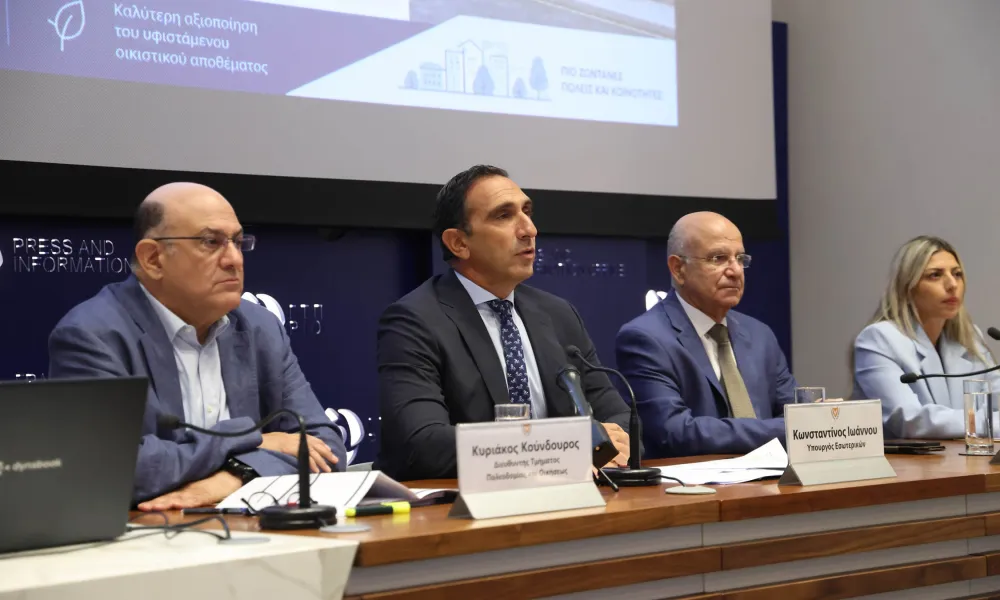

The government has unveiled two new housing schemes aimed at expanding housing supply and improving access to home ownership, as Cyprus continues to grapple with rising housing costs and affordability pressures.
Interior Minister Constantinos Ioannou said the measures form part of a broader housing strategy focused on two key objectives: increasing available housing stock and strengthening citizens' ability to secure their own homes.
Additional homes for children and grandchildren
The first scheme will allow property owners to create an additional dwelling unit on an existing residential property, primarily for the housing needs of children or grandchildren.
According to Ioannou, the measure will apply across Cyprus, subject to specific conditions and exclusions.
A key feature of the scheme is that an additional housing unit may be constructed even where the property's building coefficient has already been exhausted.
The extra dwelling may be created within an existing building, through an extension, by adding another floor or by utilising unused space on the plot.
The maximum buildable area will generally be 150 square metres, rising to 180 square metres on larger plots and under certain conditions.
The scheme also includes parking-related concessions and a 10-year restriction on transferring ownership of the new dwelling, except in cases of inheritance.
According to the Interior Minister, the objective is to help families make better use of property they already own, reducing the need to purchase new land and lowering the overall cost of acquiring a home.
State plots offered at 25% of market value
The second measure involves the allocation of state-owned plots to eligible families based on income and other criteria.
Under the scheme, beneficiaries will be able to acquire land for owner-occupied housing at 25% of its market value.
Eligible applicants must be Cypriot citizens under the age of 45. The scheme is open to families with children, couples without children and single-parent households, provided they meet the relevant income and family criteria.
The government says the programme is intended primarily to assist younger households on low and middle incomes to acquire land at significantly reduced cost.
Around 570 plots to become available
Part of the scheme is also aimed at supporting rural development and population growth in remote communities.
Expressions of interest will be submitted through community leaders before being evaluated by district administrations.
Ioannou said approximately 570 plots are expected to be allocated across all districts during the next phase to applicants who had already expressed interest.
Additional plot divisions are expected to follow, particularly in mountainous, remote and disadvantaged communities.
Detailed guides for both schemes are expected to be published on the Interior Ministry's website in the coming days.
Existing housing measures support hundreds of families
The minister also presented data on existing housing programmes.
The government's housing scheme for young people and young families up to the age of 41 has supported 700 beneficiaries, with total public expenditure reaching €26 million.
Ioannou said a new call for applications remains possible, subject to the availability of funding.
Between 2023 and 2026, housing schemes targeting mountainous, border and rural areas approved 1,075 applications, with spending amounting to €43 million.
€168 million allocated to refugee housing schemes
The government also highlighted support provided through the Service for the Care and Rehabilitation of Displaced Persons.
More than 6,500 applications from displaced persons were approved between 2023 and 2026, with total expenditure reaching €168 million.
At the same time, plans are progressing for the construction of 460 affordable homes on state-owned land, which will be offered at affordable rental rates to young people and families.
More than 4,100 homes expected through incentives
According to the Interior Ministry, additional housing supply is expected through planning incentives and the Built to Rent programme.
Officials estimate that more than 4,100 housing units will be added to the market over the next three years.
Of these, 1,142 units are expected to be made available for affordable purchase or rental.
The measures are also projected to generate more than €22 million for KOAG's Affordable Housing Fund, enabling the construction of approximately 250 additional homes.
Faster licensing process benefits 15,000 families
Ioannou also pointed to reforms designed to accelerate planning approvals.
By the end of August, authorities had licensed 2,533 detached and semi-detached homes within 40 working days, while 1,242 apartment developments and terraced housing projects received approvals within 80 working days.
According to the ministry, these developments affect more than 15,000 families and could allow buyers to obtain their homes roughly 18 months earlier than under the previous licensing system.
Government focuses on boosting supply
Ioannou said the government's housing strategy is based on a range of measures rather than a single intervention.
He argued that increasing housing supply, making better use of public and private land, and reducing development timelines are all necessary to address affordability challenges.
"More supply, more choices, faster implementation and meaningful support for citizens" remains the guiding principle of the government's housing policy, he said.