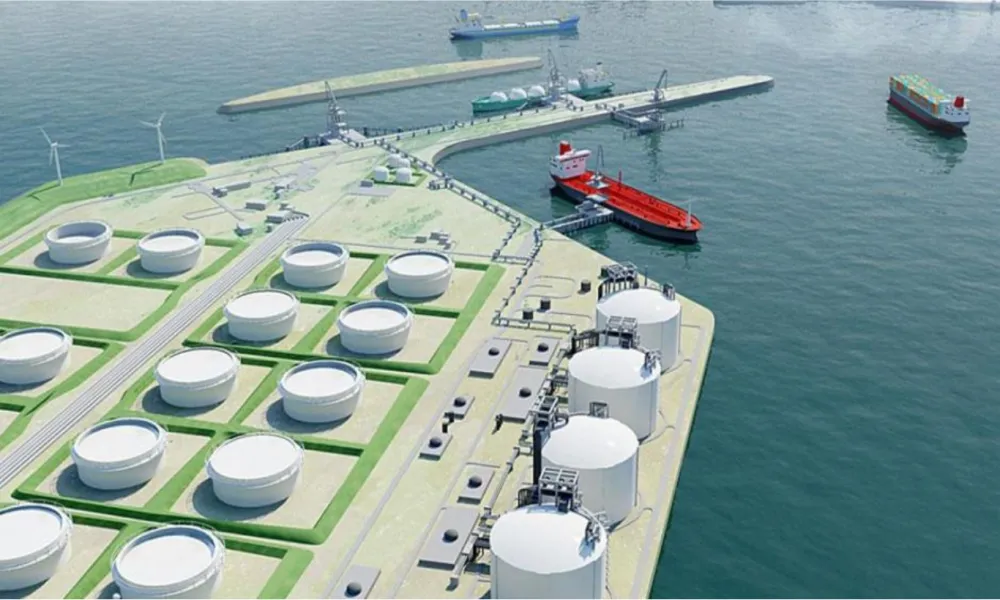

The completion of the liquefied natural gas (LNG) reception terminal at Vasilikos is not only linked to reducing electricity costs but also to ensuring security of supply. Without natural gas in power generation and the operation of new units by the Electricity Authority of Cyprus (EAC) and PEC, Cyprus will face a capacity shortfall from 2030 onwards.
On Sunday, Politis published two articles, by former Transmission System Operator director Chr. Christodoulides and former CERA chairman Giorgos Siammas, who raise concerns about a serious lack of adequacy in conventional generation from 2029, due to the withdrawal of EAC units in Vasilikos and Dhekelia, with installed conventional capacity falling to 728 megawatts. The authors estimate that Vasilikos will not be operational by 2029 and propose, once again, the construction of a small pipeline from the Aphrodite field.
Energy Minister Michalis Damianou told Politis that the operation of the Vasilikos natural gas terminal is the only path to addressing the adequacy issue. He acknowledged that those who doubt the project will be completed on time “are not unreasonable,” given its troubled history. However, he stressed that there is no “Plan B,” and that efforts are focused on launching a tender within 2026 for the completion of the project, with award to a new contractor before year-end. As for bringing gas from Aphrodite, he considers it an unrealistic option.
Vasilikos
Damianou clarified that if the Vasilikos terminal is not operational by 2030, a way will be sought to avoid withdrawing existing EAC units, as currently committed. However, withdrawal remains the main scenario. That is the intention, he said.
“As we have said many times, the Vasilikos project is a priority for the government,” he stressed.
The ageing, high-emission units at Dhekelia currently operate as a “safety net” during periods of high demand.
Following government direction, the EAC has already ordered new smaller-capacity units, with two expected in 2028 and three in 2029, to cover part of the gap. However, Damianou clarified that the addition of these generators is not sufficient to definitively resolve the adequacy issue. The solution remains the transition to a lower-cost and lower-emission fuel, namely natural gas imported via the LNG terminal at Vasilikos.
Damianou does not conceal that, in his view, policy over the past decade regarding Dhekelia was misguided, in that it underestimated the need to maintain a second point of thermal generation in the country. Strengthening Dhekelia with large-scale battery systems is presented as a “corrective move,” aiming at a mix in which storage complements new generation units and the increasing penetration of renewable energy sources.
The new tender
Regarding the new tender for Vasilikos, Damianou described a landscape with many pending issues. The withdrawal of the Chinese consortium, he explained, left behind a technically incomplete construction site. The state does not have a full picture of what has been delivered and at what stage, complicating the drafting of new tender terms. This is why a gap analysis was assigned to France’s Technip Energies.
Within this framework, the Ministry of Energy is attempting to design a tender process that will limit the scope for legal challenges, through an expression of interest procedure. The minister acknowledged, however, that no legal or procedural safeguard can completely exclude the possibility of objections or appeals that could block the award.
“There are laws, there are procedures, there are hierarchical appeals in the courts that may delay us,” he said.
At the same time, efforts are being made to avoid losing €67 million in EU funding that the European Commission is seeking to recover.
“It is a project that has been delayed for years, a project that should have been completed long ago. Our goal is to complete it, and to complete it before 2030. We are trying to resolve the problems and believe we are on the path to doing so... There are procedures in place to allow for a fast-track tender. Now, whether someone will block the process legally is something we cannot control. We hope it will not happen. If it does, we will face a serious problem,” Damianou said, outlining the full picture.
The Aphrodite field
Alternative scenarios to the Vasilikos project, such as using the Aphrodite field to directly supply the Cypriot market, are rejected by the energy minister as unrealistic under the current contract structure and the limited size of domestic demand.
Damianou noted that licence holders have every incentive to channel gas to existing liquefaction facilities in Egypt, where scale and access to international markets make the investment economically viable. Building new infrastructure in Cyprus, whether pipelines or processing facilities, solely to serve the relatively small domestic market, does not attract investor interest, according to the minister.
Even if such an alternative were politically decided today, it would require new studies, permits, tenders and contracts, essentially starting from scratch. The time required, the minister said, would likely exceed the time needed to complete the already partially built Vasilikos project.
Storage as a buffer
Electricity storage emerges as the main mechanism to mitigate adequacy risks until the end of the decade. The minister estimates that the system will remain marginally manageable this summer, with possible but limited outages, while the outlook for 2027 is expected to be more stable due to the addition of new storage units.
According to the data he cited, the system operator will have 120 MW of storage before next summer. The EAC is moving to add another 180 MW, while permits have already been issued for 151 MW of private storage projects. If these projects proceed, the system will be able to absorb a greater share of solar generation during periods of low demand and feed it back into the grid during peak hours, reducing losses and the need for costly conventional generation.