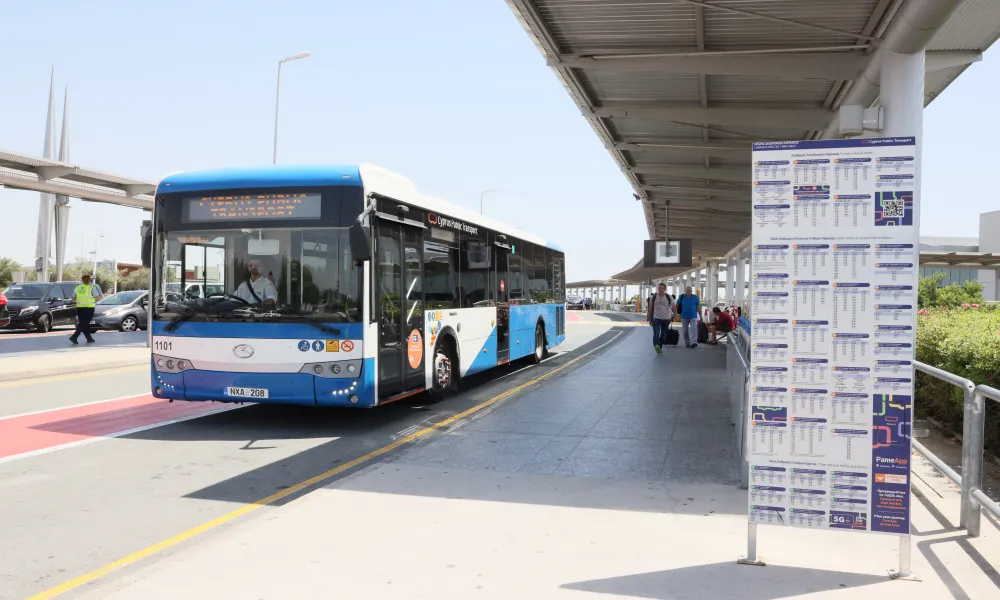

A special report by Cyprus' Audit Office has identified widespread shortcomings in Nicosia's public bus network, highlighting problems with schedules, passenger information, service frequency and accessibility that undermine confidence in the system.
The findings come from a survey conducted between 10 November and 1 December 2025, during which 110 Audit Office employees travelled on buses as ordinary passengers without notifying the operator. The exercise generated 204 questionnaires, while an assessment of accessibility measures included the participation of a representative from the Cyprus Paraplegics Organisation.
Perhaps the most concerning finding was that 63% of participants said they would not choose to use the bus again, despite positive assessments in some aspects of the service.
Chaos in passenger information
One of the report's main concerns relates to inaccurate passenger information.
The bus company's website and mobile applications were found, in some cases, to display conflicting or incorrect information regarding timetables, route numbers and bus-stop locations.
The Audit Office documented examples where the actual location of bus stops differed by around 85 metres and 135 metres from their locations shown online. The report also identified bus stops that had already been abolished but continued to appear in digital systems, as well as inadequate information regarding route changes caused by roadworks.
In two cases, passengers reportedly waited around 30 minutes before being forced to walk for another 30 minutes to reach an alternative stop.
Poorly equipped stops and infrequent services
The report found significant shortcomings in bus-stop infrastructure.
- 55% of bus stops provided no route information.
- Only 13% had real-time passenger information systems.
- 22% had neither seating nor shelter.
- 32% lacked shelter altogether.
While 74% of stops were considered adequately clean, inspectors also encountered instances of bad odours, rubbish accumulation and vandalism, including at major transport hubs.
Service frequency was another recurring issue, with some routes operating only once every one or two hours. Missing a bus could therefore result in substantial delays, making public transport impractical for work, appointments and other time-sensitive journeys.
In six of nine travel scenarios examined by auditors, passengers were required to use two separate buses, increasing journey times and uncertainty.
Accessibility concerns
The report notes that passenger experience does not necessarily improve after boarding.
Auditors identified a lack of adequate onboard information regarding upcoming stops and arrival times. They also pointed to the inability to pay fares using bank cards, a limitation that particularly affects occasional users and visitors.
A serious accessibility incident was also recorded. Although drivers generally received positive assessments for behaviour and driving standards, one driver reportedly refused to provide the assistance required to accommodate a passenger with a disability.
Questions over oversight
The Audit Office also raised concerns about supervision by the Ministry of Transport, Communications and Works.
Despite the existence of performance indicators, inspections and contractual penalties, auditors found recurring deficiencies that, according to the report, should have been detected earlier.
The ministry acknowledged a number of shortcomings in its response and said corrective measures would be introduced. However, the Audit Office argued that improvements must go beyond isolated fixes and include systematic verification of schedules, passenger information, stop conditions, accessibility standards and compliance with contractual obligations.
Is the bus really cheaper?
The report also challenges the assumption that bus travel is always the most economical option.
An analysis of ten indicative travel scenarios found that, for people who already own a car, savings are not guaranteed. Depending on journey length, passenger numbers and travel frequency, either public transport or private vehicles may prove more cost-effective.
The report concludes that attracting more passengers will require a comprehensive upgrade of the service, including reliable information, more frequent routes, better bus stops, improved accessibility and stronger government oversight.