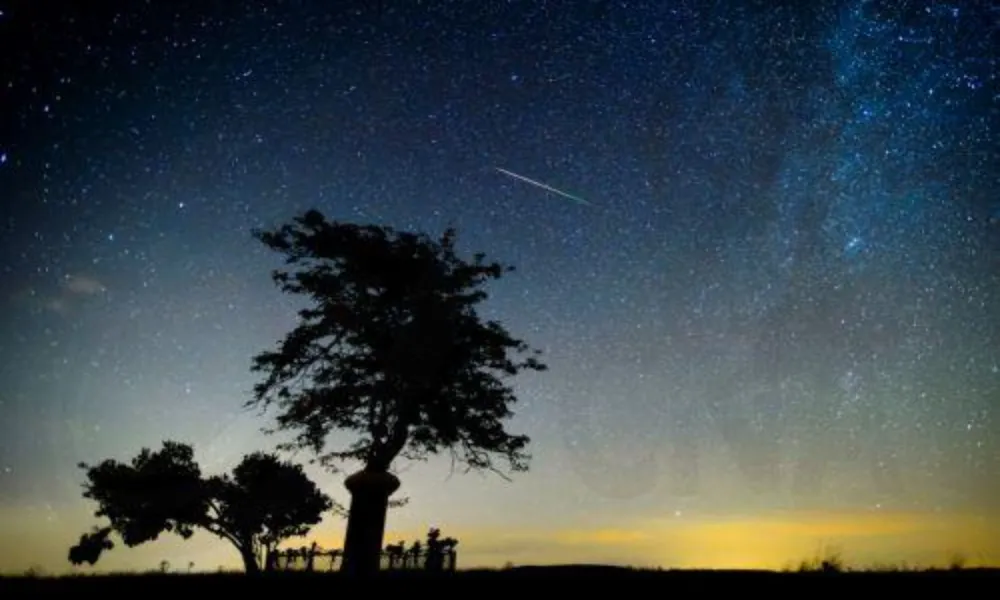

Tonight marks the peak of the spectacular Perseid meteor shower, offering skywatchers a unique opportunity to witness dozens of "shooting stars" streaking across the night sky.
This year's peak is accompanied by three additional astronomical highlights: a moonless sky that will improve visibility, a total solar eclipse visible from parts of Europe but not Cyprus, and an alignment of six planets in the early hours of 13 August.
According to astrophysicist Chrysanthos Fakas, the Perseid meteor shower has been active since 17 July and will continue until 24 August, with its maximum activity occurring tonight and tomorrow night.
"The meteors appear to originate from the constellation Perseus, which is why they are known as the Perseids," Fakas explains.
He notes that the radiant point of the shower lies towards the north-east and that the best viewing hours begin after 11pm, when the constellation rises higher in the sky.
Viewing conditions are considered particularly favourable this year.
According to Fakas, August's full moon will occur on 28 August, meaning the sky will be moonless during the shower's peak. The absence of moonlight is expected to make even fainter meteors visible, enhancing the spectacle.
How the Perseids form
According to the Cyprus Astronomy Organisation, the Perseids are created by tiny dust particles left behind by Comet 109P/Swift-Tuttle during its passages through the inner Solar System.
Each year, Earth passes through this invisible cloud of material and the particles enter the atmosphere at speeds of around 59 kilometres per second.
Friction with the upper atmosphere causes them to heat up and vaporise, producing the bright streaks commonly known as shooting stars.
As Fakas explains, objects that completely burn up in the atmosphere are known as meteors, while those that survive and reach Earth's surface are known as meteorites.
Particularly bright meteors are referred to as fireballs.
Under perfectly dark and clear skies, Perseid activity can theoretically reach up to 100 meteors per hour.
Astronomers recommend choosing locations well away from city lights, allowing the eyes about 20 minutes to adapt to the darkness and observing with the naked eye rather than using telescopes or binoculars.
Total solar eclipse
August 12 will also feature a significant total solar eclipse.
However, as Fakas points out, the event will unfortunately not be visible from Cyprus.
A total solar eclipse occurs when the Moon passes between the Earth and the Sun, completely obscuring the Sun's disc for observers located within the path of totality.
According to astronomical organisations, the eclipse path will begin in the Arctic Ocean off northern Russia, pass across Greenland, Iceland and the Atlantic Ocean, and end in Spain.
In Greece, the phenomenon will be only marginally visible in the north-western and western parts of the country shortly before sunset, with the Moon covering just 2.35 per cent of the Sun's disc.
Six planets in alignment
Meanwhile, in the early hours of 13 August, shortly before sunrise, six planets will appear in the same region of the sky.
Jupiter, Mercury, Mars, Uranus, Saturn and Neptune will form a notable planetary alignment.
Some of the planets, however, will not be visible to the naked eye and will require binoculars or a telescope.
For those looking up tonight, the August sky is expected to provide one of the year's most impressive observing opportunities, combining the summer's most famous meteor shower with a series of rare and remarkable astronomical events.