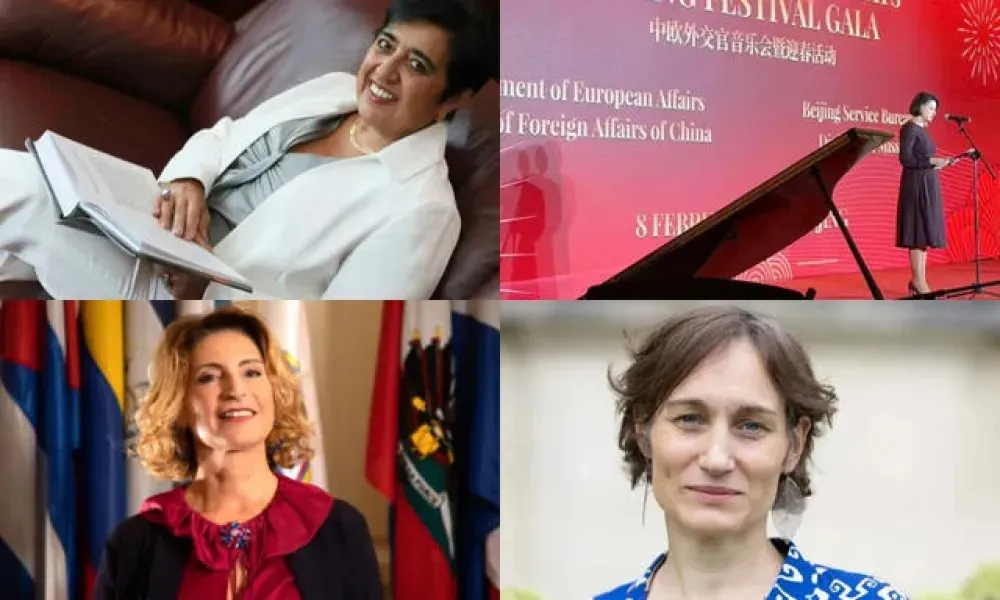

On the occasion of the International Day of Women in Diplomacy, four women who have served at the highest levels of the diplomatic world speak to Politis about what led them to this profession, the challenges they faced and what, in their view, still needs to change.
Erato Kozakou-Marcoullis
“I would describe diplomacy more as a mission, because it requires many sacrifices, especially when it comes to family life,” says Erato Kozakou-Marcoullis, the first and so far only woman to have served as Cyprus’ foreign minister.
“Twice in my career, I had to leave my family behind to fulfil my duties as an ambassador. It was very difficult. You need great strength, endurance and support from your loved ones to face these challenges.”
Being a woman, she reflects, did not prove an obstacle. In Washington, she was one of twelve women ambassadors, a record number at the time that drew significant attention. A Howard University professor, Marilyn Sefokle, was so impressed by their presence that she published a book titled Then There Were Twelve: Women of Washington’s Embassy Row (2000). In its introduction, Sefokle wrote: “Perhaps the presence of these women ambassadors marks a new era, one of confidence in women’s ability at the highest levels and in the most difficult situations.”
Her guiding principle was always clear: “I represent not only a country but an entire people.”
She is equally clear about what still needs to change. “Cyprus, despite 66 years of existence as a state, has not given sufficient attention to building a strong diplomatic service. Many diplomatic missions abroad consist of a single diplomat who also serves as head of mission, which is unacceptable and must change. The annual budget of the foreign ministry needs to increase significantly to allow for the appointment of more diplomats at all levels.”
Koula Sophianou
For Koula Sophianou, currently Cyprus’ ambassador to the People’s Republic of China, diplomacy was less a career choice and more a mission rooted in her personal history.
These experiences, she says, instilled a belief that continues to guide her: “Diplomacy is ultimately about people. We strive for their security, their dignity and their right to live in conditions of peace, stability, equality and prosperity.”
On the issue of gender, Sophianou is measured. “Looking back, I cannot honestly say I faced significant challenges because I was a woman pursuing a diplomatic career.”
The challenges she encountered were of a different kind: serving in understaffed missions with limited resources, covering a broad range of responsibilities with small teams, and accepting the personal sacrifices that postings far from family entail.
Clélia Chevrier Kolacko
Clélia Chevrier Kolacko, France’s ambassador to Cyprus, approaches the International Day of Women in Diplomacy through the lens of a policy she helped shape.
“For several years now, France has adopted a decisively feminist approach to diplomacy,” she says. “I was directly involved in this in my previous role as deputy director for global affairs, and it remains an issue of particular importance to me.”
Feminist diplomacy, she explains, has both an external and an internal dimension. Externally, it means defending the rights of women and girls in all multilateral forums, from the G7 and G20 to the United Nations. It also involves funding initiatives that combat gender stereotypes and violence against women, promote girls’ education and ensure women’s voices are present at embassy events.
Internally, it entails structural change within French diplomacy. “It means giving women the place they deserve in French diplomacy by appointing more women as consuls general, ambassadors or directors, combating sexism through a zero-tolerance policy and ensuring equal pay.” She advances this work through the organisation Femmes et Diplomatie.
Antonella Cavallari
Antonella Cavallari, Italy’s ambassador to Cyprus, draws on nearly four decades of diplomatic experience.
“I have no regrets, I would not make a different choice if I could go back,” she says. “After almost 40 years, I remain deeply convinced that I chose the right profession, the one best suited to my character and personality.”
The qualities diplomacy requires, she argues, are not gender-specific. “You must be curious, flexible, open-minded and, preferably, sociable to cope with diplomatic life without becoming anxious or exhausted, to enjoy, rather than merely endure, constant relocations, family challenges, changes in routine and, why not, the countless receptions, which are not always that exciting.”
On gender inequality, she is clear. “The fact that I am a woman did not create specific problems for me. However, I believe that today inequality is mainly reflected in the number of women in the service, which remains lower than that of our male colleagues.”