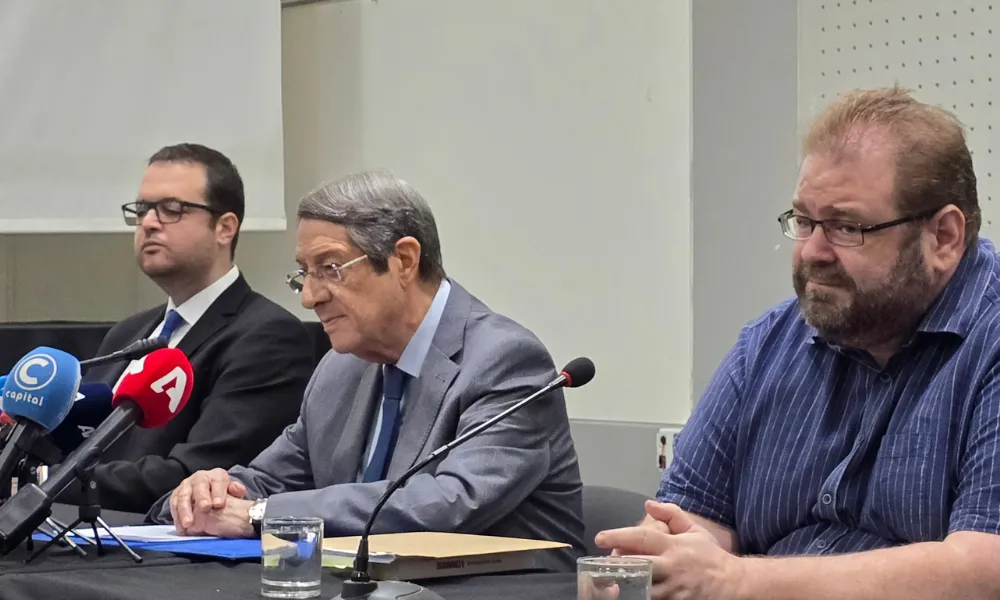
Former President Nicos Anastasiades has rejected as “completely unfounded” a finding by the Anti-Corruption Authority linking him to a €250,000 payment from Laiki Bank.
Referring to the part of the Authority’s recent report concerning Laiki Bank, Anastasiades cited inspectors’ findings, which state that “at the end of 2011, a transaction amounting to €250,000 was made from Laiki Bank for the benefit of Mr Anastasiades, which appears to have been intended to support his 2013 presidential election campaign and was misleadingly presented as a fee or commission”.
According to the report, he said, inspectors record that “the amount of €250,000 appears to have been agreed between Andreas Vgenopoulos and Mr Anastasiades”, while it is alleged that two fictitious invoices, worth €160,000 and €90,000, were used to present the payment as a professional fee and conceal its true nature.
Anastasiades said the report concludes that, while he was serving as an MP and as leader of DISY, he “abused the influence he exercised over other persons in decision-making”, and that by “receiving the sums in question, which constitute an undue advantage, he may have been involved in the offence of passive trading in influence”.
Responding to the allegations, the former president said he was never asked to provide explanations on the specific issue during his three-day appearance before the Authority’s inspection officials.
“At no point during my three-day presence before the inspectors was a similar matter raised so that I could be given the opportunity to respond. I find it truly inconceivable that an authority reaches findings that publicly tarnish individuals without first seeking their position,” he said.
Undue advantage
He also questioned the legal basis of the finding, asking what exactly constituted the alleged “undue advantage”.
“This offence presupposes the existence of an undue benefit, and I ask what that undue benefit is in this case. What is not stated in the Authority’s findings is what exactly the presidential candidate is alleged to have offered in exchange for the payment supposedly received from Laiki Bank,” he said.
Anastasiades also rejected the conclusion that he had active involvement in the operations of his law firm. He said that a reference in the partnership agreement to his having “overall supervisory responsibility over operations” did not imply active engagement.
“The provision referring to supervision of the law firm’s work merely reflects the hierarchy within the partnership, as I held a majority stake and was by far the most senior partner,” he said.
He added that since 1997, when he assumed the leadership of DISY, he had been fully dedicated to his political duties.
“How could I have exercised overall responsibility and supervision of the partnership’s work when, since 1997, I devoted all my time to my party and parliamentary responsibilities?” he asked.