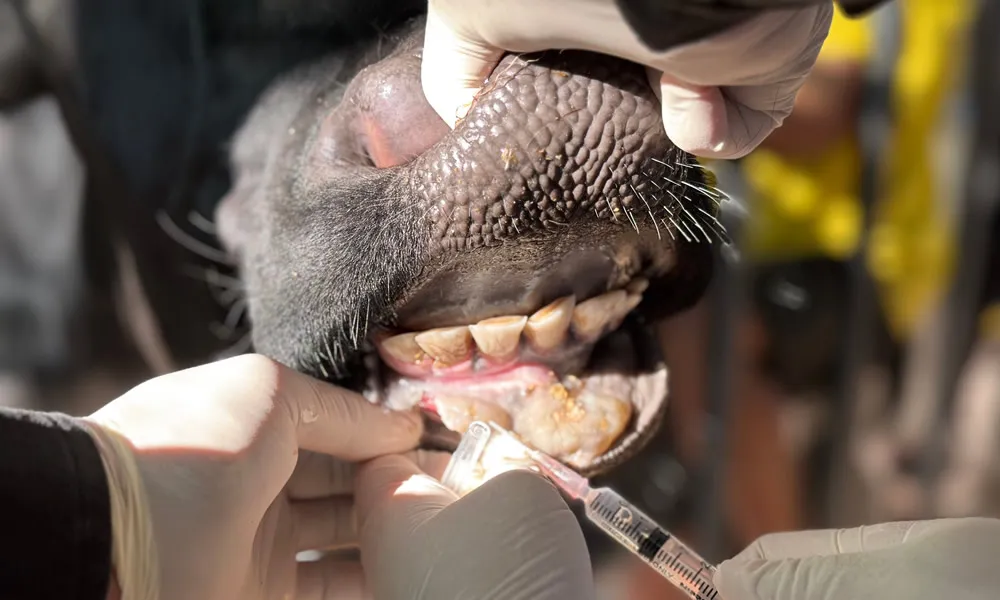

Cyprus authorities will move from next week to vaccinate the remaining 10 percent of livestock units that have not yet been covered, as scientists say for the first time since the Pakhna outbreak that the foot-and-mouth disease epidemic is currently under control.
The next phase will focus on farms in Limassol and Paphos, while experts credit strict police controls with helping to contain the spread.
Speaking after a joint meeting of scientific committees on disease control and the restructuring of the livestock sector, Professor Dimitris Tsaltas of the Cyprus University of Technology said further assessment is needed before firm conclusions can be drawn.
“We believe that in order to reach safer conclusions, evaluation must continue and the second round of vaccinations must be implemented,” he said, adding that the new phase will begin next week, roll out island-wide and be completed by early August.
The results of vaccinations and sampling will form the basis for a more comprehensive response to livestock farmers’ requests for easing restrictions, said Pan-Cyprian Veterinary Association president Dimitris Epameinondas.
“We provided farmers with a general briefing today, but we will give answers next week,” he said. “We are working towards clear answers with timelines.”
‘For now, we are controlling it’
“The number of culls so far is significant,” Tsaltas said, “but it remains within the bounds of an epidemic that, for now, we are managing to control, provided we continue along the same path.”
According to Veterinary Services data, losses stand at:
- 3.5% of the total cattle population
- 9.5% of sheep and goats
- 7.7% of pigs
In absolute numbers, 2,293 cattle, 43,311 sheep and goats and 23,742 pigs have been culled.
Second vaccination round
The second vaccination phase will target units that have remained unvaccinated so far, located mainly in Limassol and Paphos, accounting for about 10 percent of livestock holdings nationwide, Epameinondas said.
Sampling
Since the start of the outbreak, sampling has been carried out in 830 farms. Over the past week, 31 units were tested, with results issued for 25.
In Paphos, surveillance has already been conducted twice, including during the confirmation of the case in Pakhna, Limassol, with all results returning negative, Epameinondas said.
“Once vaccinations are completed, full-scale surveillance will begin across the entire district,” he added.
In Limassol, surveillance and contact tracing are continuing within a 10-kilometre zone around the infected area, after which further sampling will follow.
Role of the police
Scientists again stressed that strict adherence to biosecurity measures, combined with vaccination, remains key to containing the crisis.
Tsaltas said police enforcement has had a “very positive impact”, both in preventing illegal movements within the government-controlled areas and curbing illicit transactions involving the north.
“We must all be part of this effort, not just livestock producers,” he said. “If we observe suspicious activity, we should inform the police or the Veterinary Services.”
He also described the contribution of both the police and the National Guard as crucial, pointing to continuous inspections and the detection of smaller cases, mainly involving illegal movement of materials.
“The National Guard is assisting with disinfection efforts at various locations, contributing both personnel and expertise,” he added.