
Just as investors had begun to get used to the idea of an ideal scenario of disinflation and steadily increasing growth, the sharp rise in oil prices threatens to push markets into a new regime, according to Ned Davis Research (NDR).
In periods of rising inflation, market leadership has historically shifted, and there is a new category of stocks that could emerge as winners, the firm noted.
Researchers pointed to the sharp rise in consumer prices, with inflation accelerating at an annual rate of 3.8% in April, the fastest rate in the past approximately three years.
“The data suggest that the disinflationary environment that supported the market’s upward trajectory since the bear market low of October 2022 is no longer in place and has turned into an inflationary headwind,” said Rob Anderson, the firm’s strategic analyst, and Tan Nguyen, analyst.
The firm identified a number of sectors in the market that have historically withstood periods of strong inflation. Below are the main conclusions for investors, according to Business Insider.
Value stocks
An inflationary environment tends to favour value stocks, both in cyclical and defensive sectors, the firm said.
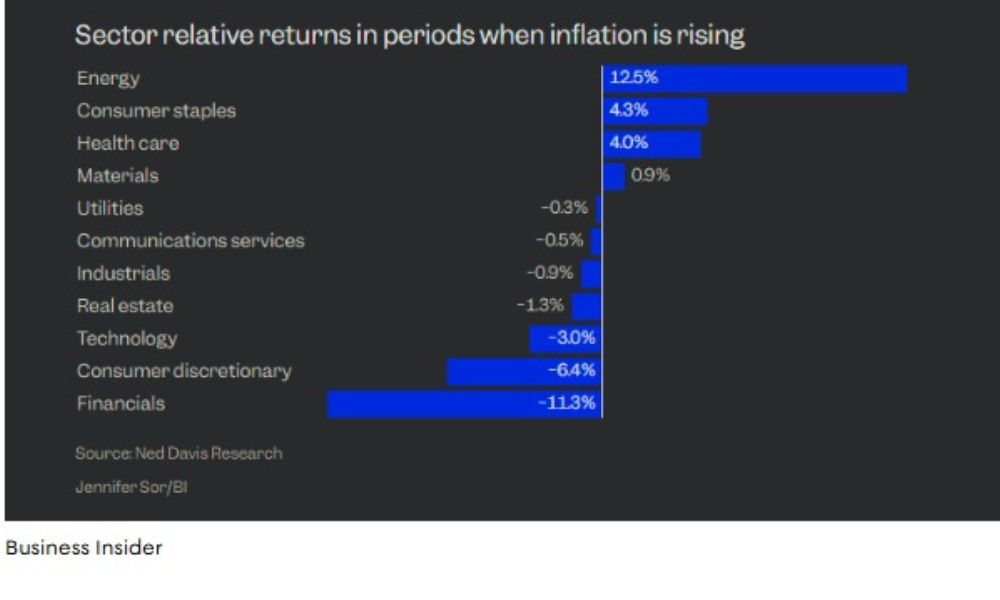
In periods when inflation was rising, market gains were mainly concentrated in the sectors of energy, consumer staples, healthcare and materials, according to NDR’s analysis.
Selected sectors
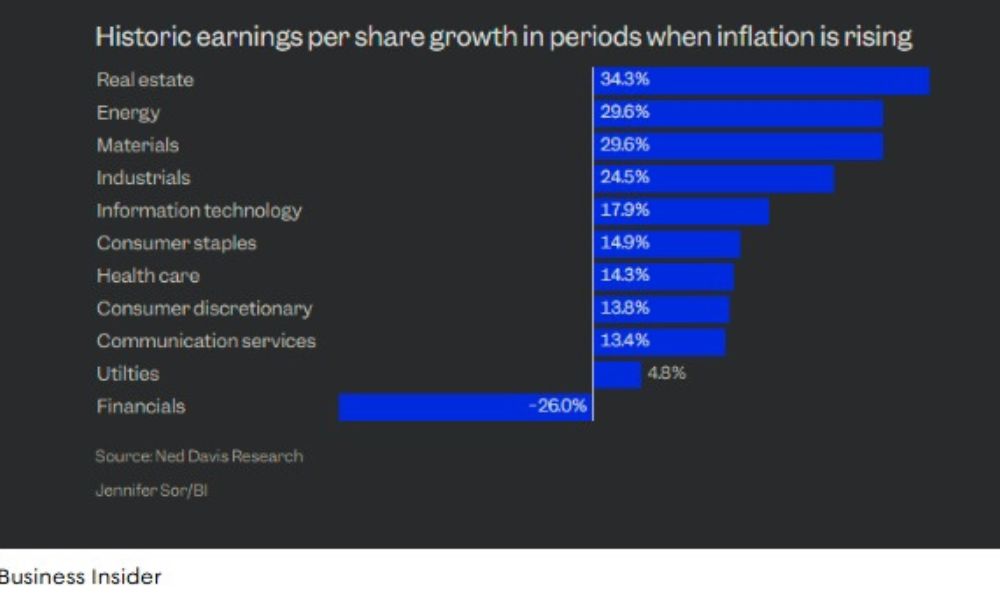
In a high-inflation environment, gains tend to be strongest in the sectors of real estate, energy, materials and industry.
The real estate sector has recorded an average earnings growth rate of 34% in periods of rising inflation. The energy and materials sectors have typically recorded earnings growth of around 30%, according to NDR’s analysis.
Avoid the financial sector
In periods of rising inflation, the financial sector has been the weakest “by a wide margin”, the firm said, recording an average relative loss of 11%.
Stocks in this sector tend to be hit during periods of strong inflation, as higher prices can keep interest rates elevated for longer. This can increase borrowing and financing costs while also leading to portfolio losses, NDR added.
“This sector is the biggest exception to the Growth/Value trend. The sector has performed better in low-volatility environments,” the firm noted.
Investors may be cautious towards the broader market when assessing prospects for interest rate cuts by the Federal Reserve, the firm underlined. Historically, when the Fed has paused its monetary easing cycle for six months or more, the broader market tends to decline sharply within the next four months, researchers said, citing their analysis of stock performance following a shift in the Fed’s stance.
The Fed last cut interest rates in December, meaning that the central bank’s pause on policy changes is approaching the six-month mark in June.
“The current situation likely falls into the category of a pause and has followed the typical correction pattern, although it is driven by the war with Iran. Stocks tend to recover after the initial fall, on average,” NDR added.