
*Dr Chara Olympiou, Project Manager & Researcher, C.S Centre for Sustainability (C4S)
The ‘Circularity is Scool!’ Toolkit has been finalised and is now freely available, a comprehensive, free educational tool designed to support primary school teachers in integrating the principles of the circular economy into both their teaching and the day-to-day running of the school. The guide was developed as part of the European ‘Circularity is Scool!’ project, which is co-funded by the European Union’s Erasmus+ programme (Small-Scale Partnership in School Education, KA210-SCH, Grant Agreement No. 2025-1-CY01-KA210-SCH-000359057) and is being implemented from September 2025 to February 2027.
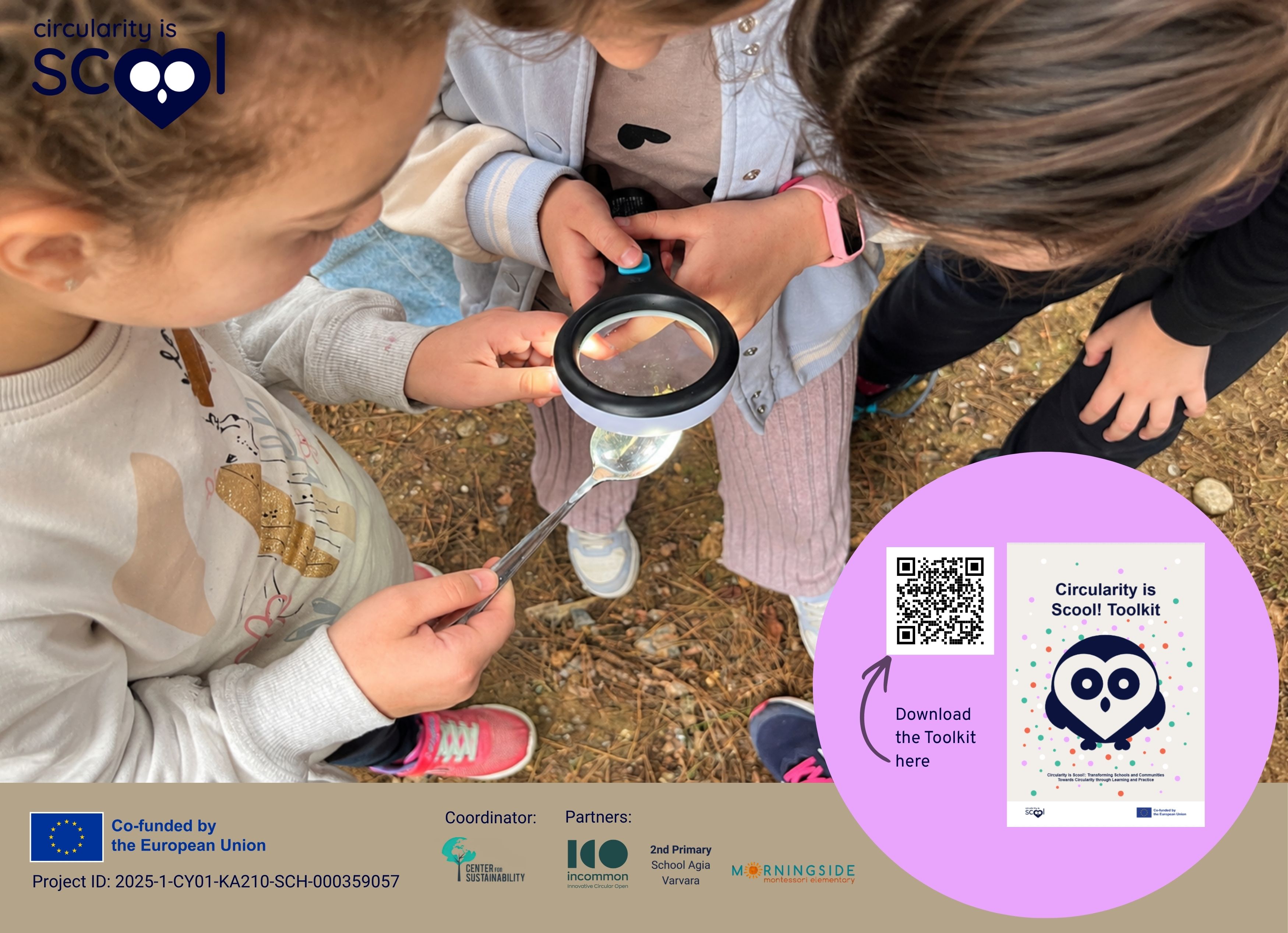
The project is coordinated by the C.S Centre for Sustainability (C4S), Cyprus, with partners incommon (Thessaloniki, Greece), Morningside Montessori Private Schools (Cyprus) and the 2nd Primary School of Agia Varvara (Greece). incommon, an organisation with extensive experience in participatory environmental education and education on the circular economy, was responsible for developing the educational guide.
The project and its objectives
‘Circularity is Scool!: Transforming schools and communities through education and the implementation of the circular economy’ aims to transform primary schools into living laboratories of sustainability. Its specific objectives are to develop a comprehensive guide to the circular school, to pilot and evaluate it in real school settings, to empower the school community through knowledge and practical application, to support circular practices within the school environment, and to ensure a long-term impact through dissemination and networking.
How the guide was developed
The guide was not designed ‘in an office’. Its development began with an investigation into the needs and aspirations of teachers and environmental education specialists, continued with participatory design workshops, and led to a first draft, which was piloted in the two partner schools. A total of 12 experiential workshops were held - six at each school - as well as circular activities on school premises. Feedback was systematically gathered through focus groups with pupils and teachers, reflective logs, focus groups, site visits and structured questionnaires.
At the same time, the first draft underwent an external evaluation by independent experts with experience in environmental education and the circular economy. The findings of the evaluation were incorporated into the final version.
What it covers and who it is aimed at
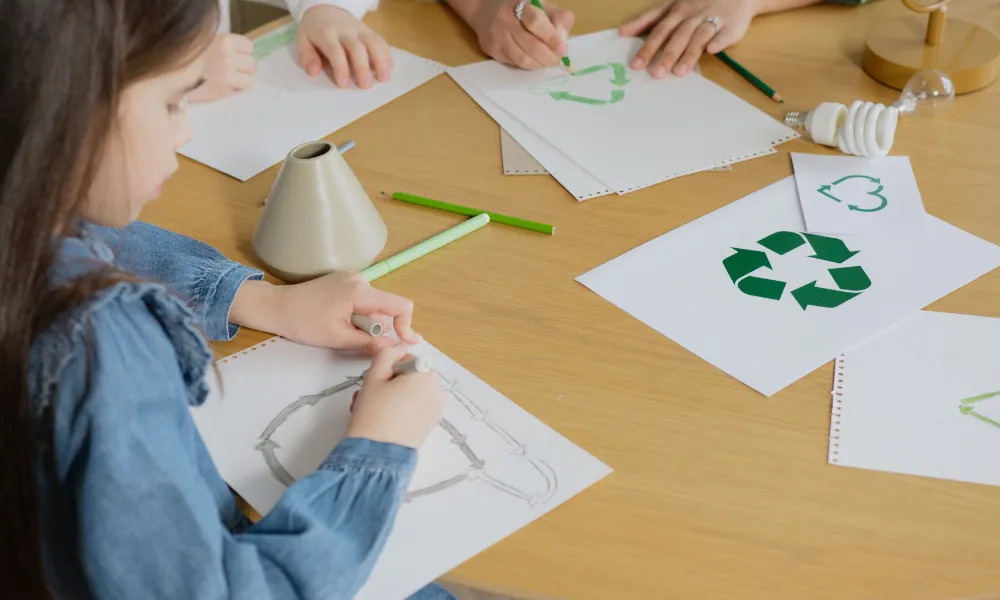
The guide is aimed at primary school teachers working with children aged 6-12 and can be adapted to different curricula and school contexts. It comprises six hands-on workshops on the themes of Materials and Products, Food, Water, Energy and Community Engagement, as well as six circular economy initiatives that can be implemented on school premises: a compost bin, a school vegetable garden, a rainwater harvesting system, a materials library, a tool-lending scheme and waste sorting bins at source.
The activities are underpinned by a theoretical framework on the circular economy in education. For each activity, detailed step-by-step lesson plans are provided, along with links to the curriculum, adaptation guidelines and QR codes for supplementary digital resources. The Guide also includes templates and guidelines for implementing circular initiatives, as well as suggestions for monitoring and sustaining each initiative over time, so that the changes become part of the school’s day-to-day operations. It also presents good practices and case studies from schools that have piloted the Guide, thereby illustrating how the activities work in real school settings. Particular attention is paid to inclusion and language support, so that all pupils can participate meaningfully, including children with a migrant or refugee background and varying levels of language proficiency.
Free access
The ‘Circularity is Scool!’ Toolkit is available free of charge, in Greek and English, in digital format. Schools, teachers and organisations can download it and use it freely from the project’s website.
The project is funded by the European Union. The views and opinions expressed are solely those of the authors and do not necessarily reflect the views of the European Union or the European Education and Culture Executive Agency (EACEA). The European Union and the EACEA cannot be held responsible for the views expressed. (Grant Agreement No. 2025-1-CY01-KA210-SCH-000359057)