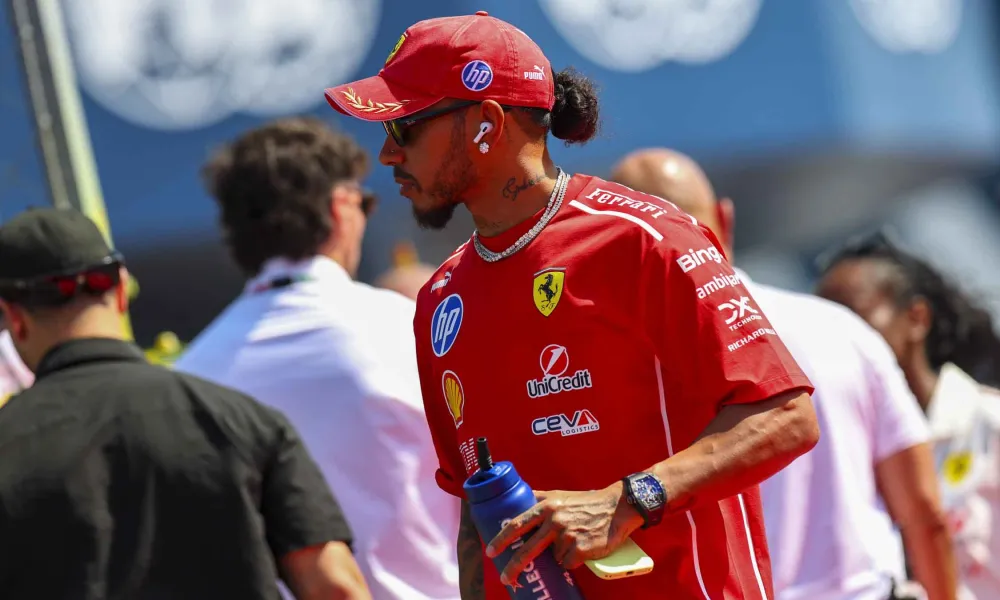

Few athletes have reshaped the image of their sport quite like Lewis Hamilton.
Widely regarded as one of Formula One's greatest drivers, Hamilton's influence extends far beyond the racetrack. Throughout his career, the seven-time world champion has increasingly used his global profile to speak out on social justice, human rights, education and humanitarian issues, challenging the long-standing culture of political neutrality traditionally associated with Formula One.
Visit to Rafah highlights humanitarian concerns
Hamilton recently visited the Rafah border crossing in Egypt and facilities operated by the Egyptian Red Crescent, where aid destined for Gaza is processed and distributed.
During the visit, he met humanitarian workers and organisations involved in relief efforts and greeted staff with the Arabic phrase "Assalamu alaikum", meaning "peace be upon you".
The British driver has repeatedly called for peace in regions affected by conflict and has used social media to draw attention to the humanitarian situation in Gaza.
Speaking in October, Hamilton said the international community should continue advocating for peace in regions including Palestine, Sudan, Syria and the Democratic Republic of Congo.
A childhood far from Formula One privilege
Hamilton's activism is closely linked to his upbringing.
🚨 | #Hamilton oggi in Egitto a vigilare sugli aiuti a Gaza. https://t.co/jE7NByqd26
— Roterly (@Roterly_F1) November 10, 2026
Born in Stevenage to a working-class family with roots in Grenada, he entered a sport traditionally associated with wealth and privilege. His father, Anthony Hamilton, worked multiple jobs to support his son's karting ambitions.
When Hamilton made his Formula One debut with McLaren in 2007, he became the first and, to date, only Black driver in the sport's history.
Despite his immediate success, Hamilton has spoken openly about experiencing racism and feeling isolated early in his career.
He has previously said that for years he felt pressure to keep his head down, focus solely on racing and avoid expressing political or social views publicly.
Black Lives Matter and institutional change
A turning point came in 2020 following the killing of George Floyd in the United States.
Hamilton became one of the most prominent voices in world sport supporting the Black Lives Matter movement. He pushed Formula One to formally acknowledge anti-racism initiatives and encouraged drivers to take part in symbolic protests.
He also persuaded Mercedes to temporarily replace its traditional silver livery with black as a statement of solidarity against racial discrimination.
His activism extended beyond symbolism.
Hamilton helped establish the Hamilton Commission, an independent study conducted with the Royal Academy of Engineering in the UK that examined barriers facing Black people seeking careers in motorsport and engineering.
He later launched Mission 44, a charitable foundation dedicated to improving access to education, science and technology opportunities for young people from underrepresented communities.
Speaking out on LGBTQ+ rights
Hamilton has also used his position to address LGBTQ+ issues.
During races in countries where homosexuality remains criminalised, including Saudi Arabia and Qatar, he wore a rainbow-coloured helmet carrying the message "We Stand Together".
At the time, Hamilton argued that sports figures have a responsibility to raise awareness of human rights issues rather than ignore them while competing internationally.
Addressing criticism
Hamilton's activism has not been without critics.
Some have questioned how a driver competing in a global motorsport series with a substantial environmental footprint can also campaign on climate issues.
Hamilton has acknowledged that contradiction while attempting to reduce his own impact. He adopted a vegan lifestyle, sold his private jet, promoted sustainability initiatives within Mercedes and invested in environmentally focused businesses and start-ups.
More than a racing driver
Hamilton has often rejected the idea that athletes should remain silent on wider social issues.
"I am not just a racing driver. I have a platform and I intend to use it," he has said.
Now approaching two decades in Formula One and with more than 100 race victories and seven world titles to his name, Hamilton remains one of the sport's defining figures. Yet for many supporters, his legacy will be measured not only by his achievements on track but also by his willingness to use his influence well beyond it.
Source: In.gr