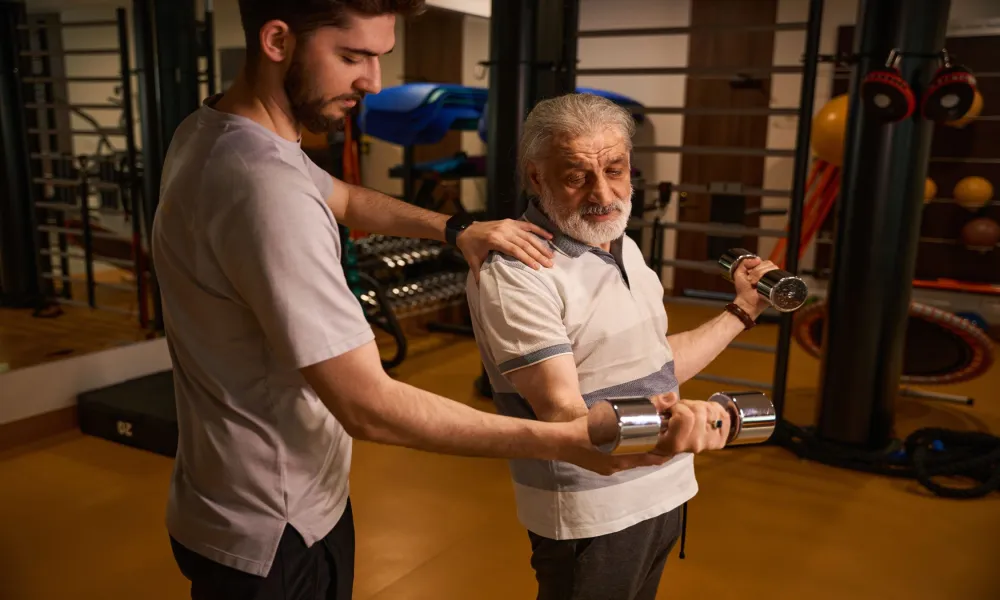

Weight training is widely recommended for older adults, but research suggests that how you lift may matter as much as how often you train. While slower, controlled lifting remains effective for building strength and muscle, studies indicate that lifting with greater speed may be particularly beneficial for maintaining mobility and independence.
Why muscle power matters
Muscle power, or the ability to generate force quickly, tends to decline faster with age than muscle strength. Research has linked this decline to changes in fast-twitch muscle fibres, which are responsible for rapid and powerful movements.
According to a study of 839 older adults in Italy, low leg power was associated with a significantly greater likelihood of mobility limitations than low strength alone.
Power is also important when recovering from trips and preventing falls. A study involving 94 older adults found that people who had experienced a fall generally demonstrated lower leg power than those who had not.
Building power through training
Evidence suggests that power can be improved through targeted exercise.
A large review of 20 trials involving 566 older adults found that lifting weights quickly produced greater improvements in muscle power and modest gains in everyday physical function compared with slower lifting.
Researchers note that training for power differs slightly from traditional strength training. Instead of moving the weight at a steady pace throughout the exercise, participants lower the weight under control and then push or lift it back up as quickly as possible while maintaining proper technique.
Strength and function may benefit differently
The evidence suggests that different lifting speeds may produce different outcomes.
A 2026 review of 16 studies found that slower lifting tended to produce better gains in muscle size and strength, while faster lifting generally delivered greater improvements in everyday physical function.
Similarly, a 2022 review found some evidence that faster lifting could support strength gains, although researchers noted that many studies were small and of varying quality.
Fast lifting is not enough on its own
Researchers caution that power training alone is unlikely to improve balance significantly.
Evidence remains strongest for balance and functional exercises, including movements that mimic daily activities such as stepping, turning and changing direction. When combined with strength training, these exercises may reduce falls by around one-third.
A simple technique change
Experts say developing power does not require a completely new training programme.
A common recommendation is to:
- Lower the weight slowly and with control.
- Lift or push the weight upward as quickly as possible.
- Use a light-to-moderate load.
- Stop before fatigue causes movement speed to slow.
The same principle can be applied to bodyweight exercises. For example, during a chair squat, sit down slowly and then stand up as quickly as is safely possible.
Researchers stress that the goal is not necessarily to move the weight fast, but to attempt to move it as quickly as possible while maintaining safe technique.
Source: The Conversation